This guide provides a practical B2B decision framework. Final specifications, market obligations, testing scope, labels, packaging and shipment requirements must be confirmed for the exact finished SKU and destination.
Custom Logo LCD Writing Tablets: OEM Branding and Retail Packaging Guide
A successful custom logo LCD writing tablet program is not simply a logo printed on a standard device. It is a controlled product-and-packaging project: choose a proven tablet platform, approve artwork and product claims, define the retail pack, validate the final configuration, and release shipment only after the factory has shown that the branded unit and its cartons match the approved sample. For buyers in the US, UK, Germany, and France, the most dependable approach is to treat branding, packaging, safety information, language, and destination-market responsibilities as one specification—not as last-minute artwork changes.
This guide explains how to source a branded LCD writing tablet from an OEM partner without losing control of the details that shoppers, retailers, warehouses, and regulators can see. It is written for private-label brands, promotional-product distributors, educational suppliers, retailers, and import teams. It does not replace advice from the importer’s product-safety, customs, packaging-EPR, or legal advisers; requirements depend on the product version, battery arrangement, intended user, sales channel, and country of placement.
Why logo placement and packaging must be planned together
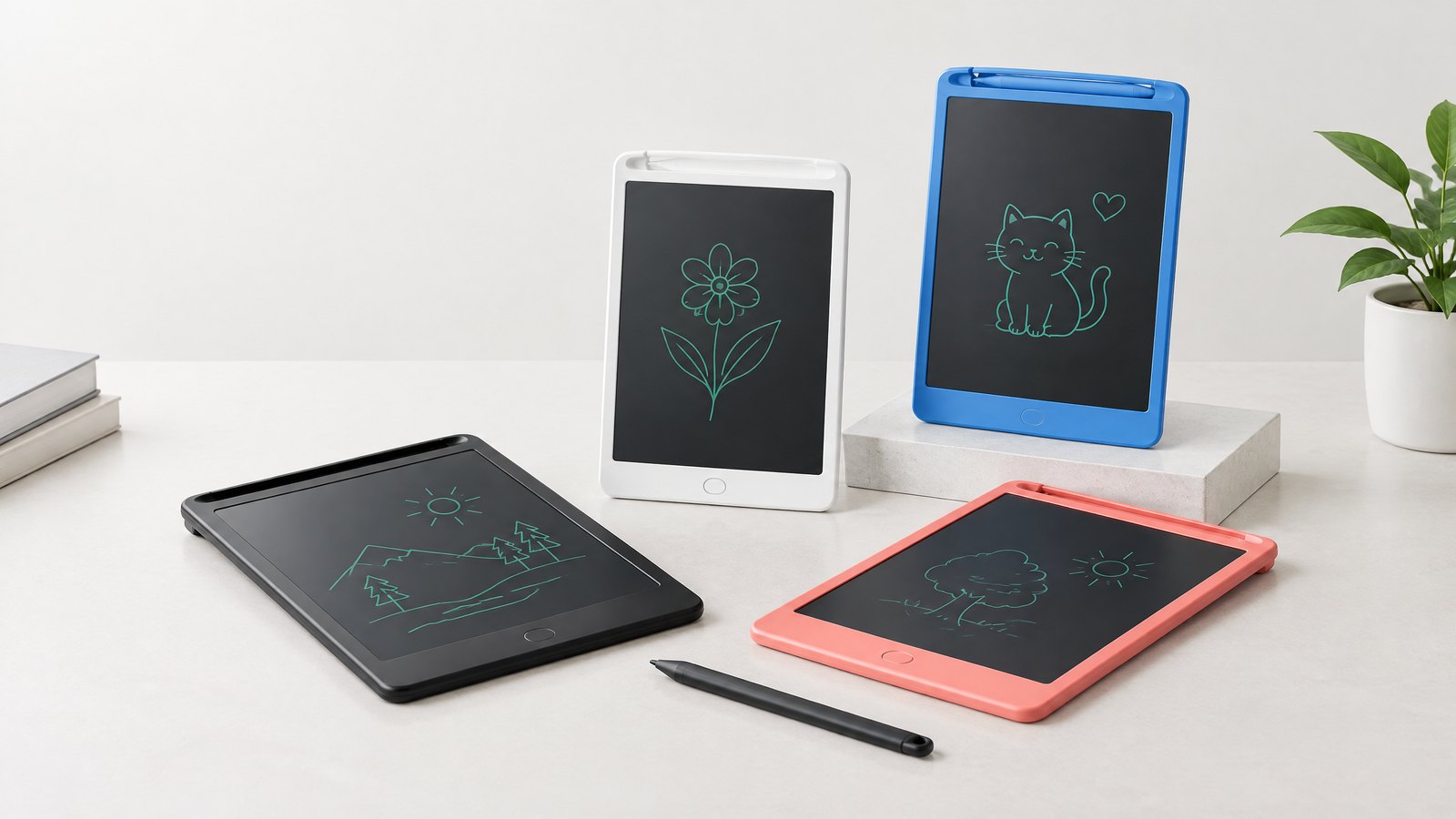
An LCD writing tablet is often an appealing private-label product because the basic experience is easy to explain: write or draw on the pressure-sensitive screen, use the erase function, and reuse the tablet. Yet a device that looks straightforward can become difficult to launch when three versions of the truth exist—one in the buyer’s artwork file, one on the factory’s production order, and one on the retail carton.
A buyer may approve a front-bezel logo but overlook the back label, instruction leaflet, carton barcode, stylus cavity, battery-access wording, master-carton marks, or multilingual copy. The result can be a shipment that functions but cannot move into a retailer’s distribution centre or onto a marketplace listing. The cost is not only rework. It can be delayed appointments, incorrect inventory records, unusable labels, or consumer confusion.
The practical rule is simple: the sellable unit is the tablet, accessories, retail pack, inserts, and labels together. Create one controlled specification for that unit. It should identify the exact base model, color, logo version, decoration location, packaging style, product contents, labels, written claims, destination markets, and approval owners. Changes after that point should be versioned and explicitly approved, rather than communicated in informal messages.
For buyers seeking a private label writing tablet, this discipline separates a repeatable range from a one-off promotional item. A good branded range can use a shared device platform while varying print, color, language panel, insert, and carton label by customer or country. That approach preserves sourcing efficiency without hiding market-specific responsibilities.
Start with the commercial model: OEM, private label, or deeper customization?
The terms used in supplier conversations are often loose, so define the work rather than relying on a label. An LCD writing tablet OEM project may mean only applying buyer-supplied artwork to an existing product. It may also describe a broader arrangement involving changes to housing color, stylus, screen size, packaging, manuals, or electronics. Ask the supplier to state precisely what is standard, what is configurable, what needs a new tool or material, and which changes affect documentation or test evidence.
OEM versus ODM in usable procurement language
In a practical procurement brief:
- Private label / logo customization usually starts with an established device. The buyer supplies brand assets and chooses from available colors, pack formats, and accessory options.
- OEM configuration can include buyer-controlled product and packaging specifications on an established platform. It may include a buyer’s labels, barcode, instructions, and retail presentation.
- ODM or design development implies a material product-design change, such as a new shell, form factor, mechanism, or feature set. It generally needs a more formal development plan, samples, and change control.
Do not assume “OEM” transfers design ownership or exclusivity; document any agreed rights, territory, tooling ownership, or color formula. Likewise, intended age, marketing, retail category, and destination can change the product-safety analysis.
Define the intended retail use before requesting a quote
A quote request works best when it begins with the intended use, not the decoration method. State whether the tablet is for business notes, travel, gifts, classroom use, general consumers, or a children’s range. Explain whether it will be sold loose in a display, in an e-commerce mailer, in a shelf-ready retail carton, or as part of a kit. These decisions influence the necessary packaging, claims, warnings, instructions, and checks.
Give the supplier a one-page product brief with:
| Brief item | What to specify |
|---|---|
| Base device | Model reference, screen size class, lock/erase behavior, stylus, battery configuration, intended user |
| Brand assets | Logo file, colors, clear-space rule, approved typefaces, trademark notice if required |
| Decoration | Location drawing, dimensions, print colors, finish expectation, acceptable variation policy |
| Retail unit | Carton, sleeve, blister, or other format; product contents; insert and manual requirement |
| Markets and channel | US, UK, Germany, France; retail, distributor, marketplace, or direct-to-consumer route |
| Required information | Barcode owner/data, SKU, country-of-origin position, importer/contact details if applicable, languages, warnings, recycling information |
| Quality release | Approved sample, inspection checkpoints, photo requirements, document pack, release authority |
| Logistics | Unit pack orientation, inner pack if any, master-carton label fields, shipping mark, destination warehouse needs |
This is also how to compare suppliers fairly. A lower unit quote is not comparable if it omits a leaflet, a retail carton, barcode labels, a particular decoration process, or required pack-out evidence.
Build an artwork package a factory can execute
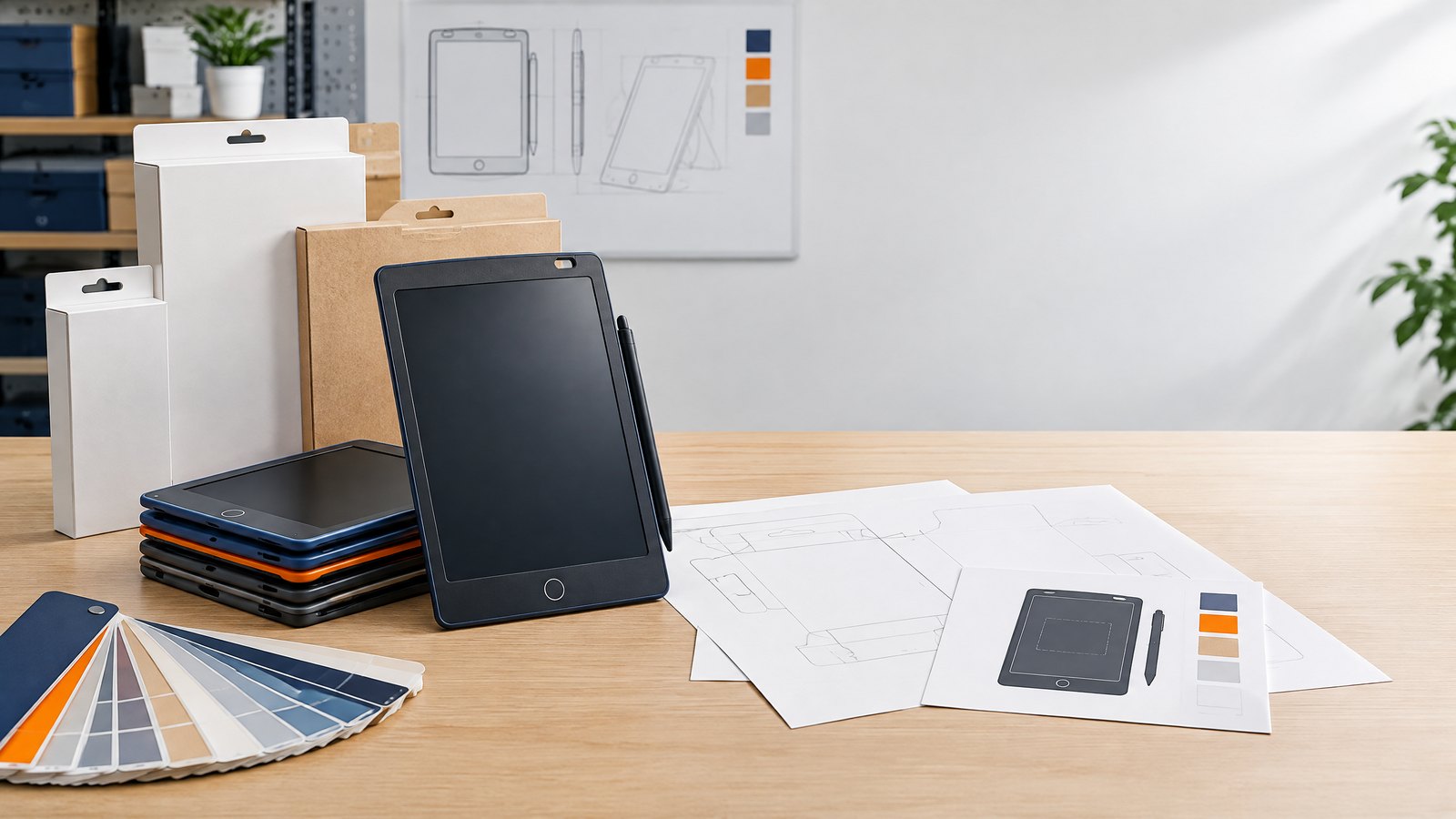
A logo file alone is not production artwork. The factory needs an unambiguous instruction set that relates artwork to the physical part. Supply vector artwork where possible, identify the exact revision, and include a placement drawing with reference edges and dimensions. Separate product artwork from packaging artwork. A tablet front, rear product label, carton front, carton sides, insert, and master-carton mark are different production files with different approvals.
Choose decoration by reviewing real samples
Common possibilities include surface printing, a label, laser marking, or a moulded/embossed feature, but suitability depends on the housing material, surface texture, logo complexity, color, and available production process. Rather than choosing from a generic list, ask for physical or photographed samples made on the intended material and finish. Compare them under normal retail lighting and in the packaging configuration.
The signed sample should confirm placement, small-text readability, color on the specified housing, agreed mark durability, clearance from controls and stylus features, and consistency with the carton image. Avoid “make logo prominent” or “match artwork”; set a placement and finish standard, then retain the approved physical result as the visual reference.
Control product claims as carefully as graphics
Package claims should be factual, supportable, and tied to the supplied product. “Reusable,” “lock function,” or “includes stylus” must describe the exact configuration. Do not add performance, age, environmental, health, or safety claims because they look persuasive on a retail panel. A claim can create a testing, substantiation, translation, or retailer-review obligation.
For example, “paperless” may be understood as a marketing expression, but it should not be expanded into a broad environmental promise without substantiation. An erase-lock feature should not be represented as protecting data if it only prevents accidental clearing in normal use. If the product is battery-powered, make the battery type and user-replacement instructions consistent across the device label, manual, and pack. The retailer should never discover a different statement on the unit than on the listing.
Design custom LCD tablet packaging for the real sales channel
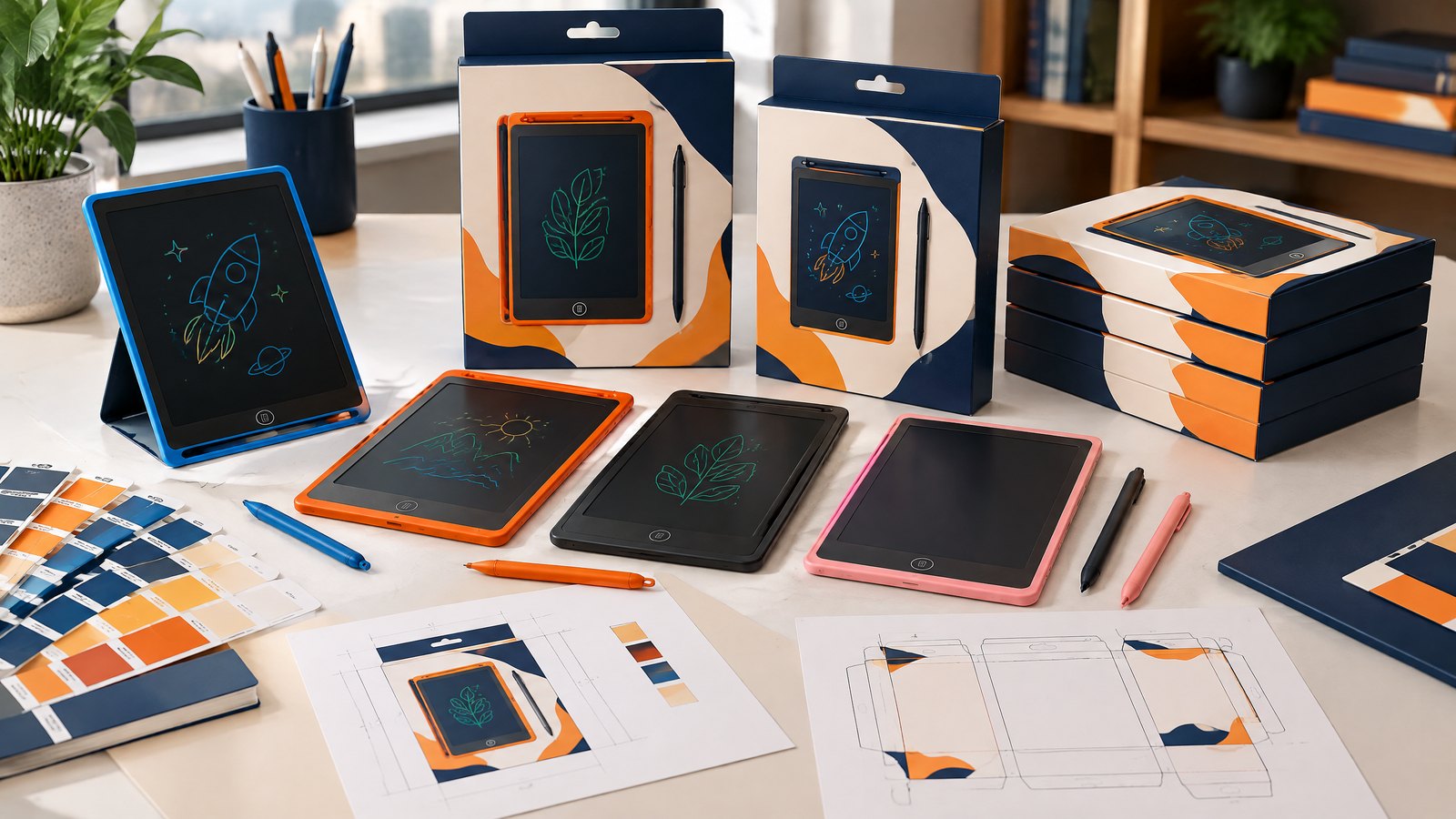
Custom LCD tablet packaging should protect the product, communicate the brand, carry necessary information, and work in handling. Its job is more demanding than looking attractive in a flat proof. Start by mapping the physical journey: factory line, packed master carton, port or air handoff, warehouse receiving, retail shelf or parcel fulfilment, and consumer opening. Every layer should have a purpose.
Select a retail-pack architecture deliberately
A compact carton with an internal tray or folded insert may present a tablet cleanly and protect it from surface scuffs. A sleeve can be visually economical but may need an additional internal solution to prevent the tablet from sliding. A window can show the device but adds considerations around film, exposed surfaces, and how the pack behaves when stacked. A display-oriented pack may need a hanging feature or retailer-specific layout; do not add one until its strength and positioning are evaluated on a sample.
The simplest pack that adequately protects the product is often easier to pack, inspect, recycle, and replenish. Avoid decorative empty volume simply to make a compact tablet look larger. The European Commission notes that the EU Packaging and Packaging Waste Regulation is intended to reduce unnecessary packaging, improve recyclability, and make packaging information clearer; it applies broadly to packaging and packaging waste.2 The design team should therefore record materials and components rather than treating sustainability as a final graphic badge.
A retail pack specification should identify:
- Materials and pack-out—board, inserts, films, labels, adhesives, product orientation, stylus, battery state, leaflet, and closing method.
- Information panels—brand, contents, model/SKU, barcode area, origin/importer fields where applicable, warnings, instructions, and country version.
- Acceptance and outer-carton data—print and closure quality, loose-component controls, SKU, quantity, origin, justified handling marks, and shipment reference.
Make packaging artwork data-driven, not improvised
Before design starts, obtain the barcode data and retailer label rules from the responsible party. Reserve an uncluttered barcode area and inspect actual printed samples with the intended scanner or a validated scan check. A visually sharp carton can still fail receiving if a barcode is too close to a fold, distorted on a curved surface, hidden by a seal, or associated with the wrong variant.
Create an artwork matrix for every sellable version. Rows are SKU-country combinations; columns are product-logo file, carton artwork, leaflet, barcode, language, recycling/sorting information, and approval status. This small control document prevents a France carton from being packed with a UK leaflet or a blue unit from receiving the black-unit barcode.
Mid-article CTA — Email your product brief, target markets, artwork status, and retail-pack requirements to info@lcdwritingtablet.com to begin an OEM branding and packaging review.
Plan labels, languages, and market responsibilities early
The factory can print approved files, but the buyer/importer usually needs to determine what information is appropriate for the product placed in each market. Build time into the program for that review. A generic “international” carton may be efficient, but only if all required information, languages, and label decisions have been checked for each destination.
US: battery and consumer-product questions belong in the specification
Many LCD writing tablets use a button or coin cell, although the configuration must be confirmed for the selected model. In the United States, requirements can apply to consumer products that contain or are designed to use button cell or coin batteries. CPSC guidance explains that relevant requirements include secure access to replaceable battery compartments, specified warnings on product packaging, product warnings where practicable, and applicable warnings in instructions or manuals.1 It also distinguishes the treatment of certain toy products that meet the relevant toy-standard battery provisions.1
The sourcing implication is not to copy a warning from another product. Identify the actual battery format, whether it is installed or packed separately, how the compartment opens, who the intended user is, and whether the product is marketed as a children’s product. Then ask the responsible compliance professional and supplier for the evidence and label review appropriate to that configuration. Keep artwork frozen until that review is complete. A late battery-warning change can affect carton panels, inserts, and master-carton work.
UK: packaging data and EPR are commercial planning inputs
UK packaging EPR guidance says obligations may apply to organisations that supply or import packaging or packaged goods, with duties varying by producer status.3 The UK government describes the scheme as shifting household packaging waste costs toward producers and encouraging reduction, reuse where practical, and recyclable design.3
For procurement, retain a bill of packaging materials and weights from the supplier rather than trying to reconstruct it from freight records later. Ask who is placing the packaged product on the UK market, who owns the SKU, and who will maintain the data. This is an operational question for the buyer and importer, not a certification the factory can issue by itself.
Germany and France: separate country versions may be the safer option
Germany and France are EU markets, but a single English-language pack should not be assumed suitable for both. Product information, consumer instructions, importer information, waste-sorting marks, packaging participation, and producer-responsibility duties should be checked for the exact route to market. Plan German and French consumer-facing copy as early as the English source copy, because late translations can disrupt layout and print proofing.
For France, check applicable sorting information; for Germany, confirm packaging-registration and participation responsibilities with the market placer. Battery duties require a separate review: the EU Batteries Regulation has phased requirements, so a generic disposal symbol is not a complete answer.4
Turn factory quality control into visible release evidence
The strongest LCD writing tablet packaging plan is supported by a quality plan that tests the configuration being shipped—not merely an unbranded base unit. Start with a pre-production or approval sample that includes the correct tablet color, logo, packaging, labels, leaflets, and accessories. Record the sample’s date, artwork revisions, and approval comments. It becomes the “golden sample” used to resolve questions during production and inspection.
Useful checkpoints from materials to packed goods
A realistic inspection plan has several gates, although the exact scope and sampling plan should be agreed for the product and order.
First-off and in-process checks. Confirm the correct housing, screen appearance, stylus, logo, battery configuration, labels, cartons, and inserts. During the run, check writing visibility, erase and lock functions where fitted, button feel, stylus fit, battery-compartment closure, housing fit, and the correct language/carton feed. Record the defined method and result.
Finished-goods and shipping checks. Check sealed units for correct product-pack pairing, print, barcode readability, accessory count, closure, and cosmetics across carton positions. Confirm master-carton SKU marks, quantity, destination labels, orientation, and condition; retain dated photos of the final unit, pack-out, sealed carton, and shipping marks.
Use a defined test, owner, result, and acceptance rule. If transit, compression, or drop evaluation is required, agree the protocol before production rather than relying on an undocumented internal practice.
The defect vocabulary should be specific
A defect guide should define critical, major, and minor findings for this product. A failed erase function, insecure battery compartment, wrong warning/language, missing accessory, or mismatched barcode can block shipment; a small print speck may not. Agree rework, reinspection, replacement, and release decisions in advance.
This evidence-led approach is useful when sourcing from an OEM writing tablet manufacturer because it anchors the relationship in a defined configuration. It also helps when the same device is offered under several brands: factory staff can identify the correct combination by SKU and controlled artwork, not by memory.
Prepare cartons and documents for a clean handoff to logistics
Shipping begins with pack-out, not with the freight booking. Confirm the outer dimensions and weights of the actual packed retail unit and master carton after packaging is finalized. A paper estimate from an early design phase is not reliable enough for warehouse slotting, freight costing, or marketplace fulfilment planning.
For each shipment, align the commercial invoice, packing list, product/SKU description, quantities, country-of-origin declaration as appropriate, shipping marks, and any agreed inspection report. The importer or customs broker should advise on tariff classification and customs documentation; do not rely on a carton artwork description as a customs classification.
Ask the factory to separate country or customer versions clearly. A mixed shipment can be economical, but cartons and pallet labels must make variants unmistakable. Keep one sealed retention sample of each final SKU, including its leaflet and any battery-related packaging. It is far easier to answer a post-arrival question when the team can inspect the exact shipped presentation.
The outer carton should protect, identify, and stack appropriately for the planned route. Overly ambitious claims such as “fragile” or “this side up” are not a replacement for pack design. If a handling instruction is necessary, state it correctly and make sure the pack has been evaluated for the transportation conditions it is expected to face. Likewise, a retail carton designed for a shelf may need additional protection for direct-to-consumer parcel shipping; do not assume one layer performs both jobs.
Common failure patterns—and how experienced buyers avoid them
Treating packaging as an artwork-only task
A designer may produce a beautiful carton without the barcode, translations, warning space, insert structure, or accurate product contents. Avoid this by locking the data inputs before layout and reviewing a physical sample, not only a PDF.
Approving a logo but not the complete commercial sample
A photo of a logo proof cannot confirm device color, readability, component fit, carton protection, or the correct product-pack pairing. Approve a complete final sample where possible, and preserve the approval record.
Using one document for every country without validation
A common pack can reduce complexity, but it is not automatically compliant or shopper-friendly across the US, UK, Germany, and France. Build a country matrix and make a conscious decision about common versus localized panels, inserts, and labels.
Letting product changes bypass packaging review
A different battery, lock function, model size, or accessory may change the manual, warnings, pack fit, SKU, barcode association, and evidence required. Every product change should trigger a check of packaging and documents.
Asking for a “certificate” instead of evidence for the actual model
Compliance evidence is configuration- and market-dependent. Ask which model, battery, accessories, intended age/use, test method, laboratory, document date, and product labeling the evidence covers. Then have the importer or qualified adviser determine whether it is suitable for the target market. A generic file name or a logo on a PDF is not enough.
Releasing freight before the final pack-out check
Once cartons are collected, rework is expensive. Require final photos, inspection records, carton labels, and the document pack before shipment release. This is especially important for branded writing tablets headed to multiple warehouses or countries, where a minor variant mix-up becomes a major inventory problem.
FAQ
What information should I send for a custom logo LCD writing tablet quote?
Send the base model or feature requirement, estimated order quantity, target countries, intended user and sales channel, brand artwork, preferred product color, logo placement, retail-pack concept, required languages, barcode/SKU data if available, destination warehouse requirements, and desired delivery window. State whether the tablet uses a button or coin battery and whether it is supplied installed or separately, if known. If you do not know a detail, mark it “to be confirmed” rather than letting the supplier choose silently.
Is an LCD writing tablet OEM order the same as buying a stock item?
Not necessarily. A stock item may have no branding or custom packaging. An OEM order may involve only a logo, or it may include controlled product labels, color, insert, carton, and market-specific information. Ask for a line-by-line description of the supplied configuration and keep that description tied to the purchase order and approved sample.
How do I prevent the wrong tablet from going into the wrong carton?
Assign a unique SKU to every sellable combination of device version, color, logo, language pack, and carton. Use an artwork matrix, approved physical samples, line-clearance checks between variants, barcode verification, and final packed-unit inspection. Do not rely on similar-looking cartons or handwritten instructions.
Can one retail carton serve the US, UK, Germany, and France?
Sometimes, but only after a product and packaging review for each destination. The available space, language needs, battery warnings, importer details, sorting information, and producer-responsibility rules can make localized cartons or inserts more practical. Decide before printing, not after inventory has arrived.
What factory tests are reasonable for branded writing tablets?
Reasonable checks are those linked to the specified product and sales route. They commonly cover visual condition, logo and print appearance, writing and erase behavior, lock function where fitted, battery-compartment closure, stylus/accessory inclusion, barcode scan, correct insert/carton pairing, carton closure, and shipping-mark accuracy. Any safety, regulatory, transit, or retailer test should be defined and supported for the actual model rather than assumed from another item.
Who is responsible for packaging EPR and market compliance?
Responsibilities depend on the party and country. The manufacturer can provide product and packaging information, while the brand owner, importer, distributor, or marketplace seller may have legal duties when placing goods or packaging on a market. Confirm the commercial chain and obtain qualified advice for the destination. UK government guidance, for example, says obligations can apply to parties that supply or import packaging or packaged goods.3
Conclusion: make the retail unit the controlled product
The most reliable custom-logo project is a system, not a print order. Define the tablet platform and intended use; translate the brand into executable artwork; make the packaging protect, inform, and identify; review destination-market responsibilities before print; and use an approval sample plus documented quality gates to release the shipment. These habits reduce avoidable rework while giving retailers and consumers a consistent product experience.
A well-managed custom logo LCD writing tablet program can scale from a focused promotional run to a multi-country private-label line when every SKU is controlled as a finished retail unit. The supplier relationship becomes easier to manage when the product brief, artwork matrix, sample, inspection evidence, and shipment documents all describe the same item.
Final CTA — Email info@lcdwritingtablet.com with your logo, product brief, target markets, and packaging objective for a tailored OEM discussion.
Image Plan
Image 1: Branded tablet hero on retail pack
- Purpose: Show the relationship between a finished branded device and shelf-ready packaging at the start of the guide.
- Placement: Directly below the opening answer, before “Why logo placement and packaging must be planned together.”
- English caption: “A custom-branded LCD writing tablet and its retail carton should be approved as one sellable unit.”
- ALT text: “Black LCD writing tablet with a custom logo beside a clean branded retail carton.”
- English AI image prompt: “Photorealistic premium B2B product photograph, an unbranded fictional logo printed on a slim black LCD writing tablet beside a matching recyclable paper retail carton, stylus neatly positioned, neutral white studio background, soft shadow, front three-quarter angle, no real brand names, no readable regulatory marks, high-detail commercial catalog style.”
Image 2: Artwork-to-sample approval workflow
- Purpose: Explain that a digital logo proof is not sufficient without a complete physical approval sample.
- Placement: In “Build an artwork package a factory can execute,” after “Choose decoration by reviewing real samples.”
- English caption: “Approve logo position, print quality, labels, and pack-out on the final configuration—not on artwork alone.”
- ALT text: “Product manager comparing a tablet logo proof, printed carton proof, and finished LCD writing tablet sample.”
- English AI image prompt: “Realistic B2B sourcing desk scene: hands reviewing a vector logo placement sheet, a printed retail-carton proof, and a finished LCD writing tablet with stylus; visible measurement ruler but no legible private data; clean factory sample-review environment; documentary product photography, natural light.”
Image 3: Final pack-out quality check
- Purpose: Make the inspection and shipment-release section concrete without implying a specific certification.
- Placement: In “Turn factory quality control into visible release evidence,” before “Useful checkpoints from materials to packed goods.”
- English caption: “Final pack-out verification checks the branded unit, insert, barcode area, carton closure, and shipping marks together.”
- ALT text: “Quality inspector checking branded LCD writing tablet retail cartons and a completed packing checklist.”
- English AI image prompt: “Photorealistic electronics-factory quality-control station, inspector in plain professional attire examining sealed LCD writing tablet retail cartons, tablet sample, barcode scanner, and neutral checklist; organized master cartons in background; no visible real logos, no safety certification symbols, authentic documentary lighting.”
Image 4: Multi-market packaging matrix
- Purpose: Visualize how a shared platform can use controlled country-specific packaging information.
- Placement: In “Plan labels, languages, and market responsibilities early,” after the Germany and France subsection.
- English caption: “A country-version matrix helps keep product, language, barcode, and packaging files aligned.”
- ALT text: “Organized packaging planning board showing US, UK, Germany, and France LCD writing tablet SKU versions.”
- English AI image prompt: “Clean editorial infographic-style flat lay, four organized fictional LCD writing tablet packaging variants labeled US, UK, Germany, France with colored file tabs, artwork sheets, barcode placeholders, and translation notes; modern B2B design, no real marks, no compliance claims, readable country names only.”
References
Continue with the next sourcing decision.
Use these internal links to compare products, check common buyer questions, review compliance preparation, or send your requirements to the factory.
Turn this sourcing plan into a product brief.
Share your target market, product requirements, packaging preference and estimated volume for a practical OEM / ODM discussion.