This guide provides a practical B2B decision framework. Final specifications, market obligations, testing scope, labels, packaging and shipment requirements must be confirmed for the exact finished SKU and destination.
Introduction
For a buyer, an LCD writing tablet is deceptively simple: a thin screen, a stylus, a one-touch erase button, and a low unit cost. In practice, its success in a retail range, promotional program, education channel, or private-label launch depends on choices that are easy to overlook at first. Screen size affects both perceived value and carton efficiency. The erase mechanism, lock function, battery access, stylus attachment, packaging language, and age grading can all change the practical suitability of the item. The same product family can serve a preschool gift set, a classroom note tool, a hotel kids’ amenity, or an adult desktop reminder product—but not with the same specification.
This guide helps procurement teams, importers, distributors, and brand owners in the United States, United Kingdom, Germany, and France compare product types, build an RFQ, evaluate samples, and plan appropriate quality and compliance evidence. It is not legal, testing, or product-safety advice. Specifications, requirements, pricing, and lead times vary by model and order; confirm them against the current quotation, drawing, and purchase order.
1. Direct Answer: What Should a Buyer Specify First?
Start with a product brief, not “What is your cheapest tablet?” Identify the user, channel, market, and trade-offs. For a first order, specify the user group; screen and housing; writing, erase, and lock behavior; power; stylus; branding; package/languages; quantity; destination; and expected inspections or documents.
An LCD writing tablet uses a pressure-responsive liquid-crystal writing film, not a conventional backlit display. Writing creates a visible line and an electrical pulse normally clears it. It is for repeated use, not permanent storage: many models do not save files, show one color or a limited color effect, need a battery for erase, and are not high-precision graphics devices.
A sound buying decision balances five factors:
- User fit: age, dexterity, writing habits, and expected supervision.
- Product experience: line visibility, screen response, stylus comfort, clear-button reliability, and lock logic.
- Commercial fit: target unit cost, minimum order quantity, branding method, carton quantity, and replenishment plan.
- Risk control: market-specific safety and labeling review, sample approval, inspection criteria, and traceability.
- Operational fit: packaging protection, replacement battery or stylus policy, retailer data, and delivery timing.
Start with a baseline sample or product concept, then decide which features create real value for your buyer. A premium-looking frame, a better stylus holder, a practical magnet, or stronger retail packaging can be more important than pursuing a marginally larger screen. Treat every requested change as an engineering and quality decision, not just a cosmetic choice.
2. Buyer Context: Match the Product to the Channel and User
A product brief should describe how and where the tablet will be used. “Children’s product” is too broad: a toddler activity item, ages-3+ travel toy, and school-age creative accessory need different attention to stylus size, small parts, hand feel, and package claims. A LCD writing tablet for kids may need playful styling and easy stylus retention, while an office note board may prioritize a slim profile, stand, magnet, and neutral color.
Consider the purchase driver. In mass retail, shelf readiness, package durability, barcode placement, benefit communication, and cartons can matter as much as the product. E-commerce prioritizes photography, dimensions, instructions, and clear limits; promotional programs may prioritize logo legibility, presentation, and delivery over advanced styling.
US, UK, German, and French buyers may need localized languages, responsible-party and traceability details, warnings, retailer data, and battery information. Do not assume one English-language pack suits every destination. Determine early whether it is sold as a toy, general consumer product, stationery item, or business gift; classification and claims can change the compliance route.
Build a “must-have / should-have / optional” list before requesting a quote. For example, a black body, nominal 8.5-inch screen, one-button clear, pen tether, and bilingual pack may be mandatory, while a screen lock, magnet, logo print, or custom mold may be optional. This lets the factory price alternatives clearly when cost or timing changes.
3. Product Definitions: Understand What You Are Buying
The category has several overlapping names. Using a precise functional description in the RFQ prevents a supplier from quoting a different product architecture than you expect.
3.1 LCD e-writer, drawing board, and note tablet
An LCD drawing tablet generally has a flexible or semi-rigid pressure-responsive writing surface for a stylus or fingernail. Its image remains until cleared. Formats range from portable to desk-oriented, with immediate handwriting, repeated erase, and low complexity.
An electronic writing tablet is a broader term. It may describe this LCD technology or products with different displays, memory, charging, or connectivity. Request a functional specification, images or sample, erase mechanism, power source, and storage/transfer capability.
3.2 Doodle boards and child-focused formats
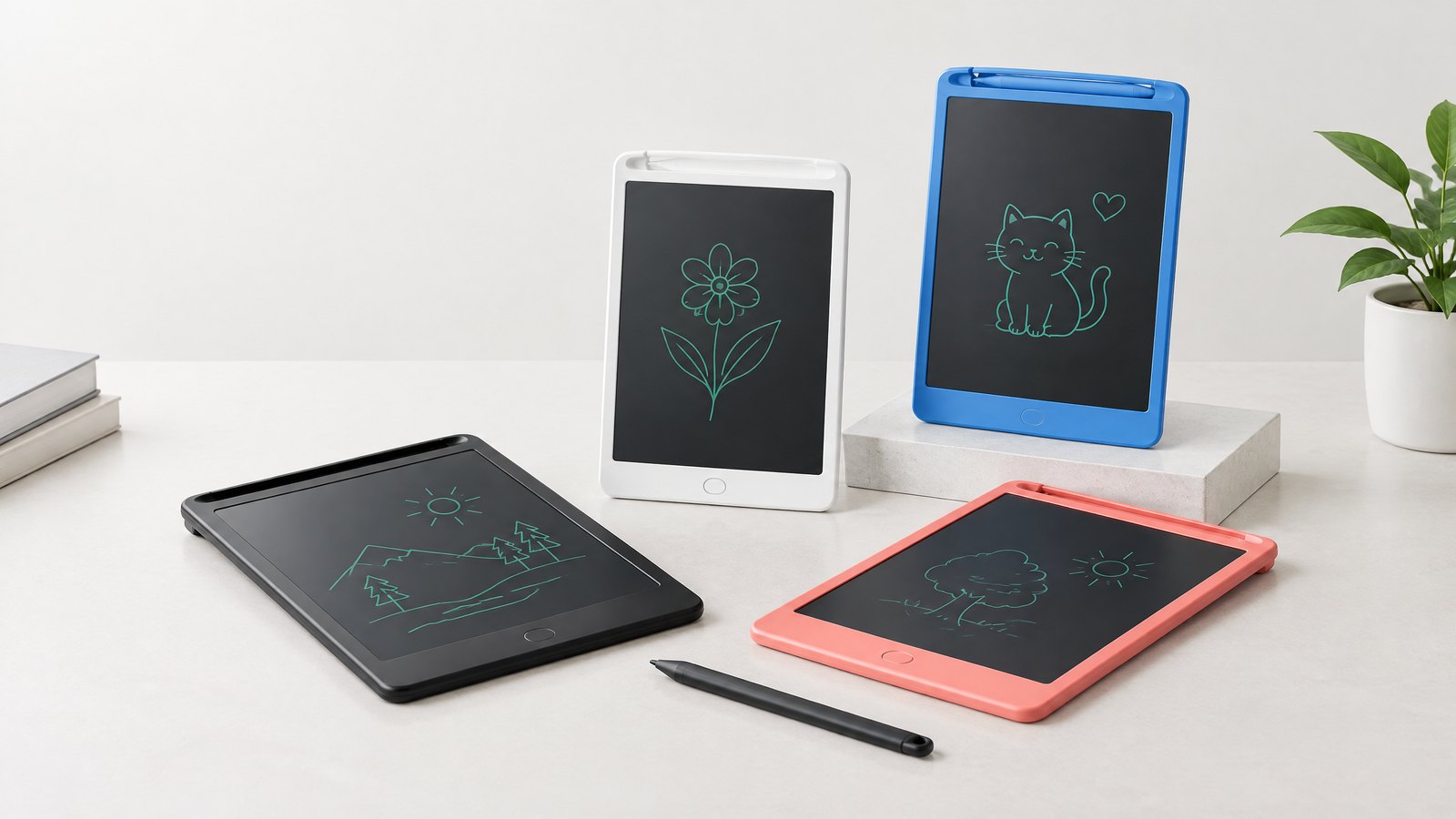
A LCD doodle board usually emphasizes casual drawing, creative play, or travel. It may have shaped housings, bright trim, a thick stylus, lanyard holes, and one-button control. If it is marketed to children, review age grading, foreseeable use, packaging imagery, removable parts, battery access, and small-part risk.
3.3 Reusable versus connected devices
A reusable writing tablet means the screen can be written on and cleared many times. It does not mean unlimited service life, cloud storage, Bluetooth, rechargeable power, or archiving. Describe it as a reusable surface for notes and drawings if no storage exists.
Basic LCD writing products differ from e-ink notepads, graphic tablets, and touchscreen computers. They may use a replaceable coin cell, a sealed battery, or another low-power configuration. One press typically clears the full screen; check any lock function under normal handling during sample approval.
4. Selection Criteria: Compare the Features that Affect Real Use
4.1 Size, form factor, and housing
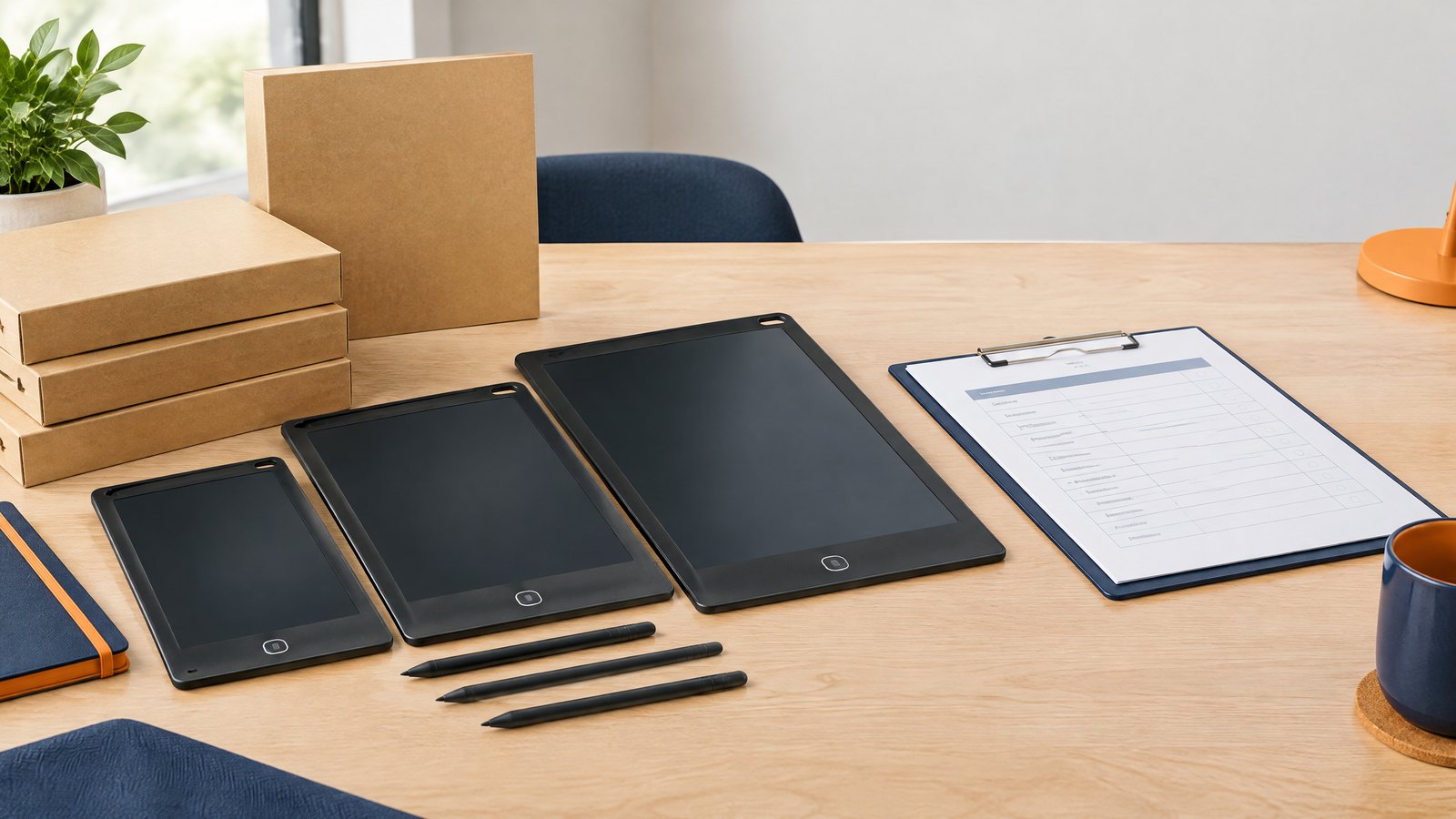
Nominal screen size is only one measure. Request overall dimensions, weight, active area, bezel width, and stylus length. Compact units suit travel and impulse retail, while larger ones better suit lists, handwriting practice, or desk notes. Housing also affects transport resilience.
Review casing material, corners, mold lines, assembly gaps, and button feel. A slim shell may flex more; a chunky housing can improve grip but adds shipping volume. For a stand, magnet, handle, or hanging hole, define load and intended use.
4.2 Screen visibility and writing behavior
Evaluate a sample in expected lighting: line contrast can differ in daylight, offices, and dim rooms. Check response to a light or firm stylus stroke and a fingertip, and whether the user can make clear marks without excessive pressure. Confirm that the color effect matches the sales description.
Ask whether it is monochrome or uses a multi-color or color-zone effect. “Color” can mean a fixed rainbow background, not selectable ink colors. Approve the wording used in photography, package copy, and listings; do not promise a precise shade, pressure, or result without support.
4.3 Erase, lock, and power details
The erase button is a high-frequency electronic action. Check that it clears fully, consistently, without unusual force, and after repeated cycles. If included, test both lock states: clearing must be blocked when locked and available when unlocked. Clarify its stated purpose.
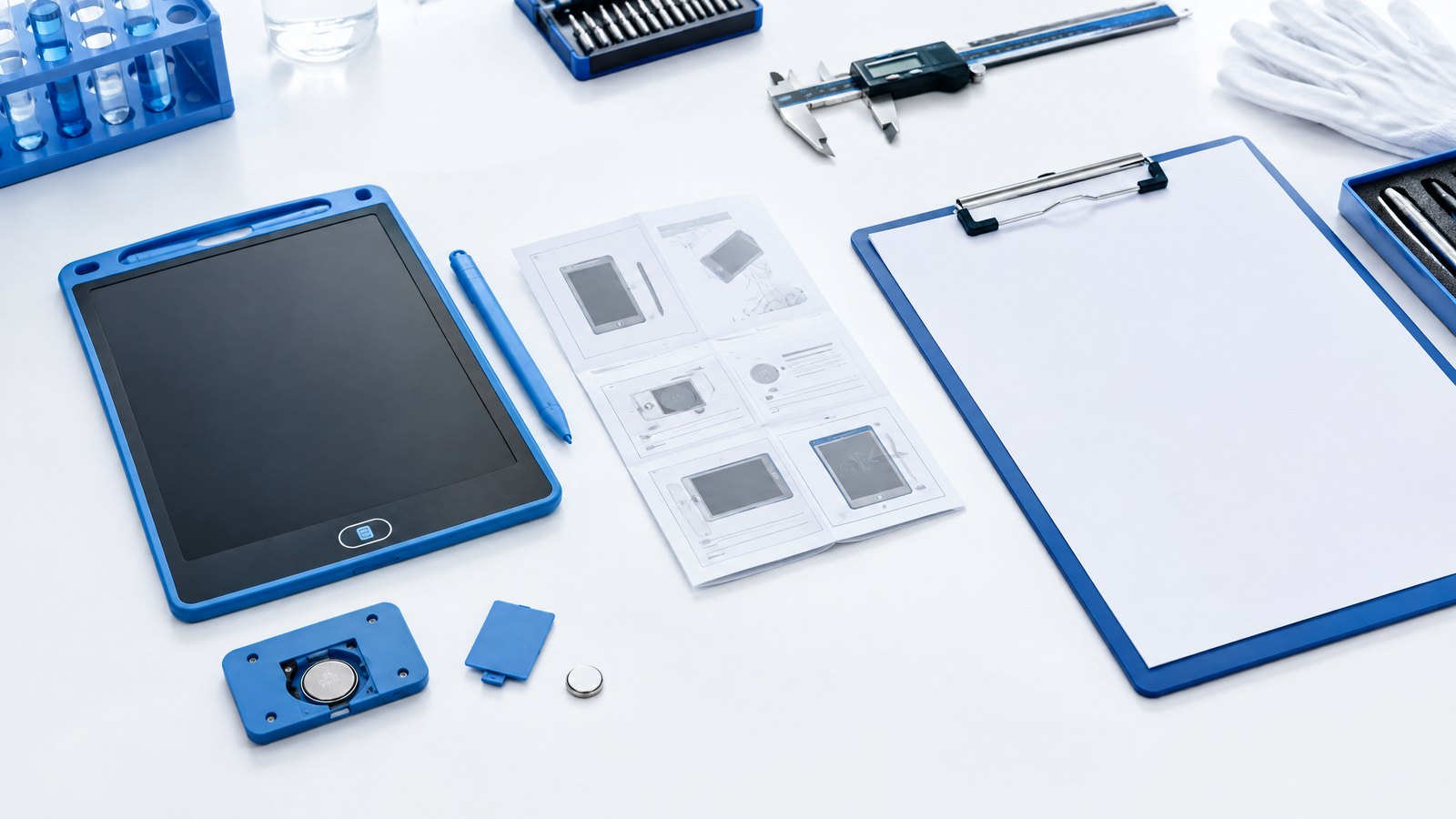
Make power architecture explicit: battery type, installed/separate packing, compartment access, tool requirement, spare-battery policy, and instructions. For rechargeable products, request input, cable, indicators, charging protection, and documentation. Battery-powered goods have supply-chain, labeling, transport, and end-of-life implications needing market review.
4.4 Branding and packaging
Branding options include bezel/rear logo print, custom housing color, insert, sticker, sleeve, color box, or instruction leaflet. Provide vector artwork, color references, location tolerance, and languages. Confirm print method, surface finish, and logo visibility with the stylus parked.
Packaging should protect the screen from compression, scratches, and accidental button activation. Request dielines/dimensions, tray details, barcode position, carton marks, weights, and pack quantity. Confirm installed-battery status and how any activation tab, isolator, or instruction is handled.
5. Technical Specifications: Turn a Product Idea into an RFQ
A quotation is only comparable when suppliers are pricing the same specification. Include a technical schedule or product data sheet as an attachment. The table below illustrates the questions a buyer should obtain; it is not a default specification.
| Area | What to define or request | Why it matters |
|---|---|---|
| Product identity | Model code, reference photos, version/date | Prevents an untracked substitution |
| Dimensions | Overall size, active area, thickness, weight | Affects use, packaging, and freight |
| Screen | Nominal size, display effect, writing responsiveness | Sets user expectations and listing copy |
| Controls | Clear button, lock type, switch locations | Supports functional inspection |
| Power | Battery type, quantity, inclusion, compartment design | Affects safety review and logistics |
| Materials | Housing, screen cover, stylus, lanyard/tether | Enables material and risk assessment |
| Accessories | Stylus, cable, manual, stand, magnet, spare items | Defines what is in the box |
| Branding | Logo method, artwork, color, location | Avoids print approval disputes |
| Packaging | Unit pack, inner carton, master carton, labels | Controls damage and fulfillment suitability |
| Commercials | MOQ, tooling if any, price basis, lead time, Incoterm | Allows a valid landed-cost comparison |
For a custom project, use an approved sample number, dated artwork, signed specification, and photo record tied to the purchase order. “Same as sample” is not enough if a sample is later revised. Make targets measurable: state active area, stylus-storage requirement, button location, and packaging orientation. If you need erase-cycle, drop, packing, or material checks, agree on the method, sample quantity, acceptance rule, and reporting format before production. The specification should reflect what is quoted and manufacturable.
6. Factory and Quality Evidence: What a Responsible Buying Process Looks Like
A reliable OEM/ODM process creates evidence at the right moments instead of waiting for the final shipment. It begins with a feasibility discussion: review the target model, requested branding, intended market, commercial quantity, packaging concept, and any special features. If the buyer supplies a reference sample, record its condition and identify which details are reference-only versus mandatory.
Sample approval is a practical control point. Review the screen appearance, housing color and finish, writing response, erase and lock functions, stylus fit, printed artwork, instruction content, and package construction. Photograph approved views and note any exceptions or temporary hand-applied labels. If a pre-production sample will be used as the “golden sample,” identify it by version and date and keep the approval record available to both parties.
During product evaluation, a buyer or independent inspector can observe screen and erase testing on a reasonable sample basis. The goal is not to claim guaranteed lifetime performance without evidence; it is to check that the unit writes visibly, clears when expected, and that lock behavior and buttons work as specified. Inspectors can also look for obvious issues such as dead areas, poor line contrast, cracks, loose styluses, sharp edges, inconsistent assembly gaps, cosmetic marks, or incorrect print. Agree in advance whether any observed issue is critical, major, or minor and how rework or replacement will be handled.
Packaging checks should include the approved unit pack, print content, language version, inserts, barcode, labels, protection around the product, carton markings, carton quantity, and whether cartons match the packing list. Confirm that packaging artwork does not make unsubstantiated claims such as “non-toxic,” “safe for all ages,” “unbreakable,” or a compliance mark unless the buyer has verified that claim is appropriate and supported.
Before goods leave the factory, conduct a pre-shipment inspection at an agreed production stage, commonly when goods are substantially completed and packed. The inspection plan may cover product count, random visual and functional checks, workmanship, packaging, labels, carton condition, and document consistency. It does not replace legal compliance work, a factory audit, or laboratory testing when those are needed. It does give the buyer a structured opportunity to compare finished goods with the approved specification before the balance is paid or the container is sealed.
Mid-article CTA — Build a quote-ready specification. Send LcdWritingTablet your target market, quantity, screen size, user group, branding artwork, package concept, and delivery destination. Ask for the matching model options, current MOQ, quotation, sample route, and a confirmation of which details must be reviewed for your market before you approve production.
7. Compliance and Safety Considerations: Plan Evidence Before You Print Claims
Compliance is product-, market-, and sales-channel-specific. Buyers should confirm their obligations with qualified compliance professionals, accredited laboratories where needed, and the relevant importer or responsible economic operator. A factory may provide available product information or cooperate with document requests, but the buyer should not assume that a generic report, an online logo, or a competitor’s package proves suitability for a different model or destination.
For the United States, whether the item is treated as a children’s product or toy can affect the applicable Consumer Product Safety Commission (CPSC) requirements, labeling, testing, and certification responsibilities. If the product is within toy scope, standards such as ASTM F963 can be relevant; if it is a children’s product, limits and documentation under CPSIA may also require review. The design—including small or detachable parts, accessible batteries, cords/straps, edges, and age grading—should be assessed for foreseeable use. Do not print claims about age suitability until the product and package have been reviewed.
For the European Union—including Germany and France—general product safety, traceability, instructions and warnings, economic-operator responsibilities, and CE-marking rules may apply according to classification and legislation. The EU General Product Safety Regulation (GPSR) is a core reference. Electronics, batteries, packaging, and producer responsibility can add country-specific obligations. A CE mark is not a decorative quality mark; use it only where required and supported by the appropriate assessment and documentation.
For Great Britain, applicable product-safety and marking arrangements may differ from the EU route. UK buyers should review current GOV.UK guidance for product safety, labeling, and UKCA/CE acceptance where relevant to the specific product and date of placing on the market. Northern Ireland arrangements can differ again. Confirm the exact selling territory rather than using “UK” as a blanket regulatory instruction.
Battery handling warrants separate attention. Verify the actual battery type and product design, battery-compartment security, instructions, transport classification/documentation needs, waste/collection obligations, and required symbols or warnings for the destination. For young users, accessible button/coin cells are a serious risk area. Material and restricted-substance requirements, electrical safety, packaging, and recycling obligations should likewise be checked against the final bill of materials and market plan—not a generic product description.
8. Application Examples: Specify the Use Case, Not Just the Category
8.1 Children’s activity and travel retail
A child-focused board can be positioned for drawing, handwriting practice, restaurant waiting time, or car travel. Focus on grip, stylus retention, readability, accidental erase prevention, package communication, and age-appropriate risk review. Weigh shaped-frame shelf appeal against extra tooling, packing volume, and cosmetic-damage risk.
8.2 Education and learning-support programs
For classroom activities or after-school kits, standardization and serviceability can be more valuable than novelty. Clarify whether students will write small characters, equations, diagrams, or brief responses; this determines suitable active area and writing contrast.
8.3 Office, home, and desk reminders
A digital writing pad can work as a visible reminder surface for shopping lists, short messages, meeting prompts, or front-desk notes. In this use case, magnet placement, stand stability, clean aesthetics, and a discreet stylus holder may matter more than toy-like graphics. State clearly that the product is for temporary handwritten content if it does not include memory, synchronization, or a way to export notes.
8.4 Promotional, hospitality, and private-label programs
For a branded giveaway or guest amenity, choose a format with enough clear logo space without interfering with use. Consider custom-print lead time, individual presentation, and delivery consolidation. A standard shape plus controlled branding can often meet the objective without a custom mold.
9. Buyer Checklist: Use Before Sample Approval and Before Shipment
Use this checklist to make the handoff between sourcing, product, quality, compliance, and logistics teams more consistent.
Product and commercial checklist
- Intended user, use environment, and target age or audience are written down.
- Model, active screen area, overall dimensions, display effect, and color have been confirmed.
- Clear button, lock function, stylus attachment, and accessories are defined.
- Battery/power arrangement and in-box contents are specified.
- MOQ, unit price basis, tooling/artwork charges, lead time, payment terms, and Incoterm are quoted.
- Approved sample, dated drawings, artwork files, and revision numbers are traceable.
Quality and packaging checklist
- Writing visibility, erase behavior, lock operation, stylus fit, casing assembly, and cosmetic standard are checked on the sample.
- Agreed inspection method, timing, defect classification, and rework process are documented.
- Package layout, languages, warnings, barcode, country/market details, and carton marks have been approved.
- Product protection, packed quantity, carton dimensions, weights, and palletization needs are confirmed.
- A pre-shipment inspection plan or release process is agreed before production begins.
Compliance and market-readiness checklist
- Product classification and applicable destination-market requirements have been reviewed.
- Required labels, instructions, warnings, traceability data, and responsible-party details are assigned to the correct party.
- Any laboratory testing or technical documentation needed for the final configuration is planned, not assumed.
- Battery, electronics, packaging, recycling, and producer-responsibility obligations have been checked for the import market.
- Claims on packaging and listings have been checked against actual features and available substantiation.
10. Frequently Asked Questions
Are LCD writing tablets the same as tablets with apps?
No. Common LCD writing tablets are standalone pressure-writing devices that generally do not run apps, connect to Wi-Fi, browse, or retain digital files. Confirm the functions for each model rather than relying on the category name.
Can users erase only one word or drawing area?
Many basic models clear the entire screen at once. Some products may use a different design, but selective erase should never be assumed. If it is a required feature, place it in the RFQ and approve it on a physical sample.
Does a lock switch save the drawing permanently?
Usually, a lock feature is intended to reduce accidental clearing. It is not the same as file storage or a backup function. Verify the actual behavior for the chosen model and explain it accurately in consumer instructions.
What is the right screen size for a first private-label order?
Choose based on use case, target retail price, and package/freight constraints. Compact formats suit travel and promotional distribution; larger active areas may suit lists and school-age writing. Request alternatives priced to the same package and quantity assumptions.
Should we order a sample before artwork is finalized?
Yes. A neutral sample can assess writing experience, erase function, size, and construction. Once selected, approve a branded or pre-production sample with final artwork and package details before mass production.
Can a supplier simply add a CE, UKCA, or other mark to the package?
No. Regulatory marks and declarations must reflect the final product, applicable law, and the required assessment/documentation. Treat them as a compliance decision led by the responsible business parties, not a generic print option.
What should an inspection focus on?
Focus on the agreed specification: appearance, assembly, writing and clearing, lock operation, accessories, artwork, labels, packaging, carton count, and obvious transit damage. Define sampling and acceptance standards in advance.
11. Conclusion and Next Step
LCD writing tablets offer a practical, low-complexity alternative to disposable note paper for drawing, temporary notes, and simple learning activities. The strongest buying programs do not select on unit price alone. They choose a model for a real user and use case, translate the concept into a controlled specification, approve samples, verify functionality and packaging, and plan market-specific compliance evidence before goods are produced.
For US, UK, German, and French buyers, the most efficient next step is a quote request that includes the target market, audience, quantity, preferred size, required features, branding, package style, and delivery destination. This gives an OEM/ODM partner a clear basis to propose suitable standard models or a scoped customization route—and gives your team a reliable basis for comparison.
End CTA — Start with a specification-led inquiry. Contact LcdWritingTablet with your RFQ, reference images, expected order quantity, target price range, market destination, and artwork requirements. Request a current model recommendation, a quotation tied to the confirmed specification, sample options, packaging details, and the quality/compliance information that should be reviewed before purchase-order approval.
Sources and Verification Note
Use current primary guidance when finalizing a product for sale; laws, interpretations, and product classifications can change. The following public sources are useful starting points, not a declaration that any particular model complies:
- U.S. Consumer Product Safety Commission (CPSC) — consumer-product, children’s-product, and certification guidance.
- ASTM International — publisher of voluntary consensus standards, including toy-safety standards; obtain and apply the current edition through the appropriate route.
- European Commission: Product Safety and the GPSR — EU consumer product safety overview.
- European Commission: CE marking — when and how CE marking applies.
- GOV.UK: Product safety for businesses — Great Britain product-safety guidance.
- IEC — international electrotechnical standards organization; confirm any applicable standard with qualified compliance advisors and testing partners.
Image Plan
-
Purpose: Establish the product category and show the core user interaction.
Insertion position: After the Introduction.
English caption: “A slim LCD writing tablet used for quick notes and sketches.”
ALT text: “Hand using a slim LCD writing tablet with stylus to write a shopping list.”
English AI image prompt: “Photorealistic commercial product photograph of an unbranded slim LCD writing tablet on a clean light desk, adult hand writing a short shopping list with a stylus, visible reflective writing screen, soft natural daylight, no logos, no readable brand names, premium B2B catalog style, landscape composition.” -
Purpose: Compare common form factors for buyers evaluating a range.
Insertion position: In Section 3, after ‘Doodle boards and child-focused formats.’
English caption: “Common LCD writing tablet formats: compact travel, child-friendly, and desk-note styles.”
ALT text: “Three unbranded LCD writing tablet form factors arranged side by side.”
English AI image prompt: “Studio product lineup of three unbranded LCD writing tablets side by side: compact rectangular travel model, playful rounded child-friendly model, and larger professional desk-note model, each with a matching stylus, white seamless background, balanced soft shadows, clean OEM sourcing catalog photography, no text or logos.” -
Purpose: Support the quality-control section with a credible process visual.
Insertion position: In Section 6, before the mid-article CTA.
English caption: “A production sample is checked for screen response, erase function, and packaging details.”
ALT text: “Quality inspector checking an LCD writing tablet screen and retail packaging at a workbench.”
English AI image prompt: “Realistic documentary-style factory quality control scene, adult inspector at a clean workbench testing an unbranded LCD writing tablet with stylus and examining a plain retail box, clipboard with generic checklist but no readable company data, bright professional lighting, Shenzhen consumer electronics assembly environment, authentic but non-branded, landscape.” -
Purpose: Visualize retail-ready packaging and shipment planning.
Insertion position: In Section 9, after the Quality and packaging checklist.
English caption: “Retail packs and master cartons should be approved against the final packing specification.”
ALT text: “Unbranded LCD writing tablet retail boxes packed inside labeled shipping cartons.”
English AI image prompt: “Photorealistic B2B logistics image of neatly arranged unbranded LCD writing tablet retail cartons with protective inner trays beside sealed plain master shipping cartons, generic handling symbols only, no company logos or legible addresses, clean warehouse packing station, professional procurement guide aesthetic.”
Continue with the next sourcing decision.
Use these internal links to compare products, check common buyer questions, review compliance preparation, or send your requirements to the factory.
Turn this sourcing plan into a product brief.
Share your target market, product requirements, packaging preference and estimated volume for a practical OEM / ODM discussion.