This guide provides a practical B2B decision framework. Final specifications, market obligations, testing scope, labels, packaging and shipment requirements must be confirmed for the exact finished SKU and destination.
Direct answer: A talking flashcard machine identifies a card, maps that identity to a locally stored audio file, and plays the assigned word, phrase, sound, or prompt through its speaker. In a private-label program, the important question is not simply whether the sample speaks. Buyers should validate the card-identification method, audio/content mapping, child-use controls, battery and charging design, print durability, packaging, and market-specific compliance evidence before approving production. The exact obligations depend on the finished product, intended age, country of sale, and responsible economic operator.
2. Direct-answer introduction
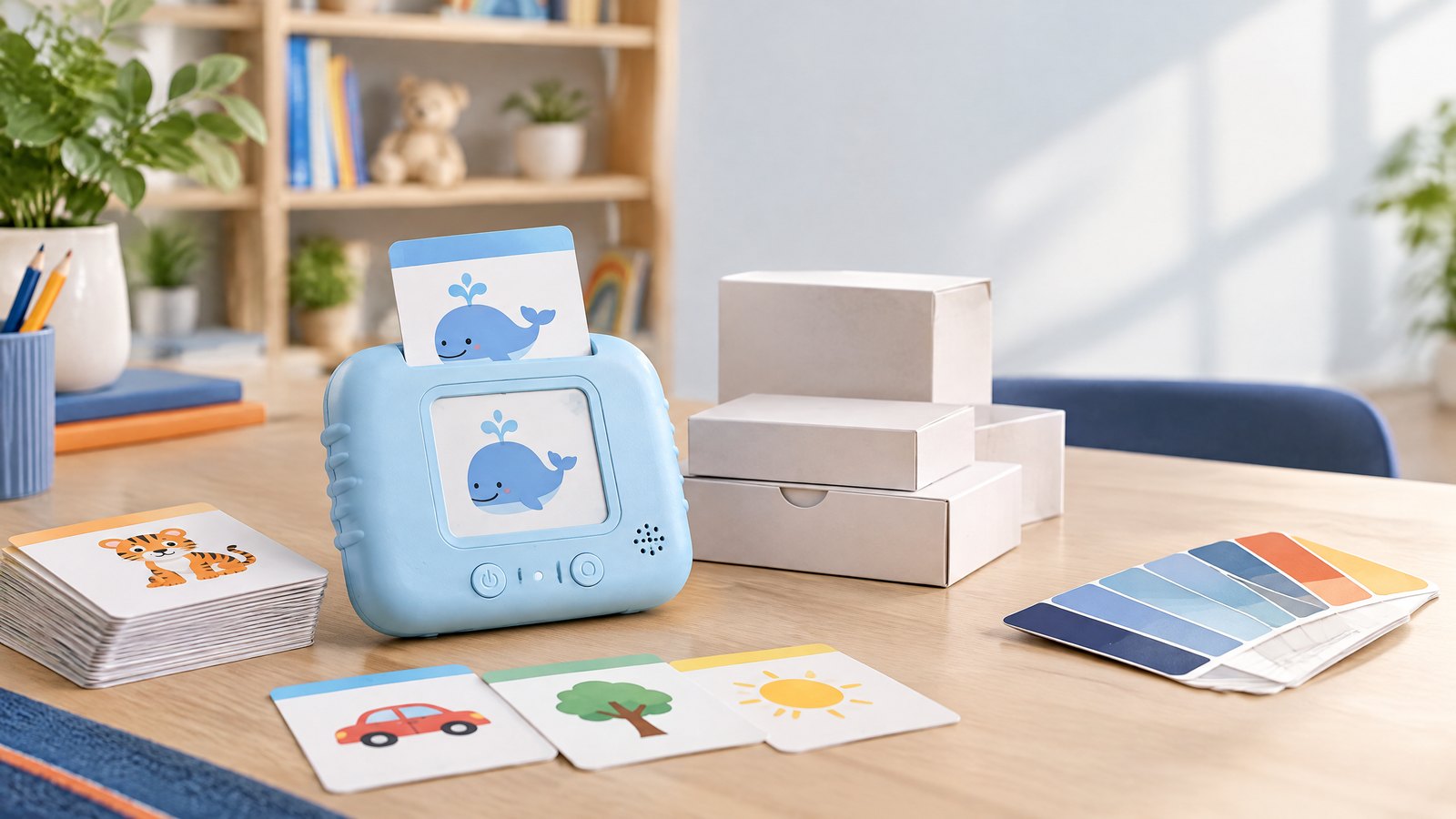
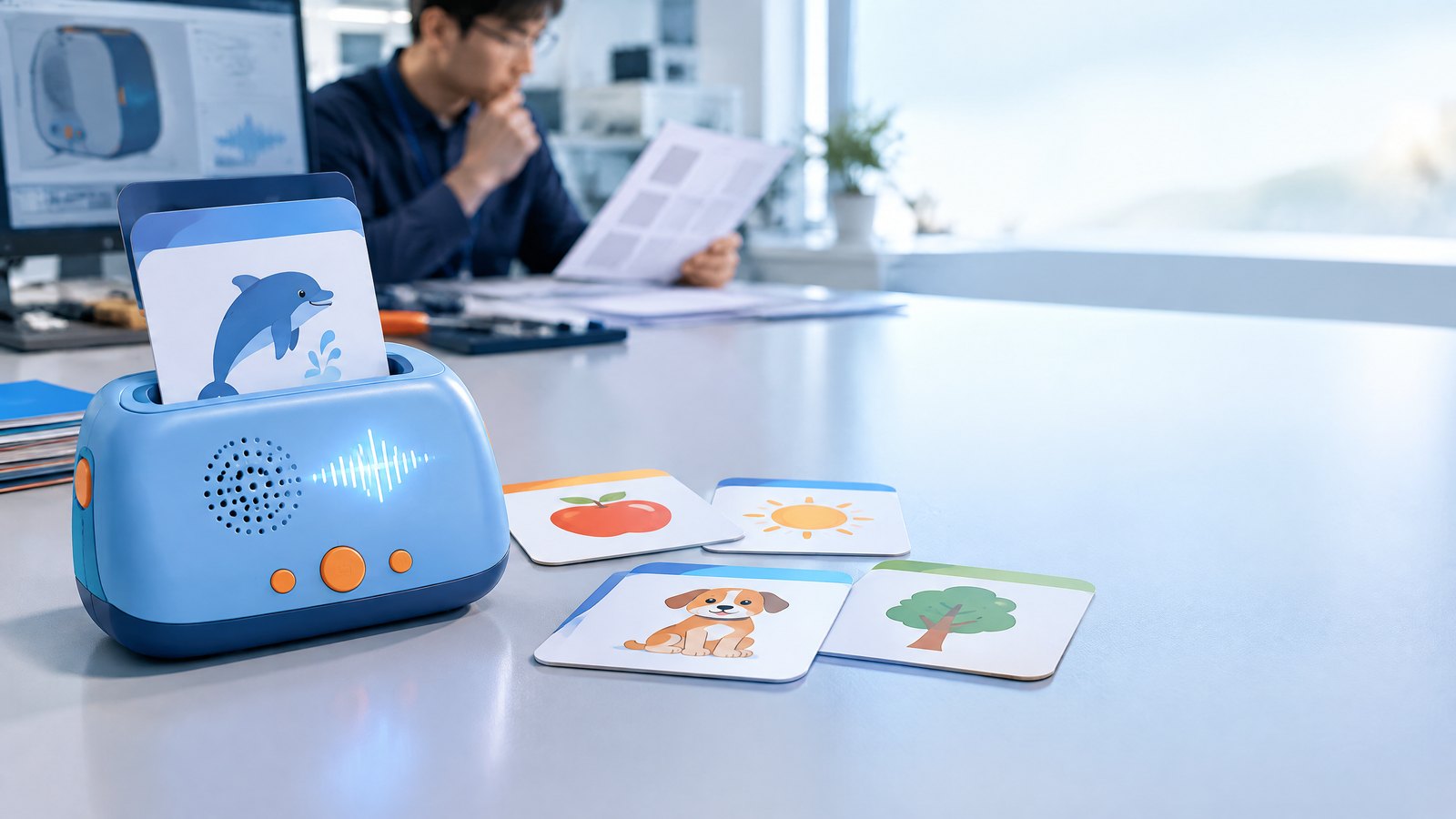
Talking flashcard machines turn a physical learning card into a repeatable audio cue. A child inserts, taps, or presents a card; the reader identifies the card; firmware retrieves the linked recording; and the device plays it. Some designs include a replay key, volume buttons, a record function, or a simple quiz prompt. The practical value is immediate, screen-light interaction: the card provides a visual cue while the reader delivers sound.
The mechanism behind the phrase “talking flashcard” is not universal. A product may use a printed barcode, an optical mark, an RFID or NFC tag, a magnetic marker, a keyed card shape, or another proprietary identifier. Barcodes are electronic-scanning symbols that encode identifiers or attributes; they are not automatically interchangeable with RFID or NFC technology.1 A recordable card-reader example describes 24 unique barcodes, each associated with an audio message, which usefully illustrates the identity-to-audio principle but should not be treated as a specification for every model.2
For a buyer, this distinction matters. The identification technology drives card cost, print tolerance, content capacity, copying risk, reader opening geometry, and quality-control method. The audio and electrical architecture drive user experience, battery sourcing, testing needs, and transport preparation. A convincing prototype is therefore only the start of a sound OEM/ODM decision.
The basic signal path, without the marketing shorthand
A simple offline reader normally has five linked layers. The card layer carries a printed image plus the machine-readable identifier. The sensing layer sees or detects that identifier. The control layer—usually a microcontroller with firmware—translates the identifier into a content index. The audio layer retrieves the corresponding file from internal storage and sends it through an amplifier and speaker. The power layer supplies the system through replaceable cells or a rechargeable battery, charging circuit, and protections appropriate to the chosen design.
The reader’s software may be as simple as a lookup table: card ID 014 → /English/animals/cat.mp3. It may also contain multiple language packs, a sound effect after a correct answer, or a card-set selector. That additional flexibility can be commercially useful, but it creates more test cases. A buyer should ask for the actual card-ID map and audio-file list rather than relying on a general statement such as “supports 224 words.” The number of cards is less meaningful than the number of unique and correctly mapped learning interactions.
Most basic readers work offline and do not need an app or a network connection. If a proposed model adds Bluetooth, Wi-Fi, NFC, a companion app, recording/upload functions, or user accounts, treat it as a materially different product architecture. Wireless features can change radio approval analysis. In the United States, the FCC explains that RF devices need the appropriate authorization procedure before they are marketed, imported, or used, with the applicable route depending on the device type and function.3 A buyer should obtain market-specific advice before assuming a report on a non-wireless base model covers a wireless private-label version.
3. Who this buyer guide is for
This guide is for organizations buying a finished reader-and-card set under their own brand, adapting an existing platform, or commissioning a new learning-content package. It is useful for education distributors deciding whether a vocabulary set fits classrooms or tutoring channels; retail buyers assessing a boxed consumer product; private-label importers who must manage product files and retailer requests; and edtech teams that want an inexpensive physical touchpoint without building an app-first product.
It is also for product managers who already have the “content” part of the project—illustrations, word lists, translations, pronunciations, brand assets, or curriculum objectives—but need to convert it into manufacturable cards and firmware. The commercial risk is rarely that a factory cannot put a logo on a box. The risk is that content, print, reader firmware, battery choice, labeling, and launch-market requirements are reviewed in isolation and do not work together in the final retail unit.
This article does not assume every device is a toy, every buyer is the importer, or every market follows one compliance pathway. Classification can depend on intended use, age grading, marketing, features, and jurisdiction. For example, the CPSC defines a children’s product as one designed or intended primarily for children 12 and under, then links testing and certification to applicable rules.4 In the EU, toy obligations include a safety assessment that considers chemical, physical, mechanical, electrical, flammability, hygiene, and radioactivity hazards.5 Confirm the classification and obligations for the exact finished SKU with a qualified compliance professional or responsible economic operator.
4. Buyer decision framework: decide the learning system before cosmetic options
Begin with the learning job: who uses the product, in what setting, and what action should happen after a card is presented? A short brief such as “a preschool learner inserts a picture card to hear one English word and can press replay” determines voice pace, card size, button count, audio length, and appropriate claims. A platform with many modes is not necessarily the better platform if it makes that first interaction unclear.
Then select the interaction and content model. An inserted-card format gives visible cause and effect but makes slot fit and card durability important. Tap or scan formats may be faster but need reliable placement. Fixed factory-loaded content is easier to control; multi-language content needs a defined language-selection rule and separately approved scripts; recordable content needs a recording length, overwrite behavior, memory-retention rule, and lock-state test. Approve spelling, scripts, pronunciation, and regional terms through a native-language reviewer before cards are printed.
The identification method must be named in the quotation. Printed optical identifiers make contrast, registration, coating, orientation, reader cleanliness, and repeated handling relevant. RFID/NFC-style systems introduce tag sourcing, encoding control, and antenna performance questions. Keyed-shape systems can be simple but may limit card configurations. Ask whether IDs are unique by card, side, or card family, and request a full card-ID map.
Finally, choose the power and service model. Replaceable batteries avoid a charge port but require a sound compartment design and clear instructions. Rechargeable units add charging, cable, runtime, and battery-transport questions. Never accept a battery-life claim without its stated volume, file length, operating cycle, battery capacity, temperature, and pass criterion. Request the battery/cell identity, nominal voltage and capacity, input specification, protection approach, and available transport documentation before bulk production.
| Decision area | Buyer question | Evidence to request | Risk if omitted |
|---|---|---|---|
| Learner and use case | Who uses it and for what learning action? | Approved brief, age grading, proposed claims | Wrong controls, language level, or classification |
| Card recognition | Is it optical, RFID/NFC, keyed, or another method? | Engineering description, card-ID map, video | Scan failures or incompatible reprints |
| Content | What plays for each card and side? | Versioned word list, audio list, native-review approval | Wrong language or duplicate mapping |
| Reader UX | How do replay, volume, language, record, and lock work? | Button matrix and test cases | Child confusion and inconsistent samples |
| Power | Replaceable or rechargeable; what happens at low power? | Battery/charging specification and test method | Shipment delays or avoidable returns |
| Launch market | What rules and labels apply to the actual SKU? | Compliance plan and traceability artwork | Unsupported claims or mislabeling |
5. Comparison and specification table: convert a generic listing into a controlled SKU
Compare alternatives by the elements that change the finished product, not by the headline card count. The entries below are validation fields, not universal requirements. Populate them from the approved quotation, sample, and product file.
| Specification field | Entry-level fixed-content reader | Custom private-label reader | Buyer validation |
|---|---|---|---|
| Recognition | Fixed optical or keyed system | Agreed method and card-ID scheme | Recognition after normal, reversed, repeated, and edge-case presentation |
| Audio source | Factory-loaded clips | Approved masters loaded to firmware/storage | Filename, version, language, duration, and playback order |
| Content capacity | Predetermined by platform | Defined in approved content map | Unique card sides, duplicates, and reserved IDs |
| Controls | Power, replay, volume | Brief-specific functions | Long/short press, lock, and audible feedback behavior |
| Card construction | Standard printed set | Defined stock, finish, corners, and edges | Image quality, ID contrast, curl, cuts, and slot fit |
| Power option | Replaceable or rechargeable | Approved battery and cable configuration | Door/port, charging indicator, low-power behavior, runtime method |
| Branding/documentation | Label or packaging change | Reader, cards, manual, box, and content | Artwork revision; SKU, lot, and final-model document match |
An existing test report is not a blanket approval for a changed SKU. A different battery, charger, material, coating, radio module, age grade, factory, or claim can require the responsible party to reassess the evidence. CPSC guidance says a material change to a children’s product after initial certification requires retesting for affected rules and a new CPC based on passing results.6 Maintain a change log and review each change for safety, compliance, performance, and logistics effects.
Private-label enquiry CTA: Send your target market, intended age, language(s), card count, artwork status, power preference, and launch timing to info@lcdwritingtablet.com. Request a configuration review that distinguishes existing-platform customization from new engineering, sampling, or compliance review.
6. Buyer checklist: questions to close before deposit or mass-production approval
Use this as a purchase-order attachment or pre-production gate. It converts verbal expectations into a record that the buyer and manufacturer can check against the finished SKU.
Product and content checklist
- Control every mapping. Keep a numbered register for card artwork, side, machine-readable ID, spoken script, audio filename, voice/language, and final approval date. Verify the complete register on a device; do not sample only the first cards.
- Approve the user outcome. Review audio on target hardware for intelligibility, pronunciation, playback consistency, and unacceptable clipping. Test printed cards after realistic handling, including cards at the edges, light/dark artwork, and final coating.
- Define functions and faults. Document power, volume, replay, mode/language selection, record/erase/lock if present, charging, battery-door closure, low-power behavior, and the response to an invalid card.
- Freeze retail files. Version-control reader artwork, box dieline, manual, warnings, retailer barcode data, SKU, and lot/traceability placement. Make the approved revision part of the purchase order.
Market, safety, and document checklist
- Determine product scope before claims. Classification can turn on intended age, marketing, consumer use, product features, and jurisdiction; do not decide it from appearance alone.
- Name the responsible party. Identify the manufacturer, importer, distributor, or other economic operator for every market. EU toy importers must verify, among other things, conformity assessment, technical documentation, declaration, marking, traceability, instructions, and warnings.5
- Match files to the finished configuration. Compare reports and declarations to the final model/SKU, product photographs, age grade, battery, charger/cable, materials, labels, factory, and requirements. A report that does not describe the shipment is not sufficient on its own.
- Prepare product-specific evidence where applicable. CPSC states that regulated children’s products require third-party testing and a CPC issued by the domestic manufacturer or importer, based on a CPSC-accepted laboratory’s results.4 EU toy rules likewise involve product-specific safety assessment, documentation, declaration, marking, traceability, instructions, and warnings.5
- Make battery and radio review separate workstreams. Request relevant UN 38.3 test-summary information and give accurate configuration details to the forwarder.7 A Bluetooth or Wi-Fi version is not equivalent to a non-wireless base model; FCC equipment authorization depends on the device function.3
These are procurement controls, not legal advice. Final obligations depend on the product, market, and responsible economic operator.
7. Sample, testing, factory, and shipment inspection workflow
Use several gates rather than one late “final sample.” At requirements review, issue a version-controlled brief covering reader type, recognition method, card count, language, learning objective, target market, power design, claims, and acceptance criteria. List open assumptions. “Rechargeable,” for example, is incomplete without input, cable, capacity, expected test conditions, and battery-document requirements.
At the engineering/content sample gate, check the housing, slot or tap action, buttons, speaker, power arrangement, card geometry, and complete card-to-audio map. Review audio on the target reader. For each language, a qualified reviewer should check all learner-facing content where practicable. At pre-production sample (PPS), use intended materials, print process, branding, packaging, and production-representative firmware. Archive the signed PPS; a hand-cut engineering sample does not define production quality.
During production, request documented incoming, assembly, and packing checks: reader functions, card recognition, buttons/speaker, rechargeable-unit charging, visual condition, firmware version, and batch capture. Agree defect definitions and a sampling plan in the order. At pre-shipment inspection, inspect packed units from the finished lot; reconcile SKU, contents, labels, markings, artwork, carton quantity, and packing data; and function-test sampled cards against the register. For rechargeable products, reconcile battery information and shipment papers before the forwarder takes custody. IATA identifies packing, marking, labeling, and documentation as core parts of lithium-battery transport preparation.8
| Gate | Buyer-controlled deliverable | Factory-controlled deliverable | Release question |
|---|---|---|---|
| Requirements | Versioned brief and acceptance criteria | Feasibility confirmation and quotation scope | Is the SKU unambiguous? |
| Engineering/content sample | Scripts, artwork draft, card register | Working reader and mapped sample | Does every interaction work and say the right thing? |
| PPS | Signed sample and packaging approval | Production-representative sample | Does the reference represent production? |
| Production | Inspection plan and defect definitions | In-process and batch records | Are defects contained before packing? |
| PSI/shipment | Release decision and document list | Final inspection, carton, shipment data | Does the lot match the approved SKU and transport plan? |
8. Ordering and implementation preparation
Turn the signed sample into a specification pack before issuing the order. Include practical bill-of-material detail, reader drawings or photos, dimensions, color references, card register, audio list, firmware version, artwork, packaging dieline, packing method, accessories, labels, target market, claims, quality plan, and document deliverables. Version numbers and approval owners prevent the factory from following an obsolete attachment.
Set the ownership boundary for illustrations, recordings, translations, scripts, code, packaging, QR destinations, and retail barcodes. State who supplies, licenses, approves, and may reuse each asset. If buyers provide recordings, define format, file names, delivery date, and rights responsibility. Build time around content approval, artwork proofing, engineering changes, PPS, document review, production, inspection, and freight—not only a retail deadline. No bulk card printing should start before card/content proof approval; no shipment should leave before inspection and document reconciliation.
Also prepare a short troubleshooting sheet for no sound, low volume, unrecognized cards, charging/battery issues, and cleaning. Code returns by actual failure mode so future orders improve from evidence rather than assumptions. Describe intended learning use and product features accurately; do not promise unvalidated educational outcomes.
9. Practical applications: design around a repeatable use moment
Early vocabulary sets pair one image with one spoken word. Validate pronunciation, image clarity, categories, repeat behavior, and child independence. Bilingual sets need an intentional language model—sequential playback, a selector, or separate packs—and must be tested across every language mode. Keep package and manual wording aligned with regional vocabulary choices.
Phonics sets should distinguish visible letter, phoneme, word, and audio instruction in a pedagogical approval sheet. Recordable speech or inclusive-learning sets need a defined recording duration, overwrite and lock behavior, playback quality, and an interface suitable for the intended learner and supervision setting. Promotional or travel packs may put more weight on compact packaging, accurate claims, multilingual instructions, and transport readiness. In all cases, reliable mapping and a learner-appropriate interface matter more than a long feature list.
10. Detailed FAQ
How do talking flashcard machines recognize cards?
They detect an identifier associated with the card—such as a printed optical mark, RFID/NFC tag, mechanical key, or another proprietary system—and firmware maps that ID to audio or a function. Ask for the technical method; “smart card” is not a specification.
Do all readers use RFID?
No. One recordable commercial reader specifies unique barcodes paired with messages.2 Other products may use RFID/NFC or proprietary methods. Confirm the identifier layout, print restrictions, and whether a third party can make compatible reprints before releasing card artwork.
Can a buyer add its own language or voice?
That depends on memory, firmware, available IDs, audio format, and the supplier’s loading process. Supply an approved script and masters, or agree the recording workflow. Validate every card side and language mode, and clarify rights to recordings and translations.
What is the most important sample test?
Run 100% card-to-audio verification against a signed register. It identifies wrong words, wrong languages, duplicates, missing files, reversed-card behavior, and recognition failures. Pair it with handling tests that reflect actual use.
What documents should a rechargeable model have?
The package depends on configuration and route, but obtain traceable battery/cell details and relevant UN 38.3 test-summary information. PHMSA covers the design-test/test-summary context; IATA provides air-transport guidance by configuration and rating.7 8 Confirm the packed shipment with the carrier or forwarder.
Is a supplier report enough for U.S. or EU sales?
Not automatically. Evidence must match the final product, market, category, and responsible party. For applicable U.S. children’s products, the domestic manufacturer/importer issues the CPC based on required third-party testing.4 EU toy market access also requires the product-specific process described by the Commission.5
Does Bluetooth change the project?
Potentially. It changes the technical architecture and may change the RF authorization analysis. The FCC says authorization depends on the device function and covered RF devices need approval before U.S. marketing, import, or use.3
What belongs in an OEM/ODM handoff package?
The brief, approved sample, card register, scripts, audio list, reader specification, artwork, packaging, label copy, quality criteria, target-market list, and document request list. A controlled pack is more reliable than scattered messages.
11. Conclusion: make the audio mapping and market file as real as the product sample
Talking flashcard machines work through a straightforward chain: identify the card, retrieve the mapped audio, and play it reliably. Buying them well is more demanding because the learning content, recognition method, reader hardware, power design, printed cards, packaging, and market documentation must remain aligned through production and shipment.
The most reliable private-label process is practical: define the learner interaction; identify the precise card technology; control every card-to-audio mapping; approve production-representative cards and packaging; validate the finished configuration and its applicable market requirements; and inspect both the packed product and the shipment records. This approach does not guarantee compliance or performance by itself, but it creates the evidence trail and decision gates needed to manage both.
Final CTA: For an OEM/ODM discussion on talking flashcard reader configuration, branded card sets, packaging, and a sample-validation plan, email info@lcdwritingtablet.com with your target market, intended age range, language/content scope, power preference, and estimated order requirements.
References
Turn this sourcing plan into a product brief.
Share your target market, product requirements, packaging preference and estimated volume for a practical OEM / ODM discussion.