This guide provides a practical B2B decision framework. Final specifications, market obligations, testing scope, labels, packaging and shipment requirements must be confirmed for the exact finished SKU and destination.
To source smart electronic badges for private label, start with a locked use case and an exact product configuration—not a catalogue photo. Decide whether a reusable LCD display, QR code, NFC tap, Bluetooth connection, rechargeable battery, or app is truly needed; then approve a representative sample, production-ready artwork, packaging, inspection criteria, and market-specific documentation before mass production. A qualified private-label manufacturer of smart electronic badges should be able to quote against that controlled specification and support a documented approval process. The brand owner, importer, and other economic operators must still confirm the finished SKU’s legal, safety, data, and import duties for every destination market.
2. Direct Answer: Source the System, Not Just the Badge
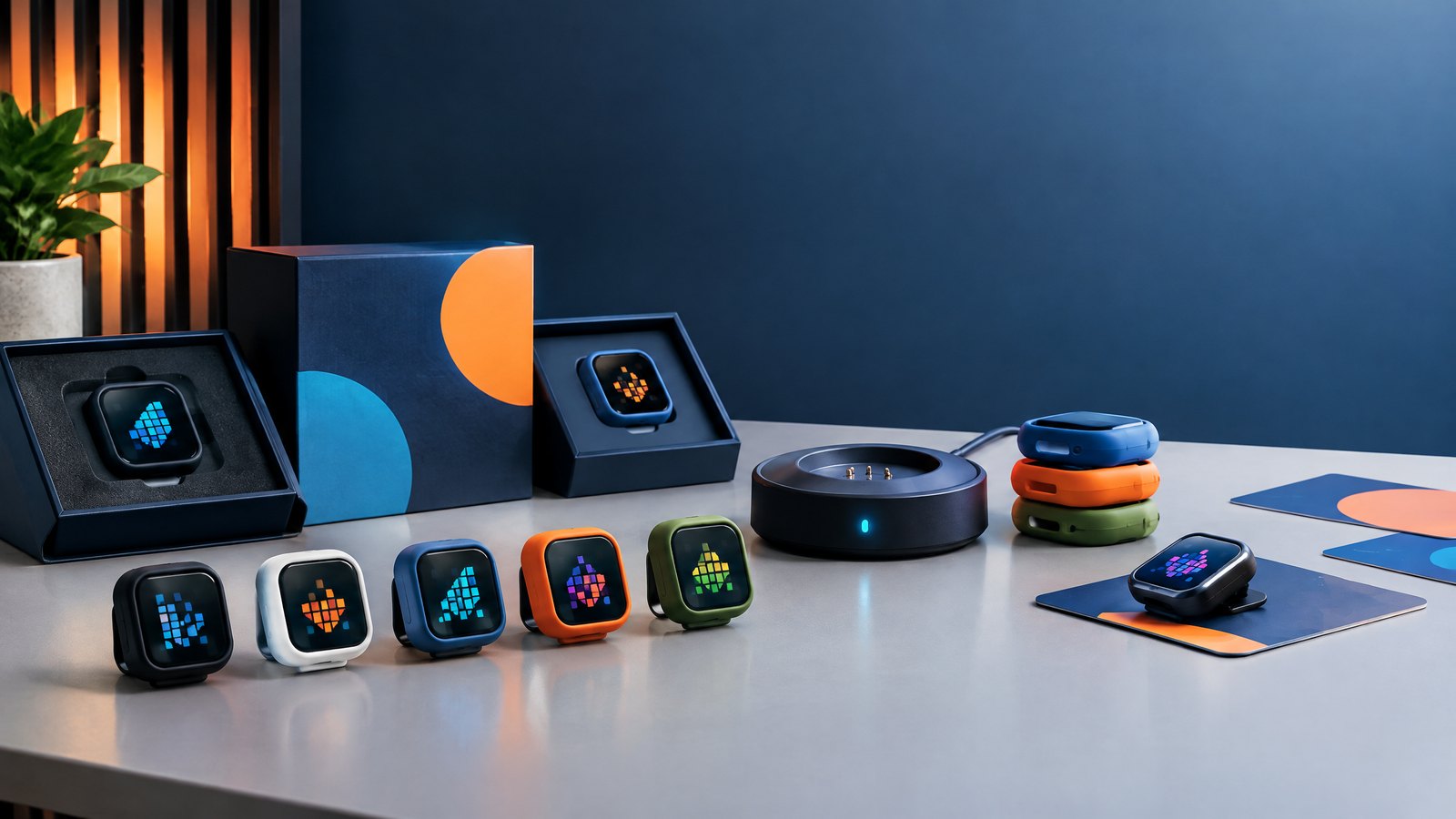
A smart badge may be a simple reusable name display, an interactive LCD pin, an NFC-enabled access or information point, or a Bluetooth-connected device. These are not interchangeable purchase descriptions. Each step up in interactivity can affect display behavior, energy use, firmware control, test evidence, privacy design, shipping preparation, support content, and total landed-cost risk.
The practical answer is to buy in stages. First, write a one-page product requirement document. Second, compare like-for-like options with a weighted decision framework. Third, evaluate a sample that matches the proposed materials, electronics, firmware, printed design, and pack-out. Fourth, freeze the approved “golden sample” and inspection checklist. Finally, release production only after labels, product claims, data handling, battery paperwork, and destination-market responsibilities are understood.
This sequence protects both parties. It prevents a buyer from assuming that an attractive prototype will be identical to the production model. It also gives the manufacturer a controlled brief rather than shifting requests. A lower feature set can often be the better commercial choice when it delivers the event or employee-identification outcome without creating an app, radio, or battery-management burden.
3. Who This Private-Label Guide Is For
This guide is for B2B buyers who want a branded electronic badge, interactive LCD pin, reusable name tag, event credential, employee identifier, visitor device, or promotion tool produced under their own label. It is useful for distributors, corporate-procurement teams, event-technology companies, uniform and promotional-product brands, retailers, training providers, and software companies that need a physical display accessory.
It is particularly relevant when the buyer will choose the artwork, user interface, retail package, model name, and sales channel. In the European Union, an organisation that has a product made and sells it under its own name or brand may be treated as the manufacturer for CE-marking purposes. That responsibility is about the entire product, including supplied components, not merely the printed logo.1 A buyer therefore should view private label as a product-ownership decision, not only a decoration service.
The guide also distinguishes three common roles. The brand owner defines the intended user, claims, branding, distribution channels, and post-sale plan. The manufacturer builds to the approved design and provides agreed records and production control. The importer or responsible economic operator may have market-access duties that cannot be outsourced simply by placing a logo on the packaging. The exact allocation depends on the contract, supply chain, product, and country. Obtain professional regulatory and customs advice for a proposed launch; this article is an operational procurement guide, not legal advice.
4. Buyer Decision Framework: Select the Lowest-Risk Feature Set That Delivers Value
Begin with a problem statement that can be checked. “A reusable employee badge that shows a name, role, and shift for one working day” is testable. “A premium smart badge” is not. Translate the problem into decisions about the display, update method, connection type, power source, attachment, enclosure, and user interface.
First, define the display job. State whether it shows a fixed image, changing text, icons, or several screens, and how content reaches it: buttons, computer utility, NFC, Bluetooth Low Energy (BLE), or a station. Specify ambient light, viewing distance, orientation, font size, language, refresh expectations, and duty cycle. Replace “long battery life” with an intended update pattern and acceptance measurement.
Second, challenge each connectivity request. QR can direct users to hosted content without adding a radio. NFC adds choices on tag type, write protection, identifiers, link governance, and reader compatibility. Bluetooth enables configuration but adds radio design, firmware, pairing, support, and possible personal-data flows. Bluetooth devices are intentional radiators in FCC examples and must follow the applicable authorisation procedure before US marketing, import, or use.6 In the EU, RED covers safety and health, electromagnetic compatibility, spectrum use, and certain privacy and personal-data aspects.2
Third, make battery and charging choices early. Choose a replaceable cell, sealed rechargeable cell, or no battery. For rechargeable designs, define the interface, cable or charger, indicator, storage state, low-battery behavior, and user access. Test the intended pack configuration. Lithium cells and batteries offered for transport must pass UN 38.3 design tests, with a test summary available on request under cited US transport guidance.7 Carrier requirements still vary by battery, configuration, route, and mode.
Fourth, design for attachment and abuse. Specify attachment, retention, sharp-edge and pinch-point expectations, sweat/splash/drop/abrasion exposure, and any lanyard or clothing interface. Describe use around children, food areas, healthcare, or controlled-access locations before selecting materials or making claims.
Fifth, evaluate data and content governance. A displayed name and a random identifier linked to an attendee record create different risks. Map each data element, storage location, recipient, retention period, update authority, and deletion action. The ICO advocates risk-based measures protecting confidentiality, integrity, and availability, with encryption or pseudonymisation where appropriate.10 Avoid personal or sensitive information on a display or readily copied identifier unless its purpose and controls are justified.
Finally, write a change-control rule. A new firmware build, radio module, antenna, battery cell, charging component, enclosure material, display, or model identifier can invalidate assumptions behind a sample, a test report, a declaration, or a qualification. Require written notification before substitution and re-evaluate the exact final configuration. A certificate image with no model match, version, scope, laboratory identity, or traceability is not a substitute for this review.
5. Comparison and Specification Table: Turn Features Into Quoteable Decisions
Use the table below as a conversation tool. It does not rank products universally. Instead, it shows where each option adds operational work. Ask every supplier to complete the same row set and identify any assumption that is not covered by the base quotation.
| Option | Best-fit private-label purpose | Buyer specification questions | Principal execution watch-outs |
|---|---|---|---|
| Reusable LCD name badge | Staff names, role labels, temporary on-site identification | Screen size and active area; viewing angle; display colour/contrast; update method; refresh cycle; button behavior; attachment | Confirm readable content in actual lighting, device orientation, display persistence, and consistent pixel behavior across the sample set. |
| Interactive LCD pin | Branded campaigns, venues, training, collectible or message-led experiences | Case dimensions; front artwork; animation or page behavior; controls; attachment; battery policy | Define what “interactive” means, including user action, response time, accidental activation, charge state, and support instructions. |
| QR-enabled badge | Link to schedules, catalogues, landing pages, or check-in journeys | QR size, contrast, placement, URL ownership, content fallback, analytics boundary | Test scans on real smartphones and printed/displayed final artwork. Maintain the destination URL and plan for an expired campaign. |
| NFC-enabled badge | Tap-to-open content, identity journeys, or controlled write workflows | Tag type, memory use, read/write permissions, UID use, phone compatibility, link security | State whether the tag is read-only after production. Do not treat a tag identifier as secure identity without a system-level assessment. |
| Bluetooth-connected badge | App-based configuration or dynamic experiences | Radio module, antenna location, pairing, app versions, permissions, firmware update method, support path | Radio rules and Bluetooth qualification can apply. Confirm the marketed model, design, and Bluetooth branding treatment before launch.6 9 |
Mid-article CTA: Request a Controlled Private-Label Brief
Planning a smart badge programme? Send the use case, target countries, estimated programme stage, preferred display and connectivity, artwork status, packaging needs, and target launch date to info@lcdwritingtablet.com. Ask for the proposal to be tied to your written specification and approval milestones.
Separate must-have requirements from nice-to-have concepts. A must-have is verifiable, such as “the on-screen name remains legible at the agreed distance under typical indoor lighting.” This prevents an unbounded development promise.
For branded packaging, specify the unit carton or sleeve, master-carton arrangement, accessory count, barcode location, insert, shipping mark, and languages. GS1 notes that UPC/EAN can encode the GTIN, enabling product identification in supply chains.11 Establish GTIN ownership and approve barcode artwork and scan test before production.
6. Buyer Checklist: What to Lock Before You Approve a Purchase Order
A purchase order should point to controlled documents, not recreate the product by email. Identify the configuration unambiguously, with a revision and date shared by the factory, inspector, freight partner, and internal team.
| Control area | What the buyer should approve or request | Why it matters |
|---|---|---|
| Product identity | Product name, buyer SKU, factory model, revision, colour, physical dimensions, attachment, accessory list | Prevents a visually similar but different unit from being treated as approved. |
| Technical configuration | Display specification, PCB/radio module if applicable, firmware version, antenna position, battery type/capacity, cable/charger details | Makes sample-to-production comparison possible and triggers change review. |
| Artwork and interface | Vector logo, colour references, screen layouts, font licences if relevant, button icons, language text, QR/NFC content | Reduces logo, translation, link, contrast, and scanning errors. |
| Claims and instructions | Approved product description, usage limits, charging and care instructions, warnings, age grading if relevant | Aligns sales copy with the intended design and destination-market review. |
| Compliance evidence plan | Target markets, requested report/declaration scope, exact model references, responsible-operator details, label placement, retention owner | A generic document may not cover a branded final product or intended market. |
| Battery and shipping pack | Battery test summary request, shipping configuration, inner protection, power state, carrier/forwarder review | Battery-powered devices require route- and configuration-specific logistics planning.7 |
| Packaging and traceability | Unit package, master carton, label data, origin marking review, carton marks, lot/date code rule, barcode proof | Supports receiving, retail execution, recalls or corrective action, and customs readiness. |
| Quality acceptance | Golden sample, cosmetic standard, functional test list, sampling plan, defect definitions, rework and disposition process | Gives the factory and inspector one shared basis for release decisions. |
| Commercial controls | Tooling ownership if any, MOQ, lead-time assumptions, payment stages, warranty terms, spare policy, change-notification obligation | Converts oral assumptions into a manageable programme record. |
For US import planning, country-of-origin marking is a concrete product and packaging review item. CBP says a foreign-origin article entering the United States generally must be legibly marked with the English country name unless an exception applies. Origin can depend on manufacturing facts and substantial transformation; have the importer or customs adviser validate the final approach.8
For EU sales, distinguish CE marking from a purchased “CE certificate.” CE applies only under applicable harmonised rules and after the prescribed assessment. The responsible manufacturer identifies requirements, prepares technical documentation, and signs the EU Declaration of Conformity; voluntary certificates alone are not recognised evidence.1 A wireless badge may need RED assessment. RoHS restricts ten named substances unless excluded, while WEEE concerns collection, treatment, and recycling systems.3 4
These points are not a jurisdiction-by-jurisdiction compliance determination. Responsible parties must evaluate the final product, claims, age group, battery, radio, sales route, and local implementation. GPSR, for example, requires an EU-established responsible economic operator for covered products and imposes product-information duties in distance sales.5
7. Sample, Testing, Factory, and Shipment Inspection Workflow
A good sample process produces a decision trail, not merely a request to “send one piece.” Request the configuration, open questions, required images, and a defined decision: approve, approve with corrections, revise, or stop. A prototype tests direction; a pre-production sample tests the intended configuration. Neither automatically proves independent compliance of the final SKU.
Step 1: Review the engineering and visual sample
Check enclosure fit, display, controls, attachment, charging port, edges, print, logo, and packaging. Test the actual user path: update, connect or tap, charge, power-cycle, reset, attach, scan, and follow instructions unaided. Record numbered deviations, firmware version, and test environment.
Step 2: Build the production control pack
Once accepted, create a golden sample or controlled visual standard labelled with buyer SKU, revision, date, and approval status. Pair it with limits for dimensions, cosmetic variation, screen acceptance, logo tolerance, functional tests, pack-out, and any transport check. Confirm the factory can test these points in production.
Step 3: Verify test and compliance evidence for the exact programme
Request documents early. Ask not “does the factory have a report?” but “what does this record cover?” Compare legal entity, factory, product name/model, electrical rating, radio/antenna, battery, accessories, relevant firmware, cited rules, date, and laboratory to the production specification. Escalate mismatches before relying on it.
If Bluetooth branding is planned, do not assume a component’s existence completes the brand owner’s work. Bluetooth SIG states that all Bluetooth products must complete the qualification process and that a supplier cannot complete it on a buyer’s behalf under the buyer’s membership account. The product name and model in qualification must match the name and model used in marketing, advertising, distribution, and sale.9 Treat this as a launch gate, not a post-launch document chase.
Step 4: Inspect before shipment against the approved reference
Pre-shipment inspection is risk control, not a certificate of perfection. It combines quantity, agreed random sampling, workmanship, functionality, packaging, and cartons. Give the inspector the golden sample, artwork proof, labels, and checklist. Require lot size, inspected quantity, findings, photographs, failed tests, rework status, and release recommendation.
| Gate | Minimum evidence to review | Decision if it fails |
|---|---|---|
| Design sample | Photos, functional notes, firmware/configuration note, artwork proof | Correct the brief or redesign; do not rely on verbal promises. |
| Pre-production sample | Proposed production materials, final labels, instructions, pack-out mock-up, approved changes | Freeze as golden sample only when all critical points are approved. |
| Document check | Model-linked reports/declarations as applicable, battery test-summary availability, supplier traceability | Investigate scope gaps before production or shipment; obtain specialist advice where required. |
| In-line check | Early output review, display and print consistency, assembly/attachment checks | Correct process before the full lot is completed. |
| Pre-shipment inspection | Quantity, workmanship, functionality, packaging, carton marks, random sample records | Rework, re-inspect, accept with agreed concession, or hold shipment. |
| Dispatch review | Final invoice, packing list, shipping instructions, battery/forwarder paperwork, final carton count | Release only when documents match the physical shipment and route. |
For rechargeable products, include transport readiness in the final gate. PHMSA treats lithium batteries as hazardous materials in US transport; requirements differ for batteries in equipment.7 The forwarder, carrier, and importer should confirm the consignment’s classification and documents. A test summary is not the entire transport plan.
8. Ordering and Implementation Preparation: Make Launch Work Before Arrival
After production approval, shift from making the badge to operating the programme. Assign owners for product data, channel files, app or portal release, content links, receiving, training, support, returns, and end-of-life handling. This prevents units arriving before content, instructions, or inventory records.
Start with master data: buyer SKU, factory model, GTIN where used, carton quantity, weights, origin-marking decision, battery description, dimensions, imagery, instruction version, and document location. Revise it through the same control as the physical product. It drives invoices, receiving, e-commerce, retailer data, support, and replenishment.
Next, prepare the digital experience. Validate QR URLs, landing pages, redirects, ownership, and the campaign-end message. For NFC, decide whether the tag is locked, who can write it, and whether authentication is needed. For Bluetooth, test launch-version app/operating-system compatibility, pairing, permissions, failed updates, unpairing, deletion, and recovery. Apply risk-based controls and clear notices for personal data.10
Then complete channel preparation. Retail units need an approved barcode, dimensions, images, descriptions, instructions, and carton labels; business programmes may need asset tags, enrolment templates, and dispatch lists. Test the barcode on the final substrate. UPC/EAN are widely used retail barcodes carrying the GTIN for product identification.11
Finally, prepare the after-sale plan for replacements, accessories, charging, content, batteries, and return triage. Decide whether returns are reset, refurbished, quarantined, recycled, or disposed of. EU programmes can involve national registration, collection, and reporting. WEEE promotes separate collection and treatment, while the Batteries Regulation also covers incorporated batteries.4 12 Confirm who fulfils market-specific duties.
9. Practical Applications: Match the Badge to the Operational Outcome
Corporate and site identification. A reusable LCD badge can show a name, role, shift, language, or visitor status. Prioritise legibility, attachment comfort, change speed, and handover; offline updates may be enough.
Events and conferences. A badge can pair visible identity with QR/NFC links to schedules, sponsors, profiles, or check-in. Prepare content ownership, on-site updates, privacy notices, charging, loss handling, and an offline fallback. Do not promise access control or identity verification without a tested system.
Retail, brand activation, and promotions. An interactive LCD pin can foreground a logo or campaign prompt. Prioritise visual consistency, packaging, barcode execution, handling durability, instructions, and ownership of a time-limited campaign link.
Training and education. A badge can display group labels, prompts, vocabulary, steps, or game progress. Define age group, attachment safety, language, updates, cleaning, and separation between device and learner records. Add connectivity only when it serves the workflow.
Hospitality and membership. A badge may show staff names, loyalty prompts, a QR menu route, or an NFC welcome. Focus on fast personalisation, repeated-shift durability, content control, and identifier policy. Minimise on-device data and protect linked systems.
10. Detailed FAQ
What should I send a smart electronic badges private label manufacturer for an accurate quotation?
Send intended use, target countries, quantity range, buyer SKU, reference image, display/content, connectivity, battery, attachment, artwork, packaging, barcode need, documents, and milestones. Mark unknowns as open. Ask the supplier to state exclusions, assumptions, and the quoted model revision.
Should I begin with a custom mould or an existing model?
Use an existing platform when speed and manageable risk matter more than exclusive design. Consider custom tooling only when the attachment, screen, enclosure, or user experience requires it. Before committing, establish ownership, design files, revision rights, maintenance, storage, approval, and exit terms. A custom shell does not remove final-configuration review.
Does a supplier test report automatically cover my private-label version?
No. It may be relevant evidence, but check its scope against the finished product. A model, component, antenna, firmware, battery, charger, enclosure, claim, or market change can matter. EU guidance makes private-label brand owners potentially responsible manufacturers, and CE depends on the applicable procedure and documentation—not a generic certificate image.1 Seek competent advice for the SKU and markets.
What changes when I add Bluetooth to an LCD badge?
Bluetooth changes RF design, pairing, firmware, application, security, support, and compliance review. FCC identifies Bluetooth devices as intentional radiators and requires appropriate authorisation before US marketing, import, or use.6 Bluetooth SIG requires qualification before sale/distribution, with a name/model matching the marketed product.9 Confirm obligations before radio-related claims.
Do QR and NFC badges need a privacy review?
They may. A static public QR link differs from a person-linked identifier or backend-tracked NFC tag. Map flows, minimise identifiers, set permissions, provide notices, manage links, and define deletion. Controls depend on processing risk; ICO guidance emphasises risk analysis and confidentiality, integrity, and availability.10
What battery documents should I ask for before booking freight?
Ask for battery identity/configuration, UN 38.3 test-summary availability, product battery information, package configuration, and forwarder-required documents. PHMSA says manufacturers must provide the test summary on request and devices containing batteries remain subject to applicable transport requirements.7 The forwarder must confirm route-specific rules.
How do I make a pre-shipment inspection useful?
Give the inspector lot information, golden sample, artwork, packaging proof, factory model, firmware note, thresholds, functional checklist, defect definitions, sampling basis, and carton marks. Require evidence of failures against agreed requirements, not an opinion that goods “look good.” Predefine concession and shipment-release authority.
What information should appear on the product or packaging for EU online sales?
It is product- and market-specific. GPSR requires an EU-established responsible economic operator for covered products and indicates where its details must appear. Distance-sale offers have visible information duties including manufacturer identity/contact details.5 Determine applicable rules, language, instructions, warnings, and labels for the final SKU and country.
Can LcdWritingTablet help without taking over my legal responsibilities?
A manufacturer can support a structured sourcing process by discussing the product brief, requested customisation, sampling sequence, packaging, and quality-control requirements. The private-label brand owner and relevant economic operators should retain ownership of market decisions, claims, final compliance review, import arrangements, and the data ecosystem. The most effective working relationship is transparent: provide the target-market plan early and ask for documents and samples tied to the exact configuration.
11. Conclusion: Use a Controlled Path From Idea to Market
The best way to source an interactive LCD pin or smart badge is to reduce ambiguity before production. Select the simplest feature set that fulfils the user outcome. Define physical, digital, battery, packaging, and content details in a revision-controlled brief; approve representative and golden samples; review model-specific documents; and inspect against objective criteria. Then prepare data, shipment records, content, support, and end-of-life responsibilities.
This process helps buyers ask better questions, compare proposals, and escalate gaps early. Confirm regulatory, customs, transport, privacy, and producer-responsibility duties for the exact product, channel, country, and responsible economic operator.
Ready to develop a controlled private-label badge brief? Email info@lcdwritingtablet.com with your intended application, target market, desired interaction method, artwork status, packaging requirements, and launch timing. Request a written proposal built around your approved specification, sample checkpoints, and inspection plan.
References
Turn this sourcing plan into a product brief.
Share your target market, product requirements, packaging preference and estimated volume for a practical OEM / ODM discussion.