
This guide provides a practical B2B decision framework. Final specifications, market obligations, testing scope, labels, packaging and shipment requirements must be confirmed for the exact finished SKU and destination.
Introduction
Direct answer: An LCD writing tablet after-sales plan should be prepared before the purchase order, not after complaints begin. Define which parts can be replaced, how customers diagnose common issues, how styluses and batteries are handled, which information the support team needs, and when a unit should be inspected, replaced, or escalated. Base the plan on the approved model, packaging, instructions, and market—not on a generic promise of warranty coverage.
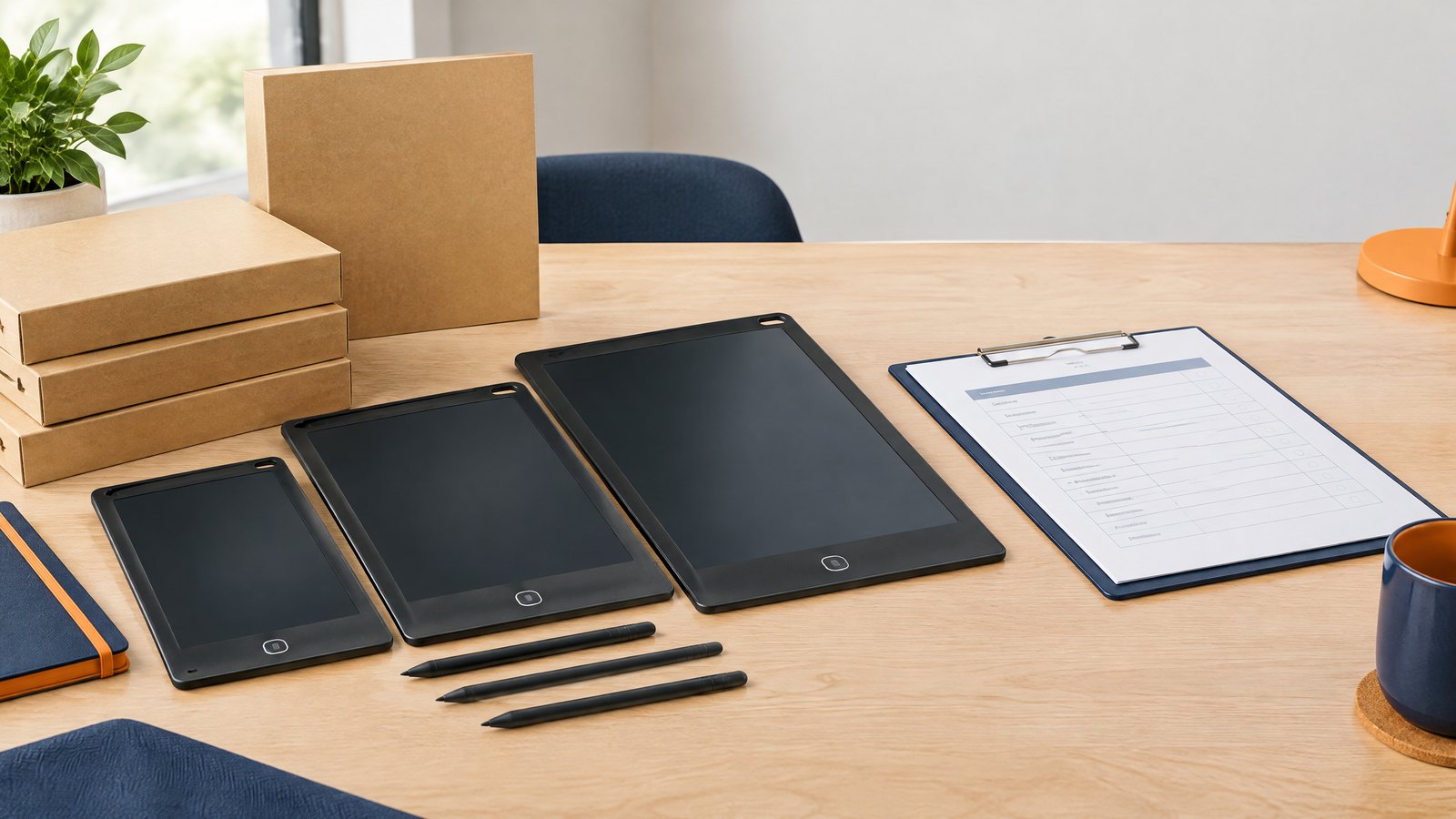
Basic LCD writing tablets can look simple, but the customer experience involves several components: the writing surface, erase button, lock switch, stylus, stylus holder, battery compartment or charging arrangement, insert, packaging, and product claim. A missing stylus is different from a weak mark under difficult lighting. A lock left on is different from an erase-function fault. Treating all complaints as one “defective tablet” category increases cost and makes product improvement harder.
For a brand owner, distributor, school supplier, or marketplace seller, after-sales planning is part of product design. It affects the instructions, spare-part quantity, warehouse process, customer-service script, reorder specification, and feedback shared with the factory.
1. Define the serviceable parts before launch
Direct answer: List every user-accessible or easily lost component and decide whether it is supplied as a spare, sold separately, replaced through support, or treated as non-serviceable. Put this decision into the product record and packaging plan.
Replacement stylus strategy
The LCD writing tablet replacement stylus is often the first spare part buyers should consider. Styluses can be misplaced in a classroom, separated from a gift set, or lost after marketplace delivery. Before production, decide:
- whether the stylus has a unique shape or uses a standard platform;
- whether it is retained by a slot, loop, magnet, tether, or storage case;
- whether a spare stylus is included in a bulk program;
- whether spare styluses have their own SKU and pack;
- whether a replacement stylus must match a specific model;
- how the product page and manual tell users to obtain help.
Do not promise universal stylus compatibility unless it has been tested with the exact writing surface. A substitute tip shape, material, or size may change the writing experience or scratch a surface. For school programs, matching the stylus to the tablet color or adding an asset mark can make collection and replacement easier.
Battery and charging support
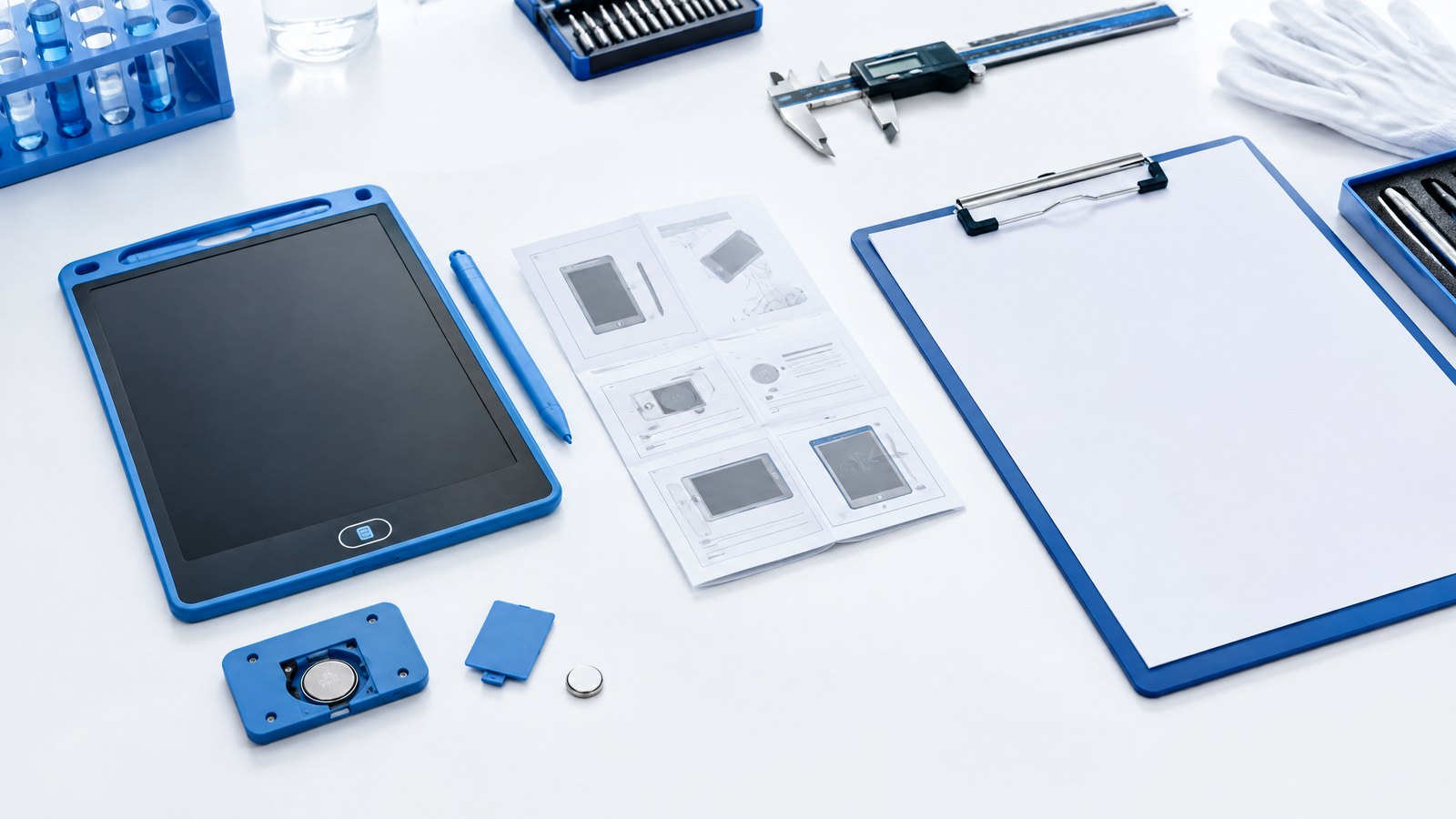
Some LCD writing tablets use a replaceable battery primarily for the erase function; others may use a rechargeable design. The support process should state the exact battery type or charging arrangement from the final SKU, who may perform replacement, and how the customer accesses the instructions.
For a product that uses a button or coin cell, battery access, packaging, warnings, and instructions can be safety-critical. The U.S. CPSC provides button cell and coin battery guidance for businesses. Requirements are configuration- and market-dependent, so review the final product with the relevant qualified partner rather than copying generic wording.
The support team should never suggest an unapproved battery type, bypass a battery cover, or instruct an end user to modify the product. If the battery is not intended to be user-replaceable, say so clearly in the manual and support workflow.
Accessories and packaging components
Depending on the model, spare or replaceable components may include tracing cards, storage pouch, screen protector, instruction leaflet, charging cable, activity insert, or retail sleeve. Each needs its own item description, revision control, and compatibility note. A replacement card set may be easy to replenish; a changed tablet dimension can make an old card set unusable.
2. Build a returns triage process around actual symptoms
Direct answer: Ask a short sequence of observable questions before classifying a return. This helps distinguish normal operation, setup error, damage, missing accessory, and potential functional fault.
| Customer symptom | First support check | Likely next action |
|---|---|---|
| Screen will not erase | Confirm lock position; ask customer to test erase after unlocking | Provide operating guidance or collect evidence for functional review |
| Writing appears faint | Check lighting, viewing angle, writing test, and model identification | Compare to approved product behavior; escalate unusual panel appearance |
| Stylus is missing | Confirm delivery pack and carton/parcel condition | Send compatible spare where policy allows; investigate fulfilment if needed |
| Tablet is cracked or marked | Ask for photos of product and packaging | Assess transit damage, handling damage, or potential packaging issue |
| Battery-related concern | Confirm the exact SKU and follow approved instructions | Provide safe, model-specific support or refer to qualified service process |
| Customer expects saving or app features | Check listing and instruction wording | Explain actual product function; correct misleading content if present |
Use plain questions that customers can answer. “Is the lock control set to the position shown in the manual?” is more useful than asking an untrained customer to diagnose the circuit. Request images or a short video only where your privacy policy and support process allow it.
3. Make the manual and product page part of support
Many avoidable contacts happen because the product page and instruction leaflet fail to explain the first-use routine. A clear quick-start should show:
- remove any screen-protection material if fitted;
- write using the provided stylus as instructed;
- check that erase lock is off before pressing erase;
- explain what erase does and does not do;
- identify battery or charging information for the exact model;
- show how to store the stylus;
- state the appropriate support contact.
Keep images and words consistent. If the retail box shows a lock switch on a specific side, the manual and product photos should show the same production-intent model. A revised housing or battery arrangement should trigger a documentation review.
For a more complete product-selection record, use the wholesale buyer guide. It helps connect user task, power choice, packaging, and market preparation before launch.
Mid-article CTA
Planning a private-label range or school program? Contact us with your model, market, user group, quantity, and spare-parts needs. We can help identify which accessories should be controlled in the sample and shipment plan.
4. Decide on stock, spares, and ownership
There is no universal spare-part percentage. The right amount depends on model complexity, order size, user environment, replenishment speed, and the commercial cost of a missing component. A school program with centrally managed assets may need a modest visible stock of compatible styluses. A marketplace seller may need a defined process for lost accessories and parcel-damage claims. A distributor may prefer to order spare parts under separate SKUs.
Questions to resolve with the supplier
- Can replacement styluses be ordered separately, and are they model-specific?
- What is the pack quantity, weight, and carton information for spare parts?
- Does a color or housing revision affect compatibility?
- Can activity cards or inserts be reprinted without changing the tablet?
- Are the battery and battery-cover components controlled by revision?
- What minimum quantity applies to a spare-part order?
- How are approved material or design changes communicated?
Record the answers in the product master and purchase documents. A spare part without a model identifier can become unusable after a small revision.
Service is not a substitute for inspection
An after-sales plan does not remove the need for factory testing and shipment inspection. The best result is to prevent predictable issues before delivery, then make genuine customer issues easier to diagnose. The pre-shipment quality-control guide gives a starting point for functional, packaging, and carton checks.
During factory testing, confirm stylus fit, erase function, lock operation, battery compartment or charging arrangement, accessories, instructions, and pack contents. During shipment inspection, verify that the production run still matches the approved reference. These checks create better evidence if a later issue is reported.
5. Use return data as product feedback
Direct answer: Log returns by symptom, model, production date or batch reference where available, channel, accessory status, and outcome. Review patterns with the factory rather than reacting to individual messages alone.
A simple return log can use these fields:
- order or channel reference;
- SKU, product revision, and pack revision;
- customer-reported symptom;
- photos/video received, where appropriate;
- triage result: usage question, missing part, transit issue, confirmed functional concern, or unknown;
- replacement, refund, repair, or guidance outcome;
- batch or shipment reference, where known;
- follow-up action for product, packaging, instruction, or listing.
Avoid drawing conclusions from a few reports. Look for repeated patterns: styluses missing from a particular packing process, lock instructions causing confusion, a screen-protection insert being overlooked, or damage linked to a carton configuration. Then agree a corrective action and verify it on the next sample or production run.
6. Write a credible warranty statement
Warranty terms depend on the seller, market, and business model. They should state what is covered, how the customer requests support, what evidence may be needed, whether accessories are included, and any lawful exclusions. Avoid a broad “lifetime guarantee” or “unbreakable” claim unless it can be meaningfully delivered and is appropriate for the market.
A credible statement can be short: “For support with your specific model, contact [support contact] with your order reference, product photos, and a description of the issue. We will review the product configuration and applicable service options.” The exact legal wording should be reviewed for your market and channel.
For B2B supply, decide how claims move through the chain: factory to importer, importer to distributor, distributor to retailer, and retailer to end customer. Written responsibilities prevent an end user from being redirected between parties without help.
7. After-sales FAQ
Can buyers order LCD writing tablet replacement styluses?
Often they can, but compatibility should be confirmed for the exact model. Ask the supplier for a spare-part SKU, pack quantity, and approval sample before listing a replacement stylus.
Why does an LCD writing tablet not erase?
First check whether the erase lock is engaged and follow the approved product instructions. If the issue continues on the exact model, collect the product identifier and evidence for a defined support review.
Can a customer replace the battery?
Only follow the instructions for the exact product. Battery access and replacement procedures differ by model and market, especially for products using button or coin cells.
What spare parts should a school program keep?
Start with compatible styluses and any planned activity cards or storage accessories. The quantity should reflect program size, storage method, and replenishment process rather than an arbitrary percentage.
How should a retailer handle a damaged LCD writing tablet?
Record the SKU, packaging condition, and visible damage; retain evidence according to its process; then determine whether the issue appears to be transit-related, handling-related, or a potential product concern. Do not make a technical claim without review.
Conclusion
After-sales readiness turns a basic reusable writing product into a manageable program. Define serviceable parts before launch, give users clear first-use instructions, create a simple triage path, control spare-part compatibility, and feed recurring patterns back into packaging, factory testing, and future sample approval.
For B2B buyers, the goal is not to promise that no issue will occur. It is to make the real product easier to understand, easier to support, and easier to improve responsibly.
Final CTA
Send your service and spare-parts requirements for an LCD writing tablet program. Include the model, market, intended user, expected quantity, packaging type, and any need for spare styluses, cards, or other accessories.
Turn this sourcing plan into a product brief.
Share your target market, product requirements, packaging preference and estimated volume for a practical OEM / ODM discussion.