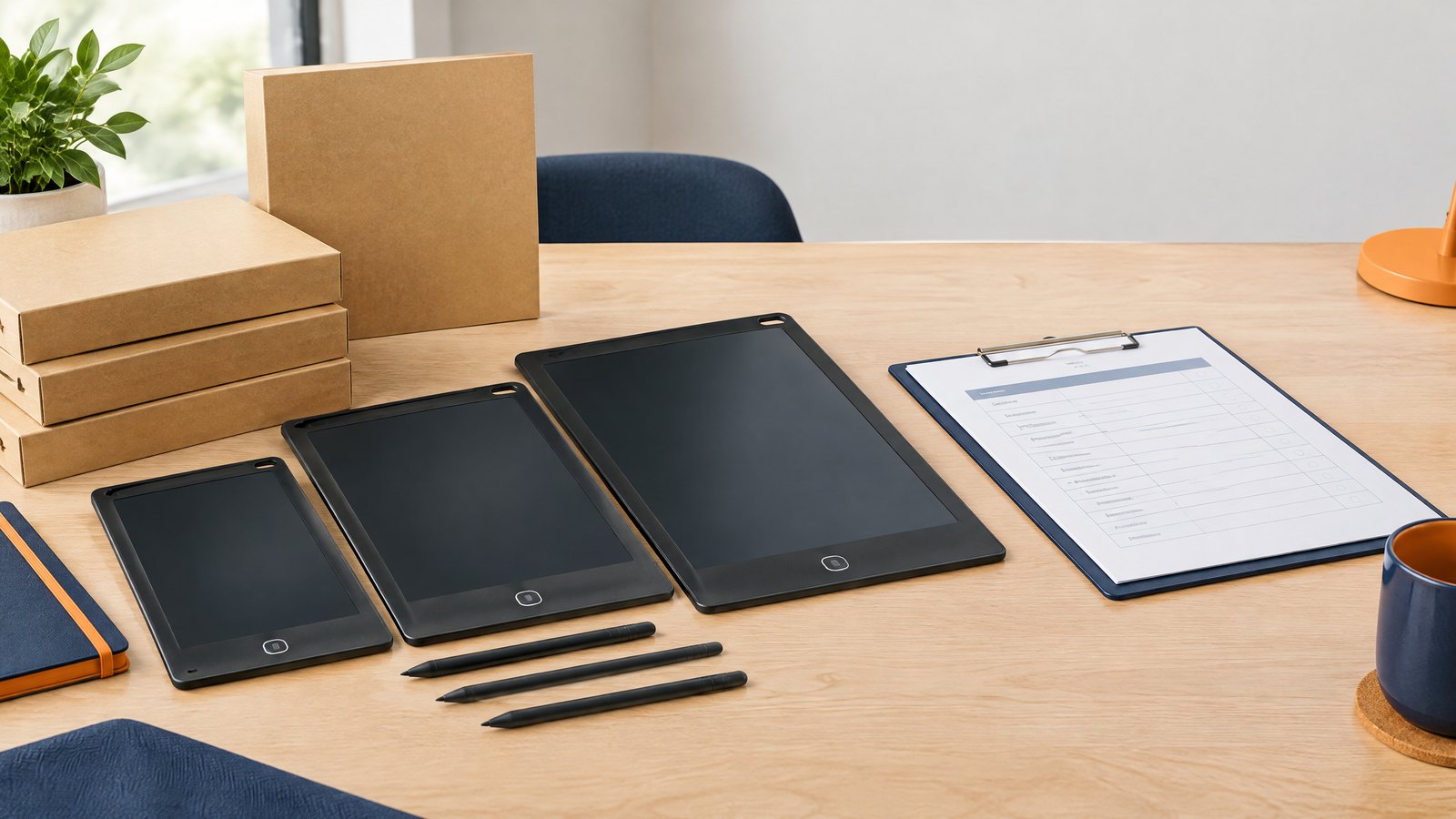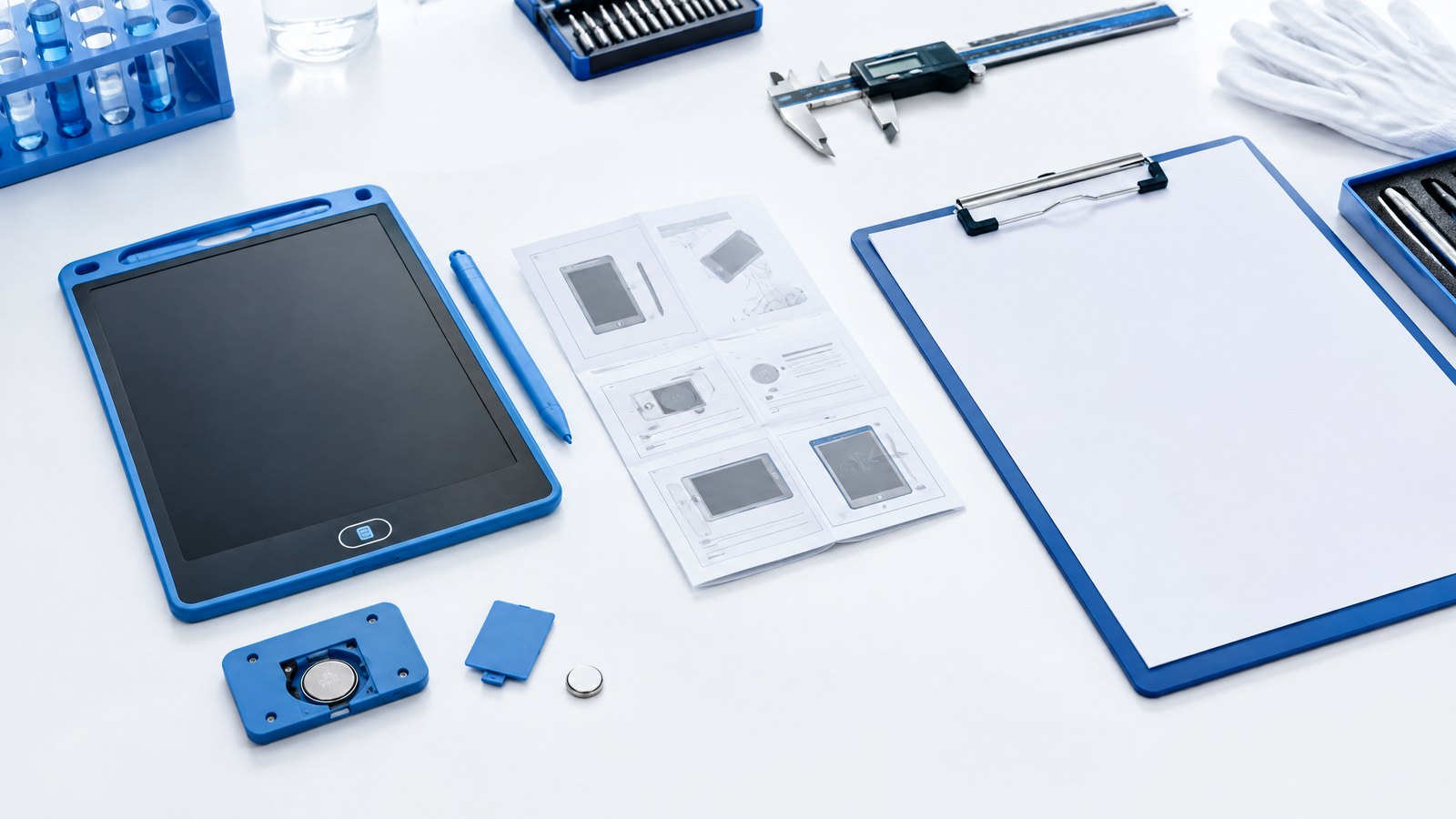
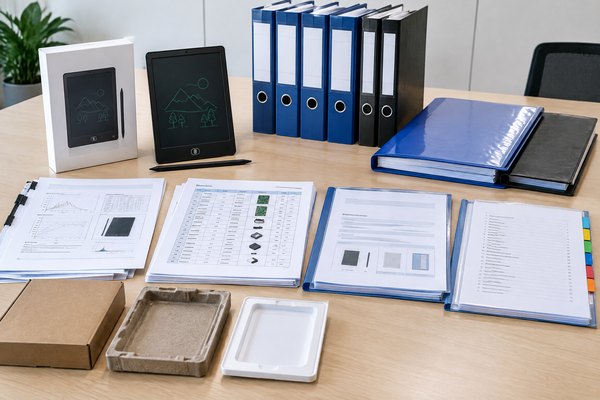
This guide provides a practical B2B decision framework. Final specifications, market obligations, testing scope, labels, packaging and shipment requirements must be confirmed for the exact finished SKU and destination.
2. Direct Answer: What Should a Buyer Request First?
An LCD writing tablet compliance document package should be a controlled evidence system for one defined product configuration, not a folder of generic certificates. Request a technical-file index first. It should identify the tablet model and revision, intended user, sales markets, applicable-rule decisions, document owner, and status. The index links drawings, the bill of materials (BOM), risk assessment, reports, declarations, labels, instructions, and change records.
The key procurement question is not “Does the factory have a certificate?” It is “Can each document be tied to the exact tablet we will place on the market?” A visually similar product report is weak if its LCD module, housing, power system, label, claim, or pack differs. New private-label artwork or a destination market can also make a generic file incomplete.
EU guidance says technical documentation is prepared before market placement, demonstrates design, manufacture, and operation compliance, and is normally retained for 10 years. It should include product identification, risk assessment, applicable rules and standards, critical components/materials, labels, and user instructions.1 For electrical and electronic equipment (EEE), RoHS requires technical documentation, the applicable conformity procedure, an EU declaration of conformity after compliance is demonstrated, and 10-year retention of the technical documentation and declaration.3
For the United States, the route depends on the finished product and claims. A children’s product subject to a CPSC rule may need a Children’s Product Certificate (CPC) based on testing by a CPSC-accepted third-party laboratory when applicable. A covered general-use product may need a General Certificate of Conformity (GCC), based on testing or a reasonable testing program.6 7 A reusable tablet is not automatically a toy or a children’s product merely because children may encounter it. Confirm intended use, design, age position, marketing, and applicable rules for the actual version.
Assumptions and limits: This guide addresses conventional, low-voltage LCD writing tablets with a replaceable cell or internal battery, sold under a buyer’s or brand owner’s name. It is a procurement guide, not legal advice, a laboratory report, certification, or a finding that any model complies. Product features, market rules, standards, language requirements, and legal responsibilities must be confirmed for the saleable configuration.
Early checkpoint: Before sampling, provide the supplier with markets, sales channels, age position, product claims, power configuration, accessory list, language set, buyer legal entity, and brand name. For an LcdWritingTablet OEM/ODM documentation-request template, email info@lcdwritingtablet.com. Email is the sole contact channel for this inquiry.
3. Who This Guide Is For
This guide is for the people who must turn an ODM tablet into a defensible branded product. Brand owners and importers need to know which records they will issue, retain, and show to authorities or retail customers. In the EU, a party that has a product made and sells it under its own name or brand is considered the manufacturer for declaration-of-conformity responsibility, even when manufacturing is outsourced.2
Sourcing teams can use the package to compare evidence quality alongside price. The useful comparison is whether a supplier can identify the exact report sample, source parts, controlled artwork, factory process, and report scope—not whether a quotation says “certificates available.” Product managers and designers need the file before the enclosure, display, battery/charging arrangement, stylus, and packaging are fixed.
Quality, regulatory, marketplace, distributor, and retailer teams need a handoff that remains usable after launch. The approved configuration, reports, declarations, marks, instructions, and release history should be easy to locate. A connected, rechargeable, or play-positioned version may need a different assessment from a basic note tablet.
4. Buyer Decision Framework
Use these seven decisions before approving samples, artwork, or production. They distinguish possible legal duties from prudent buyer controls.
Decision 1: Freeze product identity and the market boundary
Assign one controlled identity to each saleable configuration: brand, model/type, hardware revision, artwork revision, power system, accessories, pack configuration, intended use, age position, markets, and manufacturing site. Use a code such as LWT-08-BR-REV-C, not “8.5-inch tablet, new logo.” Carry that code through the index, BOM, drawings, samples, reports, label proofs, and purchase order.
EU documentation needs product identification and description. RoHS also requires an EEE type, batch, serial number, or other identification element, with alternatives where direct marking is impracticable.1 3 U.S. CPC/GCC rules require a description detailed enough to match only the covered product.6 7 Keep a one-page identity sheet with product/label photographs and accessories.
Decision 2: Make an applicability matrix before ordering tests
List markets and product functions across the top of a matrix. Down the side, list potentially relevant laws, standards, marking, language, certificate, and responsible-party outputs. Mark each as applicable, not applicable with rationale, or pending confirmation. The matrix records the decision; it is not a universal test list.
An EU non-connected EEE tablet can raise RoHS, WEEE, general product safety, traceability, and other questions. WEEE marking normally uses the crossed-out wheeled-bin symbol, producer identification mark, and a bar or date indication, normally on the product unless impracticable.5 A connected version adds a radio-equipment question. A plaything for children under 14 raises a U.S. toy-safety question; CPSC says ASTM F963 is mandatory under the applicable framework.8
Name the decision owner for each line: buyer compliance lead, importer, laboratory, EU responsible person, or factory. A sales quotation should not resolve classification by ticking “CE” or “CPSIA.”
Decision 3: Build a technical-file index, not a document pile
The technical-file index is the package’s control point. It makes missing evidence visible and maps each item to one configuration. EU guidance expressly identifies risk assessment, applicable rules and standards, critical components/materials, labels, and instructions as documentation elements.1
| Index section | Minimum controlled content | Legal duty or buyer control? | Review question |
|---|---|---|---|
| Product identity | Configuration sheet, model/revision, photos, market list | Identification may be required; photo sheet is best practice | Do all files identify the same saleable version? |
| Applicability and risk | Rules matrix, risk analysis, standards map, open issues | Risk documentation may be required; matrix is best practice | Which hazards and rules were assessed? |
| Design definition | Drawings, specifications, firmware version if any, master-sample record | Best practice supporting technical documentation | Can a reviewer identify what was tested? |
| BOM and materials | Released BOM, material/component specifications, supplier evidence | Critical components/materials may be necessary; control method is best practice | Do report samples match released parts? |
| Test evidence | Full reports, sample photos, method/version, results, laboratory details | Depends on applicable rule | Does the report cover this configuration and scope? |
| Declarations/certificates | EU DoC, CPC/GCC if applicable, component declarations | Depends on market/product | Who signs and maintains each item? |
| Labels/instructions | Product/pack/carton artwork, marks map, manuals, translations | Market-specific; controlled artwork is best practice | Do all information channels match? |
| Production/change | Inspection plan, lot traceability, approvals, nonconformities, revision log | Series conformity may be required; detailed controls are best practice | Can shipment be linked to approved design? |
Decision 4: Keep reports, declarations, and certificates separate
A test report records what the laboratory tested under a stated method and sample condition. It does not itself make a legal declaration for the finished product. An EU declaration of conformity (DoC) is the responsible manufacturer’s legal statement. EU guidance says it follows the conformity work and supporting technical documentation, and identifies the manufacturer, product, applicable legislation/standards or other means, and authorized signatory.2
A certificate is an ambiguous word. It can mean a buyer-requested material certificate, a third-party certification document, a CPC, a GCC, or a factory statement. Clarify which it is. CPSC specifies seven core elements for CPCs and GCCs: product identification, rules cited, certifier, test-record contact, manufacture date/place, test date/place, and laboratory information.6 7 An ODM may provide evidence, but it should not be assumed to take the buyer/importer’s legal certification role.
Decision 5: Test the configuration, not a family resemblance
Request the full report, not a conclusion-page screenshot. Check laboratory identity, applicant, report number/date, model identifiers, sample description and photos, test method/version, deviations, results, conclusion, and authorization. ISO explains that ISO/IEC 17025 enables laboratories to demonstrate competent operation and valid results. That is a useful confidence indicator, but buyers should still confirm that the relevant method is within accredited scope when accreditation matters to the program.9
Flag differences from the released configuration: LCD panel/film, enclosure resin or colorant, battery/cell/holder, PCB, cable/charger, radio module, magnets, fasteners, stylus, lanyard, age claim, packaging, or warnings. Component reports can support a risk-based file but do not automatically prove the complete tablet. Record a technical rationale whenever evidence is extended to a variant.
Decision 6: Control labels and instructions like engineering outputs
Create a markings map showing every required or planned item, location, language, artwork revision, and approval owner. Cover the tablet, retail pack, shipping carton, manual/safety insert, and online listing where relevant. Unless an exception applies, CBP says every foreign article entering the United States must bear the English name of its country of origin, legibly; the marking should be conspicuous and as permanent as the article permits.10
Do not use a generic “CE certificate” graphic as product evidence. Do not add WEEE, recycling, “non-toxic,” “eco-friendly,” age, or safety claims because a similar listing makes them. The FTC says product and packaging environmental claims need competent and reliable scientific evidence.11 Keep the exact claim and substantiation reference in the file.
Instructions should identify the product, intended use, relevant warnings, battery/charging steps where applicable, cleaning/storage directions, disposal information where relevant, and necessary market contact details. Translate from an approved master, then revision-control each translation.
Decision 7: Assign ownership, retention, and change authority
Name the owner of each document. The brand owner/importer normally owns the market-facing product definition, claims, artwork approval, launch decision, and any declaration/certificate it must issue. The OEM/ODM manufacturer owns controlled factory records, process evidence, supplier controls, and prompt disclosure of proposed changes. The laboratory owns its report; component suppliers own underlying declarations subject to disclosure terms. Contractually define access, confidentiality, retention, updates, and response time for retailer or authority requests.
This is not just administration. RoHS requires procedures for series production to remain in conformity and for design changes and relevant standards/specification changes to be addressed.3 ISO guidance treats specifications, test instructions, approved supplier lists, inspection plans, change records, and product-release authorization as documented information requiring control.12 Use a no-substitution rule: no material, safety, function, marking, supplier, or process change without written buyer approval and a documented compliance-impact assessment.
5. Comparison, Cost, Quality, and Specification Table
Package cost and lead time are driven by product complexity, variant count, target markets, laboratory work, translation, and the quality of existing engineering records. These are directional comparisons, not quotations or universal legal requirements.
| Package approach | Typical contents | Directional cost/lead-time effect | Evidence risk | Procurement decision |
|---|---|---|---|---|
| Uncontrolled folder | Generic reports, marketing certificates, logo sheet | Lowest apparent initial cost | Very high: unclear models, scope, owner, or revision history | Do not use as launch evidence |
| Basic market file | Product identity, selected reports, label proof, required declaration/certificate where confirmed | Moderate | Medium if variants/changes are loosely managed | Possible for one stable configuration |
| Controlled technical package | Index, risk/applicability matrix, full reports, BOM/drawings, labels/instructions, production records, change log | Higher planning effort | Lower if production remains matched | Recommended baseline for branded repeats |
| Multi-market program | Controlled package plus translations, variant map, responsible-party data, retailer pack, periodic review | Highest coordination effort | Lower only with market/variant traceability | Suitable for multi-country launch |
| Buyer specification item | Freeze or request | Index evidence | Reason |
|---|---|---|---|
| Tablet identity | Model, hardware revision, display, erase function | Identity sheet, drawings, sample record | Stops look-alike report reuse |
| Power system | Cell/battery type, holder/charger/cable, installed status | BOM, drawings, component evidence, instructions | Links safety, information, and transport work |
| Construction | Resins, colorants, LCD film, stylus, magnets/fasteners | BOM, part numbers, material evidence, reports | Makes component evidence traceable |
| Claims | Age, reusable-writing, educational, environmental, connected features | Approved claims list and artwork/listing proofs | Prevents claims exceeding evidence |
| Production release | Approved sources, checks, lot coding, change notification | Control plan, QC records, release record | Links a test sample to a shipment |
6. Product and Technical Detail: What Does the File Need to Describe?
The documentation boundary is broader than the screen. Describe the tablet’s overall dimensions and weight, display construction, enclosure and resin, stylus and retention feature, erase control, power source, battery-access or charging arrangement, ports/wireless functions, accessories, packaging, and intended user. If firmware changes the product’s functions or safety-relevant behavior, identify its version and release owner.
Make the BOM the evidence spine
The released BOM should be a revision-controlled table, not a purchasing worksheet copied at the end. For each safety- or compliance-relevant component, record manufacturer, part number, specification, revision, approved-source status, and evidence link. Typical items include LCD module, housing resin/masterbatch, cell or rechargeable pack, holder, PCB, magnets if present, stylus, lanyard, fasteners, labels, adhesive, cable/charger, and retail package materials.
The BOM need not reveal pricing to every reviewer. It must prove that samples and production use the declared construction. A change in resin grade, cell supplier, LCD module, or fastener may affect risk analysis, report scope, instructions, labels, and declarations. Record the impact decision and revise or test where justified.
Link risk analysis to evidence
Risk analysis should name foreseeable hazards and controls: battery access, detachable parts, edges, breakage, electrical/charging and material risks, magnets where present, and use by the stated user. GPSR calls for internal risk analysis and technical documentation before market placement, including risks, controls, test outcomes, and relevant standards or other elements where appropriate.4
For each hazard, show the design control, assessment/test, sample reference, production check, residual risk, and owner.
Make labeling part of the product definition
Product labels may carry type/batch identification, brand, origin, regulatory marks, electrical ratings, responsible-party information, and warnings. The exact content depends on the product and market. For EU EEE, RoHS requires product identification and manufacturer contact details on the EEE or, where not possible, on packaging or accompanying documentation.3 For EU market placement under the GPSR, an EU-established responsible economic operator’s name/trade name and postal and electronic contact details must be indicated on the product, packaging, parcel, or accompanying document.4
Keep a label master: dieline, clear zone, material/adhesive where relevant, location photo, language version, and artwork revision. It prevents a correct technical file from being paired with obsolete printed art.
7. Sample, Testing, Factory, and Quality-Control Workflow
A defensible workflow connects concept, laboratory sample, and shipment. It does not assume they are the same product.
Step 1: Open the file at concept freeze
Create the index and applicability matrix once the brief identifies markets and core functions. Record open questions with owner and due date. Freeze intended user, product claims, power architecture, accessories, and countries before obtaining a laboratory scope.
Step 2: Approve an engineering sample against controlled inputs
Build from a preliminary BOM and drawings. Photograph the configuration and list temporary parts or deviations. Review operation, closure, display/stylus fit, battery/charging area, label space, pack fit, and instructions. “Sample approved” must say what remains unvalidated; it is not a compliance release.
Step 3: Submit traceable samples and review full reports
Give the laboratory markets, classification assumption, age position, model/revision, photos, accessories, power system, label/manual art, desired rules/standards, and variant list. Ask it to identify gaps rather than test an assumed configuration. For U.S. children’s products within the applicable rules, CPSC says the CPC and supporting reports must be in English and CPC testing is from a CPSC-accepted third-party laboratory when applicable.6
Keep dispatch records. Compare report photos and description to the approved specification before accepting the result.
Step 4: Translate design controls into factory controls
Release the BOM, approved supplier list, work instructions, artwork, in-process checks, finished-product criteria, and lot traceability. Factory QC can show that a lot follows the approved configuration. It cannot decide classification, replace a required external assessment, or extend an old report to a changed product. A laboratory report likewise cannot police production substitutions. The BOM/revision code is where those evidence streams meet.
Step 5: Maintain a change and incident loop
Use a controlled request for substitutions, tooling changes, supplier changes, firmware updates, new markets, claims, artwork, packaging, nonconformities, and complaints. List affected documents, the evaluation, actions, approver, and effective lot. Retain corrective-action records. They may show that a risk control assumed at design stage is not effective in production.
8. Ordering and Implementation Preparation
Attach a document schedule to the RFQ, sample agreement, and purchase order. “Send all compliance documents at shipment” is too late and too vague. Specify document name, configuration code, language, delivery stage, format, reviewer, and ownership/access terms.
Before tooling or purchase-order release, confirm:
- Scope and responsibility: markets, intended user, claims, classification questions, economic-operator roles, and declaration/certificate owner.
- Configuration baseline: drawings, BOM, material/source references, master-sample record, product photos, and artwork revision.
- Evidence plan: assessments, laboratory scope/samples, required reports, component evidence, and certificate/declaration schedule.
- Information controls: product/pack/carton/manual/listing artwork, languages, origin/traceability coding, and responsible-party details.
- Production and change terms: inspection plan, retention, no-substitution rule, notification timing, record access, and corrective-action process.
For EU sales, establish who maintains the current technical documentation and DoC and can provide them on request. Electronic storage is acceptable when accessible, well organized, and available.1 GPSR technical documentation must be kept current and available to market-surveillance authorities for 10 years after placement on the market.4 Set a secure repository, backup, and accountable archive owner.
For U.S. sales, establish the domestic manufacturer/importer responsible for any CPC or GCC and supporting record. Confirm entry and certificate-data operations with the importer/broker for the actual product and import date; CPSC states eFiling requirements apply to most regulated consumer products from 8 July 2026.6
9. Practical Applications and Scenarios
Scenario A: EU private-label, non-connected note tablet
The buyer prepares identity, risk/applicability, RoHS/WEEE/GPSR evidence, BOM/material records, labels/instructions, reports, DoC, and retention ownership. A generic ODM CE PDF is not sufficient evidence for the buyer’s brand/configuration.
Scenario B: U.S. children’s drawing-play product
The brand uses play-focused graphics and a child age position. First, assess the toy/children’s-product route. CPSC defines a toy as an object designed, manufactured, or marketed as a plaything for children under 14; testing/CPC requirements apply to products designed or intended primarily for children 12 or younger.8 The file needs marketing/age evidence, the applicable test plan/report, CPC where required, traceability/label plan, and full change control.
Scenario C: U.S. household or office message tablet
The team identifies applicable CPSC rules and whether a GCC is required; it does not use a CPC as a marketing badge unless applicable. It controls origin marking using the actual origin determination, not another SKU.7 10
Scenario D: Same housing, rechargeable version
Adding USB charging and an internal battery is not cosmetic. It may change electrical, battery-transport, information, and regulatory questions. Open a new configuration code and impact assessment. Reuse evidence only after a documented technical comparison supports it.
10. FAQ
1. Is a factory’s CE certificate enough for our private-label LCD writing tablet?
No. The CE mark is not established by a generic supplier certificate. A party selling a product made for it under its own brand can be the manufacturer for EU declaration responsibility and needs supporting documentation for the exact product.2
2. What is the difference between a test report and a declaration of conformity?
A test report records sample, method, results, and scope. A declaration is the responsible manufacturer’s legal statement of applicable compliance. A report may support a declaration, but neither automatically replaces the other.1 2
3. Can one report cover several models?
Only where the laboratory, responsible compliance party, and a technical comparison justify the variant scope. Compare display, enclosure, power system, materials, accessories, labels, claims, and age position. Record the rationale rather than inferring coverage from appearance.
4. Who issues a U.S. CPC or GCC?
CPSC places relevant certification duties on domestic manufacturers/importers. The CPC is based on CPSC-accepted third-party laboratory testing when applicable; the GCC is based on testing or a reasonable testing program.6 7 An OEM can provide support records but should not be assumed to take the buyer/importer’s role.
5. Is a BOM part of compliance documentation?
A controlled BOM is the practical link among design, component evidence, reports, and production. It makes substitutions visible. It may be best practice as a document format, but EU guidance expressly points to critical components/materials affecting compliance evidence.1
6. What changes should trigger a review?
Review battery/charger, LCD/PCB, resin/colorant, stylus/magnets, dimensions/tooling, suppliers, firmware, labels/manuals/claims, packaging, age position, language/market, test-standard updates, nonconformities, and safety complaints. The review can determine no retest is needed, but retain the rationale.
7. Do WEEE and origin marks belong on the product?
It depends on the rule and feasibility. EU WEEE guidance normally places its permanent, visible, readable mark on the product, with limited alternatives where size/function prevents it.5 CBP requires legible, conspicuous origin marking as permanent as the article permits, subject to exceptions.10
8. Does ISO/IEC 17025 accreditation make every report acceptable?
No. It indicates a laboratory competence framework and promotes confidence in valid results.9 Buyers must still check method/scope, sample identity, report completeness, configuration match, and any program-specific laboratory requirement.
11. Conclusion: Buy an Evidence System, Not a Certificate Folder
The right LCD writing tablet compliance document package is indexed, configuration-specific, market-aware, and change-controlled. It begins with identity and applicability decisions, then connects risk analysis, technical description, BOM, test evidence, declarations/certificates, marks, instructions, production records, and retention to one released product version.
Keep legal requirements and buyer controls distinct, but map both in the same file. A declaration is not replaced by a report. A laboratory report does not control production substitutions. Factory QC does not decide classification. And product claims should not be printed without controlled support. Clear ownership and revision control make the package useful at launch and reorder.
For an LcdWritingTablet OEM/ODM project, send the product configuration, target markets, intended positioning, power system, language needs, and document deadline before sample approval. To request a configuration-specific document checklist and handoff plan, email info@lcdwritingtablet.com. Email is the sole contact channel for this inquiry.
References
Turn this sourcing plan into a product brief.
Share your target market, product requirements, packaging preference and estimated volume for a practical OEM / ODM discussion.