
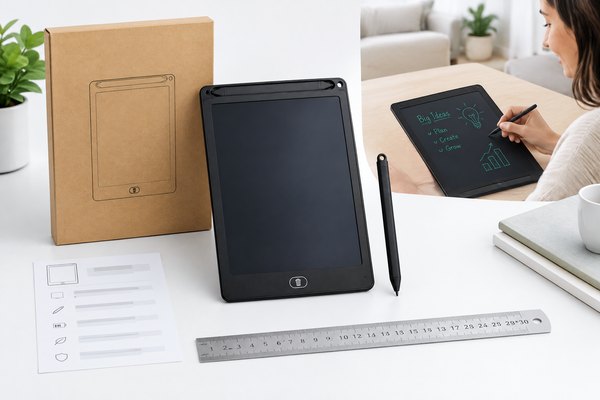
This guide provides a practical B2B decision framework. Final specifications, market obligations, testing scope, labels, packaging and shipment requirements must be confirmed for the exact finished SKU and destination.
2. Direct-Answer Introduction
A credible LCD writing tablet ecommerce listing is a controlled product record, not a collection of attractive selling points. It lets a buyer see the exact tablet, understand what is included, compare the physical dimensions with their intended use, and make a sensible decision about age suitability, battery handling, and everyday limitations before ordering. The listing must agree with the approved sample, purchase order, packaging artwork, instruction sheet, and shipment inspection standard.
For an LCD writing tablet, credibility is won in small details. A hero image should show the actual selling configuration. A dimension graphic should distinguish the visible writing area from the overall product size. A claim such as “one-touch erase” should be supported by a sample check of the button, while a claim such as “stores drawings” must not appear unless the exact model has a verified storage function. The same discipline applies to a stylus, a lock switch, a magnet, a lanyard hole, a replaceable or rechargeable battery, and every item in the retail box.
This guide is for commercial teams preparing a listing from an OEM/ODM sample. It is not legal advice or a substitute for country-specific product assessment. In the United States, objective advertising claims need a reasonable basis before they are disseminated; the basis must also cover reasonable implied meanings, not merely the literal words used 1. Where a tablet is marketed as a children’s toy or includes a button/coin cell, product classification and safety obligations can change. Build the listing only after the intended market, product variant, and target age have been confirmed.
A useful launch rule is simple: if the buyer cannot verify a statement from the sample, approved documents, or controlled test record, do not publish it. For help converting a confirmed sample and specification sheet into listing assets, email info@lcdwritingtablet.com.
3. Who This Guide Is For
This guide is written for brand owners, importers, distributors, marketplace operators, and procurement teams that will sell an LCD writing tablet under their own brand. It also helps an e-commerce manager who needs to align a factory, creative studio, compliance adviser, and fulfilment team before a product page goes live. The working assumption is a non-connected electronic writing board with a pressure-responsive display, stylus, erase control, and battery-powered electronic function. That is an assumption for planning, not a universal specification; the final listing must reflect the specific model supplied.
The guide is especially relevant when a buyer is launching multiple colour, size, or bundle variants. Variation creates a common credibility failure: an image of one size or package appears on the page for another. Establish a variant matrix first. Give each sellable configuration its own internal SKU, factory model reference, overall dimensions, display-area dimensions, unit weight, battery configuration, colour, package contents, and artwork revision. Only then decide whether variants can share text, images, or a parent listing.
It is less relevant to a general sourcing decision. It does not rank screen sizes, compare rechargeable and coin-cell products as purchase options, or describe private-label packaging development in general. Its subject is narrower: how a confirmed tablet becomes an accurate and marketplace-ready product page without creating expectations that the delivered unit cannot meet.
4. Buyer Decision Framework
Start with the buyer’s evidence chain
Before briefing photography or copywriting, nominate one person to own the source-of-truth sheet. This controlled sheet should identify the approved pre-production or production-equivalent sample, the hardware and firmware revision where applicable, the draft listing SKU, and the documents from which each public statement comes. It prevents creative teams from taking a claim from an old catalogue, a similar model, or an unapproved sample.
Use a four-part evidence chain for every material statement:
- Physical evidence is a dated inspection of the approved sample. It supports visible features such as tablet colour, pen retention, button position, lock control, port presence, and what fits in the box.
- Measured evidence supports numerical facts. Measure overall length, width, thickness, visible writing area, packaged dimensions, unit mass, and, where relevant, stylus length with calibrated or suitable tools. Record the unit and tolerance convention.
- Documentary evidence supports battery type, rated capacity, charging input, declared materials, product warnings, transport information, and applicable test or certification records. Confirm the document matches the final model and production revision.
- Functional evidence supports operational language. A defined test can confirm that writing appears, the erase control clears the screen, a lock prevents the intended erase action, or a stylus attaches as designed. It cannot by itself establish lifetime, safety, or performance under every use condition.
The fourth layer is often neglected. “Easy to use,” “durable,” “safe,” “long-lasting,” and “eco-friendly” are not harmless filler; they can imply objective performance or environmental benefits. Treat them as claims that need scope and evidence. The FTC explains that the required basis depends on factors including the type of claim, product, consequences of a false claim, and expert expectations 1. In practical listing work, replace broad language with observable facts: “erase button on the front housing,” “stylus included,” or “visible writing area: [measured value] mm × [measured value] mm.”
Decide what the customer must know before purchase
A useful decision framework answers six questions in the order a shopper needs them answered:
| Buyer question | Listing evidence | Owner before publication |
|---|---|---|
| What exactly is being sold? | Main image, model name, colour, count, package-contents panel | Product manager |
| Will it fit the intended use? | Overall dimensions, active/display area, thickness, weight, scale image | Product and creative teams |
| What does it do and not do? | Feature bullets, operating image, limitation statement | Product manager and copy reviewer |
| Who is it intended for? | Age grading, warnings, product positioning, local-market review | Compliance owner |
| How is it powered and maintained? | Battery type, replacement/charging information, manual and battery warnings | Engineering/compliance owner |
| Can I trust the page? | Sample-matched images, review policy, change log, evidence file | Listing owner |
The goal is not to place every fact in the title. It is to place each decision-critical fact in a location where the marketplace allows it and the buyer can find it. Titles identify the product; images demonstrate the configuration; bullets communicate the major verified benefits; detail copy clarifies use and limits; manuals and packaging provide required instructions and warnings. Always check the live, category-specific marketplace rules for the destination site before upload, because image, title, and content controls are platform- and market-specific 8 9.
Set an approval threshold before creative work
Do not ask a photographer to conceal uncertainty. If the final colour is not signed off, shoot a labelled working sample only for internal review. If a package insert is still being translated, do not photograph it as final. If the factory cannot confirm whether the screen measurement is diagonal, visible-area width, or housing size, block the dimension image. A short pre-publication hold is less expensive than a page correction, customer return, or mismatch between listing and delivered stock.
5. Comparison, Cost, Quality, and Specification Controls
Compare listing scope by decision value, not image count
The most economical listing is not necessarily the least expensive to produce. It is the one that reduces predictable uncertainty without paying for decorative assets that do not answer a purchase question. The table below is a planning tool, not a price list. Actual photography, retouching, translation, marketplace, laboratory, and fulfilment costs depend on the buyer’s brief and destination.
| Asset or control | Minimum credible scope | Higher-confidence scope | Cost driver | Quality gate |
|---|---|---|---|---|
| Main product image | One clean, current image of the exact sellable unit | Product fills the required frame; image checked against marketplace rules | Studio setup and retouching | Correct colour, model, stylus, count, and background |
| Feature images | Visible erase, lock, stylus, and screen views | One feature per image with a factual caption and no unsupported benefit | Styling and annotation | Every caption maps to an evidence record |
| Dimension graphic | Overall dimensions with units | Overall, visible writing area, thickness, weight, and scale reference | Measurement, design, localisation | Measurements trace to the approved sample |
| Packaging panel | Exterior box and included items | Open-box flat lay plus labelled contents and revision-controlled artwork | Artwork completion and assembly | Contents match the purchase order and packing list |
| Lifestyle image | Realistic use context | Age-appropriate use with no unsafe or misleading behaviour | Talent, props, permissions | Context does not imply an unverified age, setting, or capability |
| Technical and safety copy | Power source and basic operation | Battery, age, warnings, limitations, and manuals reviewed by market owner | Documentation review and translation | Consistent across page, box, and manual |
| Review plan | Neutral post-purchase service process | Approved marketplace workflow, issue coding, and escalation owner | Service capacity and policy review | No incentive or pressure tied to review sentiment |
Build a specification card that leaves no room for inference
A shopper cannot reliably infer the product size from a hand image, the package count from a collage, or the battery arrangement from a symbol. Publish only values that match the final SKU. Use placeholders during development; replace them with verified values before launch.
| Specification field | How to state it credibly | Common listing error to avoid |
|---|---|---|
| Product identity | Brand, model, colour, quantity, and variant | Naming a family of products while showing one configuration |
| Overall dimensions | L × W × T in mm and/or in; state whether measured on housing | Calling the diagonal display size the tablet size |
| Writing/display area | Visible area in mm/in; state measurement basis | Calling it “screen size” without explaining the basis |
| Weight | Net unit weight; separate packaged weight if shown | Showing shipping weight as product weight |
| Display behaviour | Describe only verified writing, erase, and lock functions | Claiming memory, connectivity, colour output, or backlight without evidence |
| Stylus and attachment | State included/not included and the actual retention method | Showing a pen or cord not supplied in every unit |
| Battery/power | Exact battery chemistry/type, quantity, user replacement or charging method | Saying “battery included” without naming the configuration |
| Age information | Intended age or warning exactly as approved for the market | Inventing an age range from marketing preference |
| Box contents | List each item and quantity, including battery only if supplied | Photographing optional accessories as standard contents |
| Materials and care | Only approved material descriptions and practical care instructions | Making unqualified “non-toxic,” “BPA-free,” or environmental claims |
6. Product, Application, and Technical Detail
Photograph the product as a physical object, not a graphic concept
A strong image sequence moves from identity to proof. The first image should answer “what arrives?” without overlays that violate the destination marketplace’s main-image rules. Subsequent images can show front and back, the stylus in its supplied position, the erase control, the lock control if fitted, the writing surface with a representative handwritten example, and the complete package contents. Use the actual production-intent sample, not a 3D render or a colour-corrected composite that changes the material, screen tone, or pen shape.
A dimension image deserves special care. Show arrows outside the housing so they do not obscure the unit. Use a single measurement convention, for example “overall tablet size” and “visible writing area.” If the tablet is described commercially by a diagonal size, define that term in the specification card and do not let it substitute for overall dimensions. For bundle listings, show the number of tablets and pens in one view. For colour variants, make each selected colour visually identifiable rather than assuming the customer will understand a palette icon.
Lifestyle images can clarify application: a parent making a grocery reminder, a child practising letter shapes, or a traveller recording a short note. They should not convert the product into a promise. Avoid depictions that imply school endorsement, medical or developmental outcomes, water resistance, drop resistance, data security, permanent archival storage, or a particular age suitability unless those points are documented and approved. A photograph of a child does not establish that a product is appropriate for every child of that age.
Write feature claims at the level the product can prove
For a typical non-connected LCD writing tablet, safe copy often focuses on the user action and the supplied feature: “write with the included stylus,” “clear the display using the erase control,” or “use the lock control, where fitted, to help avoid an unintended erase.” The qualifier “where fitted” is essential when the product family has variants. Do not state that a lock protects information indefinitely or that it prevents all accidental actions unless the claim has been tested under a defined protocol and reflects the actual design.
Similarly, distinguish an LCD writing surface from an electronic notebook. Many tablet designs display marks until the screen is cleared but do not save, transmit, print, synchronise, or restore those marks. If that is true of the final model, say so plainly in the description or instructions: “This model does not store or transfer drawings.” A limitation near a related benefit reduces avoidable returns more effectively than a vague disclaimer placed at the bottom of the page.
Battery claims require exact language. State whether the unit uses a replaceable button/coin cell, another replaceable battery, or a rechargeable battery system; give the verified battery designation and whether it is supplied. Do not translate a supplier estimate of “months of use” into a universal runtime claim. Runtime depends on use pattern, storage conditions, battery condition, and operating design. If an estimate is to be published, define the test method, sample condition, and boundary conditions in the evidence file, then have the responsible reviewer approve the wording.
For products containing button or coin cells in the U.S., CPSC guidance describes battery-compartment security, access after use-and-abuse testing, and warning obligations for covered consumer products; it also describes a statutory toy exception tied to the toy battery-accessibility and labelling requirements 3. The listing should never replace the required product, packaging, or instruction warnings. It should, however, accurately identify the battery type and direct purchasers to the supplied instructions. If a product is marketed as a toy for children, CPSC identifies ASTM F963 as the mandatory U.S. toy safety standard under 16 CFR part 1250 and explains that applicability must be determined for the specific product 4. For EU launches, review the applicable toy classification, technical documentation, and local-language warning requirements with the responsible economic operator; the European Commission publishes guidance for manufacturers, importers, distributors, and authorities, including age and electronic-equipment guidance 5.
Connectivity changes the review path. A basic tablet with no radio function should not carry a wireless claim. A model containing Bluetooth, Wi-Fi, or another radio function requires a separate market-specific authorization analysis. In the U.S., the FCC states that RF devices subject to its rules must be properly authorized before marketing or importation, and that the required procedure, testing, labelling, user information, and recordkeeping depend on the device 6. Do not copy an FCC mark, ID, certification claim, or test reference from another model onto the listing.
7. Sample, Testing, and Quality-Control Workflow
Freeze the listing against an approved sample
Start with a listing sample review before mass production. Photograph and measure the unit on a neutral bench, then assign it a sample ID. Create an evidence folder containing dated photos, dimension records, battery/charging documents, BOM or packing configuration, instruction draft, approved warnings, relevant test reports or declarations, and a claim register. The claim register should have five columns: proposed public wording, evidence source, product/SKU scope, approving owner, and revision date.
A practical functional check can use a fixed test script. Inspect the housing, display, stylus, battery compartment or charging interface, erase control, and any lock feature. Write several lines across the active area, activate erase, repeat the test with the lock state where fitted, and record observed behaviour. Check that included items match the purchase order. This is a product-verification activity, not a certification test. Do not call it “drop tested,” “child safe,” “waterproof,” or “lifetime tested” unless the relevant standard, method, sample plan, result, and model scope are documented.
Use staged controls from sample to shipment
The factory and buyer should agree on checkpoints rather than relying on a final visual check. At pre-production, lock the model, colour standard, feature set, accessory count, artwork, warnings, and battery configuration. During production, inspect the elements that could create a listing mismatch: component substitution, screen appearance, logo position, stylus retention, erase/lock operation, packaging revision, and carton marks. Before shipment, use the same sellable SKU and package configuration that will be photographed and listed.
| Stage | Purpose | Record to retain | Listing decision enabled |
|---|---|---|---|
| Approved sample | Confirm baseline appearance and function | Sample ID, dated photos, dimensions, function checklist | Image brief and claim register |
| Pre-production review | Prevent changes before volume manufacture | Signed specification, artwork proof, package-contents list | Variant and package-content content |
| In-process control | Catch drift or substitutions | Inspection observations and corrective actions | Hold or revise claims if the design changes |
| Pre-shipment inspection | Confirm sellable unit and packaging | Sampling report, packaging photos, final count check | Final image/content release |
| Post-launch monitoring | Find unclear expectations or defects | Review themes, return reasons, customer-service log | Correct text, image, manual, or manufacturing action |
If a change affects the customer-facing product, treat it as a listing change event. A different battery designation, pen attachment, screen area, thickness, box insert, or colour shade can invalidate a photograph or statement. Pause the affected content, revise the source-of-truth sheet, and obtain new approval. This discipline is important for connected models too: design modifications may affect prior FCC authorization requirements 6.
For air shipments with lithium batteries, involve the freight forwarder or dangerous-goods specialist early. IATA classifies lithium metal and lithium-ion batteries installed in or packed with equipment under the relevant UN entries and describes test-summary availability, package marking/labelling, protection against short circuits, and other transport controls 7. The commercial listing should accurately identify the product’s power configuration, but it should not assert transport compliance from a generic battery document. Confirm the exact cell or battery, equipment configuration, packing instruction, and shipment route.
8. Ordering and Implementation Preparation
Convert the product page into controlled production requirements
A listing launch should have a release pack. The pack links the public page to the order and makes it possible to tell whether the next production run remains consistent. At minimum, it should contain the final SKU matrix, approved sample photos, exact copy, image files, image-to-SKU mapping, dimension source, box-contents list, approved manual, packaging artwork revision, warning copy, compliance-document index, battery/transport information, and marketplace upload record.
Write the purchase order so the buyer can inspect what the page promises. Specify the factory model reference, variation attributes, colour reference, logo location, screen or visible-area measurement, tablet overall dimensions, stylus inclusion and attachment, battery configuration, retail-pack contents, barcode/location requirements, artwork revision, carton count, and inspection requirement. Avoid a generic order description such as “10-inch drawing board, blue.” It cannot resolve whether “10-inch” describes the outer body or display, whether a stylus is supplied, or which box revision is to ship.
Create a master-content system with one approved text source for title, bullets, details, enhanced content, packaging, manual, and advertising. Marketplace templates may impose character limits or attribute structures, so do not force every message into each field. Instead, maintain the full approved statement and a shorter marketplace-specific adaptation. Track a content version number and date. When the battery, age grading, package, or product function changes, the content owner should know which regions and sales channels require an update.
Build content controls for marketplaces and retail partners
A marketplace listing is partly controlled by the seller and partly controlled by platform systems, category templates, brand rules, and, in some cases, shared catalogue data. Before launch, define who can publish, edit, approve translations, approve evidence, respond to content takedowns, and handle a suspected mismatch. Retain screenshots of the final live page, but treat the marketplace page as a published rendering—not the source of truth.
Do not use a title, image, bullet, A+ module, package insert, or advertising asset to make a claim that has not cleared the claim register. This includes star ratings, testimonials, competitor comparisons, “best seller” language, unverified awards, guarantees, medical or learning outcomes, and certification marks. Amazon’s product-image and detail-page guidance should be checked in the relevant seller account and marketplace before publishing 8 9. Its review policies also prohibit certain seller practices, including incentives for reviews or seller feedback 10. Other marketplaces have their own rules; use the local policy as the publishing gate rather than assuming Amazon’s controls apply everywhere.
9. Practical Applications and Scenarios
Scenario: a family-note tablet with a replaceable button cell
A buyer launches a compact tablet for household notes. The credible page shows the exact unit, the supplied stylus, overall and visible writing dimensions, and the clear/lock controls if the model includes them. It says that the battery type is [verified designation] and identifies whether it is supplied. The package panel lists the tablet, stylus, instruction sheet, and any battery actually included. It does not make a blanket runtime promise, call the product suitable for all ages, or display a child using it simply to imply toy classification.
If the target positioning is for children or the market treats it as a toy, the buyer pauses the page for the appropriate product-safety review. The presence of a button cell makes the battery compartment, warnings, instructions, and packaging configuration especially material. The listing is then aligned with the approved age statement and warnings, not with a marketing team’s preferred age range.
Scenario: an office memo tablet sold as a multi-unit bundle
A distributor offers a four-unit office bundle. The main visual makes the count unmistakable. The specification panel distinguishes each tablet’s weight and dimensions from the master-carton or shipping weight. A package-contents image shows four tablets and four styluses only if that is the approved configuration. The text presents the device as a reusable note surface with its verified erase behaviour; it does not promise cloud backup, permanent records, or team sharing when the tablet has no storage or network function.
This scenario benefits from a simple comparison image: “1 unit” and “4-unit set” should have separate, accurate visual labels. If colour options are selectable, the selected variant must not inherit photos of a different bundle count or housing colour. The product manager checks the variation map after the page is live and after every catalogue update.
Scenario: a rechargeable model with a USB charging interface
A rechargeable variant needs a different evidence set from a button-cell model. The listing identifies the verified charging interface, supplied cable status, input requirement, indicator behaviour if any, and what the user should do when charging is complete—only as supported by the product documentation. It does not use a generic “fast charging” or “all-day battery” headline. The package image distinguishes an included cable from an optional accessory.
For logistics, the launch team supplies the freight partner with the exact battery and equipment data rather than assuming a previous model’s paperwork applies. IATA’s guidance makes clear that equipment-powered battery classifications and packing instructions matter; preparation is a shipment task, not a marketing claim 7. The listing team’s job is consistency: its power description must be identical to the approved user documentation and actual sellable unit.
Scenario: review feedback reveals an expectation gap
After launch, customers repeatedly ask whether their drawings can be saved. The correct response is not to solicit only positive reviews or to hide criticism. Review the page’s wording and images. If the product lacks storage, add a clear limitation beside the feature explanation and update the manual if necessary. Code the issue as “storage expectation,” then determine whether the confusion arose from an ambiguous term such as “electronic notebook,” a visual showing a phone, or a marketplace attribute selected in error.
In the U.S., the FTC’s consumer-review rule addresses fake or false reviews, review incentives tied to sentiment, certain insider reviews, and review suppression practices 2. A marketplace may impose stricter operating rules. Use a neutral service message that invites product support and follows the platform’s approved review-request process. Never offer a refund, gift, replacement, or entry conditioned on a positive review or a review change.
10. Detailed FAQ
What photographs are essential for an LCD writing tablet listing?
At minimum, use a compliant main image of the exact sellable unit, a front/back or feature view, a clear dimension graphic, a package-contents image, and a realistic use image if it does not imply unsupported outcomes. Add battery/charging and control images where those decisions matter. Every image must show the correct colour, count, stylus, accessory status, and product revision for the selected SKU.
How should we state the tablet size?
State overall product dimensions separately from the visible writing area. If commercial naming uses a diagonal measurement, define what is measured and keep it consistent with the product title, image annotation, packaging, and specification section. Do not expect a customer to infer the usable area from an outer-housing measurement.
Can we claim a writing or erase lifespan?
Only if the claim is supported by a relevant, controlled method for the exact model and the wording accurately reflects test conditions and limitations. “Tests prove” or similar language signals a particular level of support and needs that level of evidence 1. In many cases, it is clearer and safer to explain the verified function without publishing a universal cycle count.
What age information belongs on the product page?
Publish the approved intended-age statement and relevant warnings for the target market, and make sure they agree with the product, packaging, manual, and classification assessment. Do not use an age range based solely on lifestyle photography. In the U.S., a product marketed as a plaything for children under 14 can be a toy; CPSC guidance explains that applicability and testing/certification duties must be assessed for the specific product 4.
How should we describe a button-cell or rechargeable battery?
Name the exact verified battery configuration, state whether it is supplied, and explain replacement or charging only as the instructions support. Do not generalise runtime. For a button/coin-cell configuration in the U.S., make sure product, packaging, and instruction warnings and compartment design have been reviewed against the applicable requirements; CPSC describes the relevant covered-product rules and certifications 3. For a rechargeable configuration, verify the charging interface, cable inclusion, input information, and transport documentation for that exact version.
What should the package-contents section include?
List every item that the purchaser receives, with quantities. Typical entries might include one tablet, one stylus, one instruction sheet, and a battery or cable only if it is supplied. Exclude demonstration props, optional accessories, and items shown only for scale. The same list should match the PO, packing specification, photos, box artwork, and fulfilment configuration.
Can we put customer quotes or star ratings in listing images?
Do not assume that you can. Marketplace rules can restrict reviews, testimonials, promotions, and other content in images or detail pages; review the live policy for the specific marketplace before publishing 8 9. If a retailer allows approved review content, confirm authenticity, permissions, and required disclosures. Do not create, buy, or misrepresent testimonials.
How should we request reviews after delivery?
Use the marketplace’s permitted request mechanism or a neutral, policy-reviewed message. Ask for an honest experience, provide product support without conditioning it on a rating, and keep a record of the approved template. The FTC states that an incentive cannot be conditioned, expressly or by implication, on a review being positive; fake or false testimonials and certain suppression conduct create additional risk 2. Amazon’s review policy should be checked before any request or package insert is used 10.
What happens if the factory changes a component after images are approved?
Treat it as a change-control event. Identify every affected SKU and statement, compare the change with the approved sample and documentation, assess whether tests/authorizations or warnings are affected, then reshoot or revise the page before shipping the changed product. A new component can alter not only appearance but also battery details, dimensions, operating behaviour, package contents, or market compliance scope.
11. Conclusion and Final Email-Only CTA
A credible listing is built by making the product page auditable. Photograph the production-intent unit. Measure and label the right dimensions. State only the functions the exact model performs. Treat age, battery, packaging contents, reviews, and marketplace content as controlled information rather than sales decoration. Then connect the page to an approved sample, a claim register, inspection records, and a release pack that the factory and commercial team can both use.
The result is not merely a better-looking page. It is a page that reduces expectation gaps, helps customer-service teams answer specific questions, and makes it easier to detect when a product or packaging change requires new content. Before publication, complete one final cross-check: does every image, number, feature, age statement, power detail, and included item match the sellable SKU being shipped? If the answer is not documented, hold the claim.
To prepare a sample-matched, evidence-led product page for your LCD writing tablet programme, email info@lcdwritingtablet.com.
References
Turn this sourcing plan into a product brief.
Share your target market, product requirements, packaging preference and estimated volume for a practical OEM / ODM discussion.