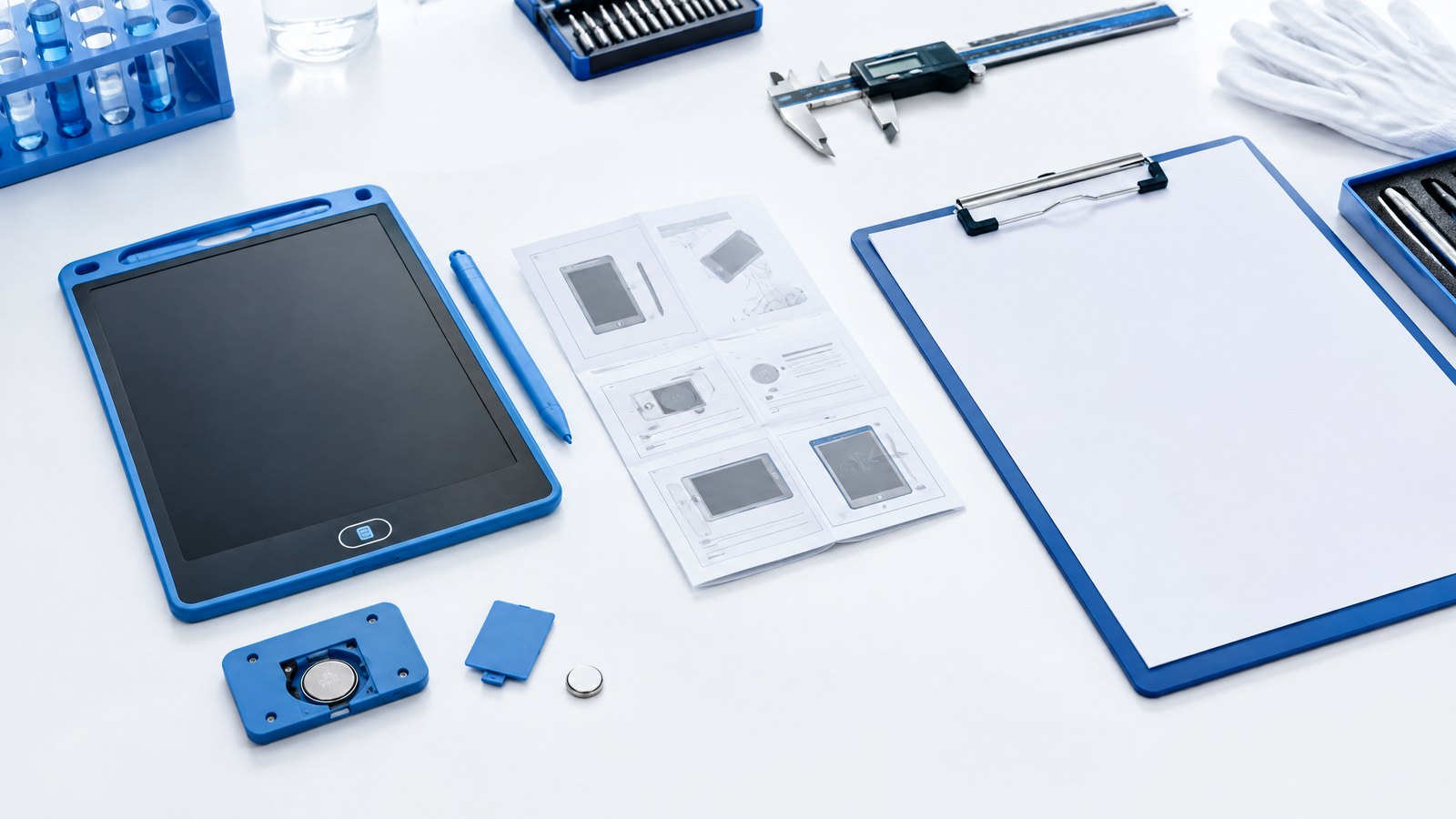

This guide provides a practical B2B decision framework. Final specifications, market obligations, testing scope, labels, packaging and shipment requirements must be confirmed for the exact finished SKU and destination.
Introduction
When an importer asks for the “best price” on an LCD writing tablet, the answer is rarely a single number. A factory quotation may show a unit price under FOB or EXW terms, while the buyer still needs to account for logo setup, retail packaging, inspection, freight, duty, local handling, marketplace fulfillment, and replacement stock. A product that looks inexpensive at the factory can become uncompetitive after it reaches the warehouse.
Landed-cost planning does not require a complicated financial model. It requires a clear list of cost layers and a consistent comparison between suppliers. The buyer should compare the same model, battery configuration, packaging scope, quantity, trade term, destination, and inspection standard. Otherwise, a low quotation may simply exclude costs that another supplier has already included.
This guide explains how to calculate landed cost for LCD writing tablets imported from China. It is written for distributors, private-label brands, school-supply companies, promotional-product buyers, and e-commerce operators. It also shows how to turn a quotation into a reorderable product brief.
The short answer: what is LCD writing tablet landed cost?
LCD writing tablet landed cost is the total cost of getting a defined, saleable product to the buyer’s agreed warehouse or fulfillment location. It normally includes the product price, customization, packaging, inspection, origin handling, international freight, insurance where applicable, import duty and taxes, destination charges, and any required local preparation. A useful calculation uses the same quantity and configuration across every supplier quotation.
1. Define the cost boundary before calculating
Two buyers can use the phrase “landed cost” to mean different things. One may stop at the destination port. Another may include customs clearance, delivery to a warehouse, relabeling, and marketplace fulfillment. Define the boundary in one sentence.
Examples:
- FOB landed-to-port: total cost through the destination port, excluding local delivery and final fulfillment.
- Warehouse landed cost: total cost delivered to the importer’s named warehouse, including customs clearance and destination transport.
- Fulfillment landed cost: warehouse landed cost plus relabeling, prep, storage, and fulfillment preparation.
- Retail product cost: fulfillment landed cost plus expected inspection, returns, replacement units, and launch-specific marketing allocation.
For supplier comparison, warehouse landed cost is often the most useful baseline. For marketplace pricing, the buyer may need a second model that adds platform fees and fulfillment costs. Do not mix those two numbers.
2. The eight main cost layers
2.1 Product unit price
Start with the price for the exact model and quantity. “8.5-inch LCD writing tablet” is not enough to create a comparable number. Record the screen size, display type, frame material, battery type, erase lock, stylus, accessories, and packaging assumption.
The current LcdWritingTablet product range presents several model architectures, including compact 8.5-inch formats, 10- and 12-inch educational formats, a Type-C rechargeable model, a transparent tracing model, and a keychain format. Use the product range to identify a starting architecture, then confirm the exact configuration in the quotation.
2.2 Branding and product customization
Logo printing, laser marking, Pantone housing colors, silicone changes, custom accessories, and new molds may be quoted separately from the unit price. Ask the supplier to separate one-time setup cost from per-unit cost. This makes the price easier to compare at different quantities.
For a first order, a proven platform with controlled logo and packaging changes may produce a clearer cost model than a new mold. A new housing can make sense for a long-term brand program, but tooling, samples, engineering, and approval time should be visible in the project budget.
2.3 Packaging
Packaging costs include box material, printing, inserts, barcode labels, manuals, polybags, protective films, inner cartons, and master cartons. Packaging can also change shipping cost because carton volume and weight may increase.
Ask for the following data:
- individual retail-box size and weight;
- units per inner carton;
- cartons per pallet, if applicable;
- master-carton dimensions and gross weight;
- packaging material and print scope;
- barcode, FNSKU, importer label, and warning requirements;
- whether packaging is retail-ready or transit-only.
2.4 Samples and inspection
Sample cost and courier cost are easy to overlook because they occur before the purchase order. Inspection can include factory internal testing, an independent pre-shipment inspection, or both. Treat the inspection plan as part of product cost, especially for a first order or a custom configuration.
The purpose of the sample is not only to confirm that the tablet writes. It also confirms screen visibility, erase response, stylus fit, battery compartment, color, logo, packaging, and accessory count. A saved sample cost can be expensive if it allows the wrong production configuration to ship.
2.5 Origin charges and trade term
FOB, EXW, CIF, DDP, and other shipping arrangements allocate responsibilities differently. Confirm what the quotation includes: factory loading, export documentation, origin terminal handling, customs brokerage, ocean or air freight, insurance, duties, and destination delivery.
Do not compare an EXW quote directly with a DDP quote without rebuilding the cost layers. The cheaper number may simply transfer more responsibility to the buyer.
2.6 International freight
Freight depends on route, season, mode, carton volume, chargeable weight, battery configuration, and destination. A 4.5-inch keychain tablet may have a different carton economics from a 12-inch classroom tablet. Rechargeable or battery-containing products may also need shipment-specific information from the freight partner.
Request carton data before requesting freight. At minimum, provide the number of cartons, carton dimensions, gross weight, destination postcode or port, requested shipping mode, and target delivery window. A freight estimate based only on unit count is not reliable enough for a final margin calculation.
2.7 Import and destination charges
Import duty, VAT or sales tax, customs brokerage, port handling, examination, delivery appointment, warehouse unloading, and local transport may all apply. The correct amounts depend on the destination, product classification, declared value, trade term, and local rules. Use your customs broker or qualified trade professional for the final classification and tax calculation.
2.8 Fulfillment, returns, and working capital
An e-commerce seller may need marketplace prep, labeling, storage, fulfillment, customer returns, replacement units, and payment fees. A distributor may need warehouse handling and regional delivery. These costs are not part of the factory price, but they affect the price the buyer can safely offer.
Working capital also matters. A deposit, production lead time, ocean transit, customs delay, and inventory holding period can tie up cash. A slightly higher unit price with reliable replenishment may be healthier than a low price attached to uncertain lead time or high minimum order quantity.
3. A simple landed-cost formula
Use this baseline formula:
Warehouse landed cost = product cost + customization + packaging + inspection + origin charges + international freight + insurance + import duty/tax + destination charges + local delivery
Then divide by the number of saleable units received. If the order includes damaged, missing, sample, or replacement units, distinguish ordered units from saleable units.
For example, a buyer may order 1,000 units but reserve 10 units for samples, replacements, or quality review. The unit cost for the customer-facing inventory should be based on the expected saleable quantity, not automatically on the ordered quantity.
Illustrative calculation structure
| Cost layer | Buyer input | Confirmation needed |
|---|---|---|
| Product value | Quoted unit price × quantity | Exact model and quantity tier |
| Branding | Setup + per-unit branding | Logo method and placement |
| Packaging | Box, manual, insert, labels | Artwork revision and pack format |
| Inspection | Internal or third-party cost | Sampling plan and report scope |
| Freight | Route and mode estimate | Carton data and battery information |
| Import | Duty, tax, broker, handling | Broker and destination rules |
| Local delivery | Warehouse or fulfillment center | Address and delivery requirements |
| Reserve | Samples, replacements, returns | Commercial policy |
Keep the calculation in a spreadsheet with a date, currency, exchange rate, supplier quotation number, and freight quotation number. Costs change. A dated model is easier to audit than a remembered unit price.
4. How MOQ changes your real cost
MOQ affects more than the ability to place an order. It affects packaging setup, inventory holding, price breaks, cash flow, and the number of units available for a pilot. A 500-unit order may have a higher unit cost but lower inventory risk. A 5,000-unit order may reduce product and packaging cost but create more exposure if the product, market, or season is uncertain.
Ask the supplier to show at least three quantity tiers where practical: pilot quantity, expected first commercial order, and annual reorder quantity. Request the price basis for standard color, logo, custom color, and custom packaging separately. This helps identify which customization step creates the biggest cost jump.
The current site communicates a standard OEM starting point around 500 units for some branding programs, while custom colors, packaging, and tooling may require different quantities. Treat the published figure as a starting point and confirm the exact model-specific MOQ in writing.
5. How to compare supplier quotations fairly
Create a side-by-side table with the same headings for every supplier. Include at least:
- model and screen size;
- writing area and overall dimensions;
- battery and power configuration;
- stylus and accessory list;
- logo and color scope;
- retail-pack format;
- carton quantity and dimensions;
- MOQ and price tiers;
- sample cost and lead time;
- production lead time;
- inspection scope;
- trade term and shipping assumption;
- destination documentation;
- quotation validity date.
A quotation that omits an item should not be treated as zero. Mark it “not included” or “to be confirmed.” This single habit prevents many false price comparisons.
6. Use customer requirements to protect margin
Customer requirements can change landed cost unexpectedly. A retailer may need a hang tab, a school distributor may need multilingual manuals, and an Amazon seller may need FNSKU labels or specific carton preparation. A promotional buyer may need individual gift boxes even when a bulk polybag would be cheaper.
Put those requirements into the first RFQ. If the requirements are not final, label them as assumptions and price a base case plus optional changes. Do not let an important packaging or labeling requirement appear for the first time after the sample has already been approved.
7. Factory testing and shipment inspection are cost controls
Quality control is often described as a cost, but it is also a margin-protection tool. A missing stylus, faulty erase button, damaged screen, or incorrect package can create return freight, customer service, replacement stock, and marketplace risk.
The inspection plan should match the product. Check writing response, full erase, erase lock, screen appearance, frame, stylus, battery cover, logo, packaging, barcode, carton quantity, and shipping marks. The LcdWritingTablet factory information describes optical erasure checks and an AQL-based final inspection workflow; buyers should request the exact report and acceptance criteria for their model.
Frequently asked questions
Is LCD writing tablet landed cost the same as wholesale price?
No. Wholesale price usually describes the supplier’s product price under a stated term. Landed cost adds the costs required to get the defined, saleable product to the buyer’s agreed destination.
Which is better for a first order: FOB or DDP?
Neither is universally better. FOB can give an experienced importer more control, while DDP may simplify a small launch if the written quotation clearly defines duties, taxes, delivery, and responsibility. Compare the complete cost and contract scope.
Does a larger LCD writing tablet always cost more to land?
Not always, but larger products usually affect carton volume, storage, and freight. Compare the complete package and use case rather than only the screen diagonal.
How should I budget for samples and inspection?
Separate sample courier, artwork sample, testing, and pre-shipment inspection as visible line items. The final amount depends on the model, market, laboratory or inspection company, and scope.
What information should I send for a landed-cost quote?
Send the model or preferred size, quantity, destination, packaging format, logo requirement, battery preference, shipping mode, delivery window, and any marketplace or retailer requirements.
Conclusion
The useful number in an import project is not the lowest factory quotation. It is the reliable cost of receiving the correct, saleable product at the intended destination. Build the model from the exact specification, separate product and customization costs, request carton data, confirm the trade term, include inspection and destination charges, and keep a reserve for samples, replacements, and returns.
When a buyer gives the factory a clear requirement sheet, the resulting quotation becomes more comparable and the production sample becomes more meaningful. That improves both purchasing decisions and future reorders.
CTA
Need a model-specific cost estimate? Use the LCD writing tablet cost calculator or send your requirements with your quantity, destination, packaging, and preferred model. The factory team can prepare a quotation with the assumptions visible.
Turn this sourcing plan into a product brief.
Share your target market, product requirements, packaging preference and estimated volume for a practical OEM / ODM discussion.