This guide provides a practical B2B decision framework. Final specifications, market obligations, testing scope, labels, packaging and shipment requirements must be confirmed for the exact finished SKU and destination.
1. Direct Answer: What Buyers Should Specify First
Introduction. Importers, retailers, education suppliers, and private-label brands should begin an LCD writing tablet brief with three connected decisions: erase-lock behavior, stylus retention/replacement, and battery architecture. These details affect daily usability, safety review, packaging, customer support, and the documentation needed for the destination market.
An LCD writing tablet with lock button normally prevents the one-touch clear function from removing the current drawing or note. It does not normally stop further writing. An LCD writing tablet with stylus should be assessed as a complete system: tip, feel, holder, tether option, material, and spares. Battery choice is equally practical. Replaceable-cell products can remain slim and cable-free, while rechargeable designs add charging hardware, transport considerations, instructions, and battery evidence.
State the target use and age positioning, screen size and color effect, lock behavior, stylus solution, battery type, destination market, packaging languages, and inspection plan. Ask the supplier to identify the exact production model and confirm all details in the quotation and approved specification sheet. Specifications vary by model and must be confirmed against a quotation.
| Feature area | Buyer decision |
|---|---|
| Erase lock | Locked/unlocked behavior, icon, and test method |
| Stylus | Holder fit, tether need, and spare-part plan |
| Replaceable battery | Exact cell, door retention, warning, and service path |
| Rechargeable power | Connector, charging guidance, protection evidence, and freight review |
| Screen | Active area, color effect, pressure response, and viewing expectation |
Select the simplest feature set that supports the use case, then validate it on production-intent samples. Do not assume similar-looking tablets share the same lock, stylus, battery, or endurance performance.
2. Buyer Context: Turn a Consumer Feature into a Procurement Requirement
LCD writing tablets are reusable surfaces for temporary drawing, early-writing practice, household lists, travel activities, and quick notes. Small details—a lost stylus, unclear lock icon, loose battery door, or misleading wording—can create disproportionate returns.
Define the channel and user first
A value retailer may prioritize compact cartons, clear operation, and secure stylus storage. An education distributor may need consistent writing response, multipack organization, and supervised-use guidance. Travel products benefit from an erase lock that stays in position and a pen that stays with the board. Promotional buyers need controlled logo and color matching, but should still test the functional components.
Put the intended use in writing: for example, “temporary drawing for home and travel; clear-button lock protects erase only; retained stylus preferred; coin cell not supplied loose.” This gives development, compliance, and inspection teams one reference point.
Localize the commercial brief, not only the artwork
For US, UK, German, and French programs, review the destination market, selling channel, and product claims at the start. A product positioned as a toy for children may face a different framework than a general-use memo board. Plan adequate room for suitable instructions, warnings, and local-language information rather than reducing it to unreadable type.
Identify the economic operator and final seller responsible for product information. A factory can provide agreed technical evidence, but the importer or brand must obtain appropriate advice for its final configuration and market placement.
3. Product Definitions: What Lock, Stylus, and Battery Features Actually Mean
The writing surface and erase circuit
Many LCD writing tablets use pressure-responsive liquid-crystal film. Stylus or fingernail pressure creates a visible mark; the clear function applies power to reset it. This is normally a temporary local-writing product, not a backlit display, cloud-connected notepad, or permanent-storage device. Screen appearance, line color, pressure response, and clearing behavior depend on the specific film and electronics.
In many designs, the battery powers the clear action rather than continuous display. A depleted cell may therefore leave existing writing visible but prevent clearing. Confirm actual behavior in the model documentation rather than treating this as universal.
Lock button versus true screen lock
The term LCD writing tablet screen lock can be misleading. On many products, the slider only disables erase; a user can still add marks. Specify whether the switch is mechanical or electronic, which position is locked, icon direction, and resistance to accidental movement.
| Condition | Behavior to define |
|---|---|
| Erase enabled | Clear activation removes visible writing |
| Erase disabled | Clear activation does not remove visible writing |
| Stylus used while locked | State whether further marks can be made |
| Low battery | State clear-function behavior and user guidance |
Stylus, holder, tether, and spare part
Styluses are not automatically interchangeable. Profile, tip radius, length, material, clip/magnet feature, and holder geometry vary by model. Check retention after repeated insertions and packed-product handling. A tether can reduce losses but should be reviewed for fit, durability, and intended-user implications.
For an LCD writing tablet replacement stylus, confirm a model-specific part number or approved compatibility statement. Define the quantity, color, material, package, and whether it fits the approved holder. Do not claim universal compatibility.
Replaceable versus rechargeable battery
An LCD writing tablet with replaceable battery often uses a coin/button cell. It can be thin and cable-free, but the buyer must define the exact cell, whether it is fitted, the opening method, labels, and disposal/service information.
A rechargeable LCD writing tablet contains a rechargeable cell or pack and a charging circuit. It may eliminate routine cell changes, but adds connector, cable, indicator, protection, transport, and instruction requirements. It is not inherently better; select it for the actual duty cycle, user, price point, and available evidence.
4. Selection Criteria: Choose Features Around Real User Friction
1. Make the lock intuitive
Position the switch where users can find it but it will not move in normal transport. Test both end positions, clear response, icons, and printed legends on the approved sample. Use “locks erase” rather than “locks the screen” unless the unit genuinely prevents input.
2. Treat stylus retention as ownership cost
A low-cost board with a frequently lost pen generates support work and reviews. Check holder retention after repeated insertion and packed-product vibration. Travel products may need a snug slot or tether; classroom sets may need a defined spare-stylus ratio. For young users, review the completed design for foreseeable misuse rather than assuming a small accessory is suitable.
3. Compare the battery journey
Do not compare power options only by nominal capacity. Ask who will change or charge it, how depletion is recognized, and how service works. A replaceable-cell design needs a clear cell reference, secure compartment, instructions, and disposal guidance. A rechargeable design needs defined input, cable, charge indication, and battery-care information.
4. Measure endurance operationally
“Long-lasting” is not a purchase-order requirement. For an erase-based board, useful evidence may be clear cycles under an agreed method; for a rechargeable unit, it may include cycles per charge and charging time. Ask how LCD writing tablet battery life is defined: battery type, starting condition, test sample size, actuation pattern, environment, end criterion, and whether the result is a target or verified result. Without an agreed protocol, avoid a numerical claim.
5. Control customization
Custom color, print, stylus, tether, artwork, or inserts can affect fit, labels, and inspection. Freeze revision-controlled artwork, approved color, bill of materials summary, battery statement, sample sign-off, and carton marks before production. Change control is often more valuable than another marginal feature.
5. Technical Specifications: Build a Quotation-Ready Specification Sheet
Request a sheet that separates marketing dimensions from controlled requirements. It should state the exact model and revision, nominal size and active area, line/color effect, housing dimensions/material/color, writing input and stylus, clear-button and lock behavior, power arrangement, intended-care guidance, and complete package/carton configuration.
| Specification | What to request | Why it matters |
|---|---|---|
| Model/revision | Code, configuration revision, front/rear photos | Prevents substitution |
| Display | Nominal size, active area, color effect | Supports listing accuracy |
| Clear/lock | Location and expected behavior | Defines core user experience |
| Stylus | Tip, material, storage, spare-part code | Controls loss and service |
| Power | Exact battery/cell or charge details | Enables safety and logistics review |
| Package | Unit box, inserts, carton pack count/marks | Drives retail and shipping readiness |
Screen and mechanical details worth sampling
Check the active area, normal-viewing visibility, writing response across the panel, bezel fit, seams, button alignment, and screen adhesion. Operate clear and lock repeatedly, and compare print placement with approved artwork. Define an acceptable, repeatable experience for the price tier rather than demanding glass-display performance from a reusable writing board.
Battery and charging details worth defining
For primary-cell products, obtain the exact approved cell—not just “button battery”—and confirm installed/separate/omitted status, pull tab, cover design, polarity marks, and replacement procedure. For rechargeable configurations, identify cell type, input, connector, cable inclusion, indicator behavior, and charging/storage instructions. Do not assume a report for one battery or housing revision covers another.
6. Factory and Quality Evidence: Make Approval Observable
A Shenzhen OEM/ODM partner should turn the agreed feature set into an inspection-ready production plan. The useful evidence is specific to the approved model, not a generic factory presentation.
Sample approval before mass production
Approve a labeled, production-intent sample against a buyer checklist. Record model code, color, artwork revision, screen size, lock behavior, stylus, battery setup, packaging draft, and deviations. For custom color, logo, stylus, tether, or inserts, approve the assembled configuration together. State that any material, battery, screen, artwork, or construction change requires written re-approval.
Screen and erase-function testing
At agreed in-process and finished-product checkpoints, inspect a defined sample: write across the active area, check normal visibility, clear the screen, move the lock, and confirm expected results in each state. Check stylus insertion/removal, holder fit, and obvious molding defects. These are practical production controls, not invented universal test results; agree sampling levels and acceptance criteria in the purchase specification.
Packaging checks and pre-shipment inspection
Verify unit-box artwork, labels, model ID, required language, battery warnings where applicable, barcode, accessories, and instructions. Check carton quantity, marks, closure, and internal protection. A pre-shipment inspection can compare quantity, workmanship, function, packing, and cartons to the approved sample. It does not eliminate risk, but creates traceability and a basis for correcting deviations before dispatch.
Mid-article CTA — Request a feature-confirmation sample pack. Send LcdWritingTablet your market, screen size, lock requirement, stylus-retention preference, battery preference, branding, and estimated volume. Request a model-specific quotation, sample photos, proposed specification sheet, and evidence for the exact configuration.
7. Compliance and Safety Considerations: Verify the Finished Configuration
Compliance is specific to the item, intended age, claims, power design, package, and destination. It cannot be established from a photo, generic declaration, or report for a different version. Identify applicable requirements for the final configuration and obtain qualified advice before market placement.
Battery access, warnings, and instructions
Button/coin cells require careful review because ingestion can cause severe injury. The US CPSC describes requirements for applicable consumer products covering compartment security, accessibility after use-and-abuse testing, and warnings on product, package, and instructions where applicable. Confirm the final product classification and rule applicability.
Review the actual compartment on the final sample: opening method, cover fit, fastener if used, polarity marks, warnings, instructions, and whether cells are separately packed. A screw alone is not evidence that a product meets all applicable obligations.
Market documents and marks
For the EU, CE marking applies only where relevant harmonised EU rules require it. The manufacturer must identify applicable legislation, assemble technical documentation, and prepare required declarations; CE is not a certificate from a central authority. Great Britain has UKCA/CE arrangements and market-specific sector rules. For US children’s products, determine whether applicable rules require a Children’s Product Certificate and third-party testing; a General Certificate of Conformity may apply to general-use products subject to a CPSC rule.
Request focused evidence: document name, model coverage, product revision, date, issuer, applicable requirement, sample description, and whether it covers the final branded/battery configuration. Do not ask only for “all certificates.”
Responsible claims and environmental information
Substantiate claims about age grade, endurance, safety, recyclability, or environmental benefit. European electrical/battery disposal obligations may apply; confirm registration, marking, take-back, and labeling duties for the sales model. Give consumers suitable battery-care and disposal instructions consistent with final documentation.
Sources and verification note
This is commercial procurement information, not legal advice. Check the U.S. CPSC button-cell/coin-battery business guidance, the European Commission’s CE-marking guidance, and the UK government’s UKCA/CE guidance, then review the primary rules and seek advice for the actual product. Standards and regulations change; this guide claims no certification, test result, or legal conformity.
8. Application Examples: Match the Feature Set to the Use Case
Travel and family retail
Specify a clearly labeled erase lock, retained stylus, slim enclosure, and illustrated instruction. A replaceable cell may suit a simple product if the final compartment and information are appropriate for the market. Test that the stylus stays in place during packed handling.
Classroom, tutoring, and activity packs
Prioritize consistent response, fast clearing, easy inventorying, and spares. Consider color coding by group or a controlled spare-stylus quantity per case. Explain that the lock protects erase; it does not permanently save work. Check every agreed function on a defined inspection sample and verify pack count/carton marks.
Home memo and adult note-taking
A memo board may favor a larger active area, neutral housing, desk-friendly stylus storage, and an erase lock for lists. Do not imply cloud backup or permanent storage unless the model offers it. Select replaceable or rechargeable power only after reviewing the actual service and documentation needs.
Promotional and private-label programs
Confirm print adhesion, placement away from the active area, holder clearance, importer/brand information, and final packaging. Allow time for color, artwork, and production-equivalent sample approval. A launch deadline should not replace safety or functional checks.
9. Buyer Checklist: Questions to Close Before a Purchase Order
- Exact model, revision, intended user, age positioning, and market are documented.
- Lock behavior is tested and product copy says precisely what it protects.
- Stylus material, holder/tether, retention expectation, and replacement part are defined.
- Exact battery/charging configuration and supplied/not-supplied status are confirmed.
- Final battery cover, markings, warnings, and instructions are reviewed for the target market.
- Any endurance claim uses a model-specific agreed protocol, or is omitted.
- Unit, insert, box, label, and carton artwork includes needed language and responsible-party details.
- Required technical/compliance documentation matches the final configuration.
- Quality plan covers screen writing, clear/lock, stylus fit, workmanship, accessories, packing, and cartons.
- Pre-shipment inspection scope and deviation response are agreed.
10. FAQ: Common Lock, Stylus, and Battery Questions
Does a lock button prevent new writing?
Usually not. Many models disable erase only and still accept new stylus marks. Verify the sample and describe the behavior accurately.
Is replaceable power always easier than rechargeable power?
No. A replaceable cell avoids charging but requires careful access, warning, disposal, and replacement planning. Rechargeable power avoids routine cell changes but adds charging, transport, and support requirements. Select according to product, user, market, and available evidence.
How should we state battery life?
Use a numerical claim only when supported by a documented, model-specific method and result. For clear-button boards, define clear cycles and conditions instead of an undefined “years of use” statement. Otherwise describe the battery type and service procedure.
Can one replacement stylus work across all tablets?
No. Tip, length, thickness, holder interface, and writing response vary. Approve a compatible part against the exact model.
What should a pre-shipment inspection cover?
Agree quantity, identity, workmanship, writing/clear/lock functions, stylus storage, power configuration, accessories, packaging, labels, carton count, and marks. Compare finished goods with the approved sample.
Can a factory provide compliance paperwork?
It can provide agreed information and reports it holds for a defined configuration. The brand/importer must still establish final market applicability and check scope, dates, model coverage, and changes from the tested version.
11. Conclusion and CTA: Buy the Feature System, Not the Photo
Lock, stylus, and battery choices are a connected user-and-quality system. Define what the lock protects; choose a tested retention and spare-parts plan; and select replaceable or rechargeable power for the real ownership, evidence, and market needs. Convert the choices into a controlled specification, production-intent sample approval, and inspection plan.
The dependable result is a model-specific quotation, approved sample, traceable artwork, observable functional checks, appropriate market review, and pre-shipment comparison with the agreed reference. Specifications, battery arrangements, and requirements can change, so confirm final details against the quotation and product documentation.
End CTA — Start with a specification-led RFQ. Contact LcdWritingTablet with your destination market (US, UK, Germany, or France), intended use, target screen size, lock requirement, stylus/storage preference, battery preference, branding and packaging files, and estimated volume. Request a model-specific quotation and production-intent sample plan before mass production.
Image plan
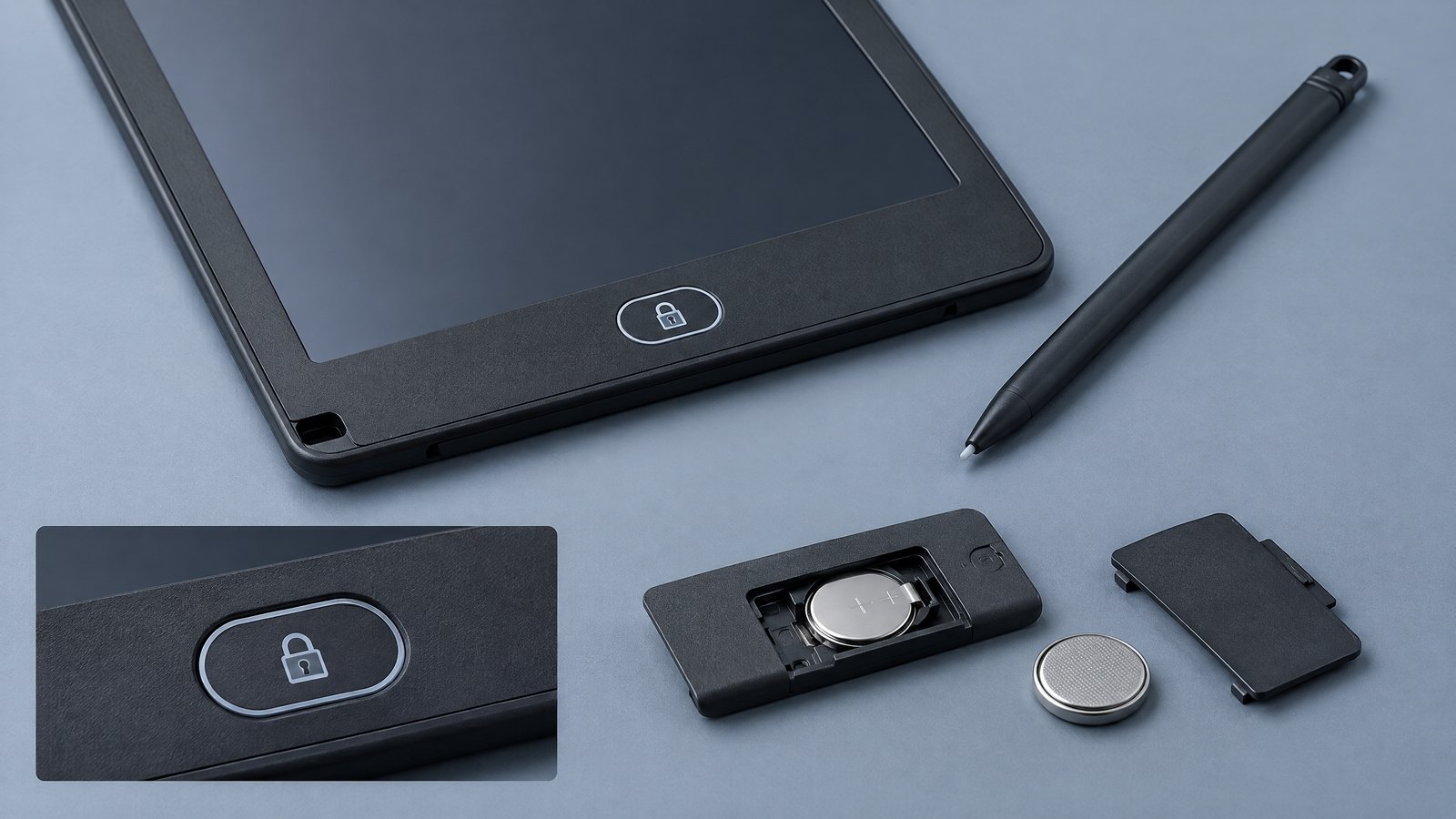
- Purpose: Clarify erase protection versus input lock. Insertion position: After “Lock button versus true screen lock” (Module 3). English caption: “A lock switch commonly protects erase while allowing further writing.” ALT text: “LCD writing tablet lock slider beside clear button.” English AI image prompt: “Clean studio product photo of an unbranded LCD writing tablet, clear button and lock slider with padlock icons, stylus in holder, light neutral background, realistic.”
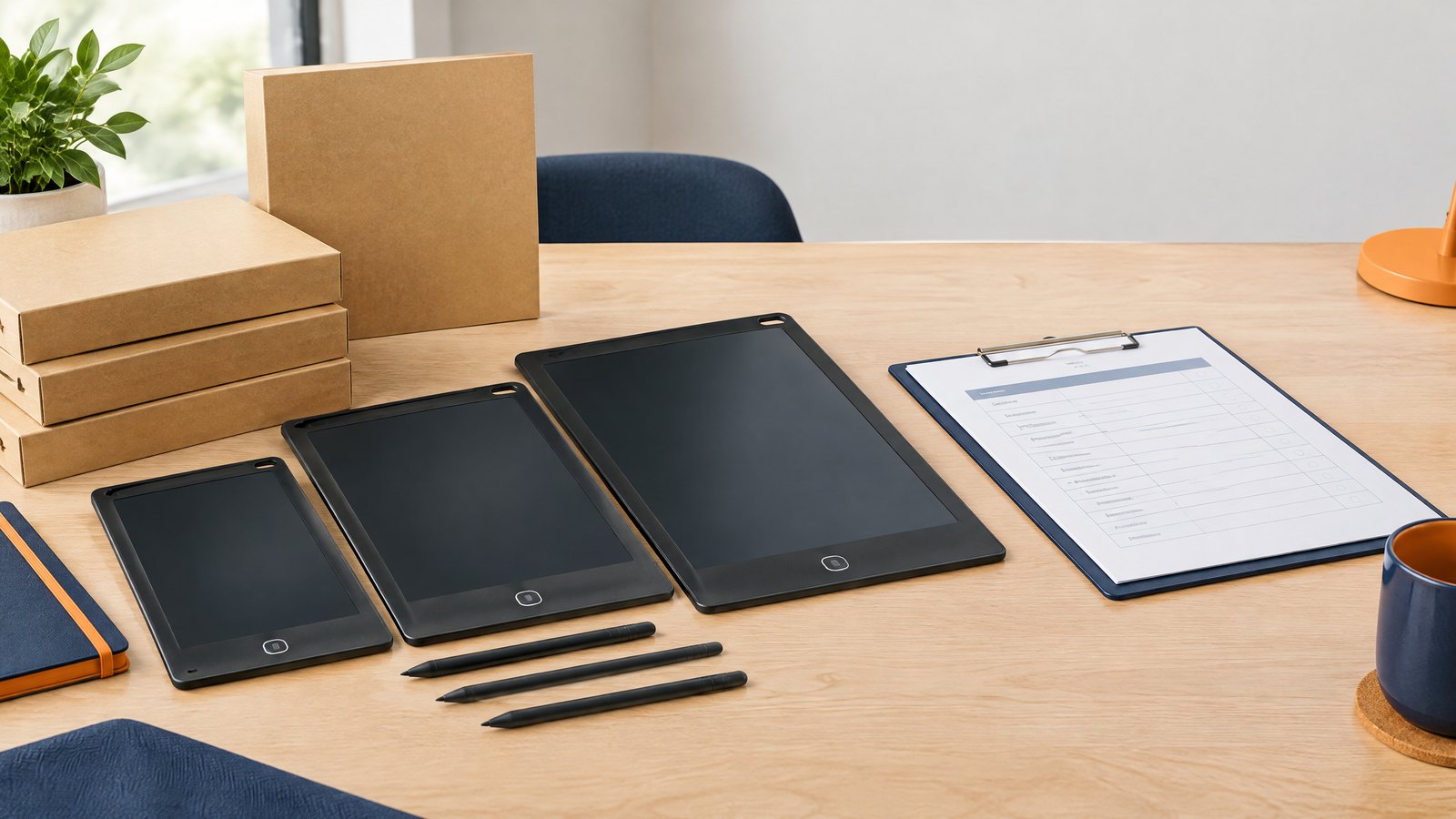
- Purpose: Compare stylus storage solutions. Insertion position: After “Stylus, holder, tether, and spare part” (Module 3). English caption: “Compare slots, recessed holders, and tether options before choosing storage.” ALT text: “Three LCD writing tablets with different stylus holders.” English AI image prompt: “Professional OEM buyer-guide illustration of three unbranded LCD writing tablets: side stylus slot, recessed holder, and tethered stylus; white background, crisp English labels, realistic materials.”
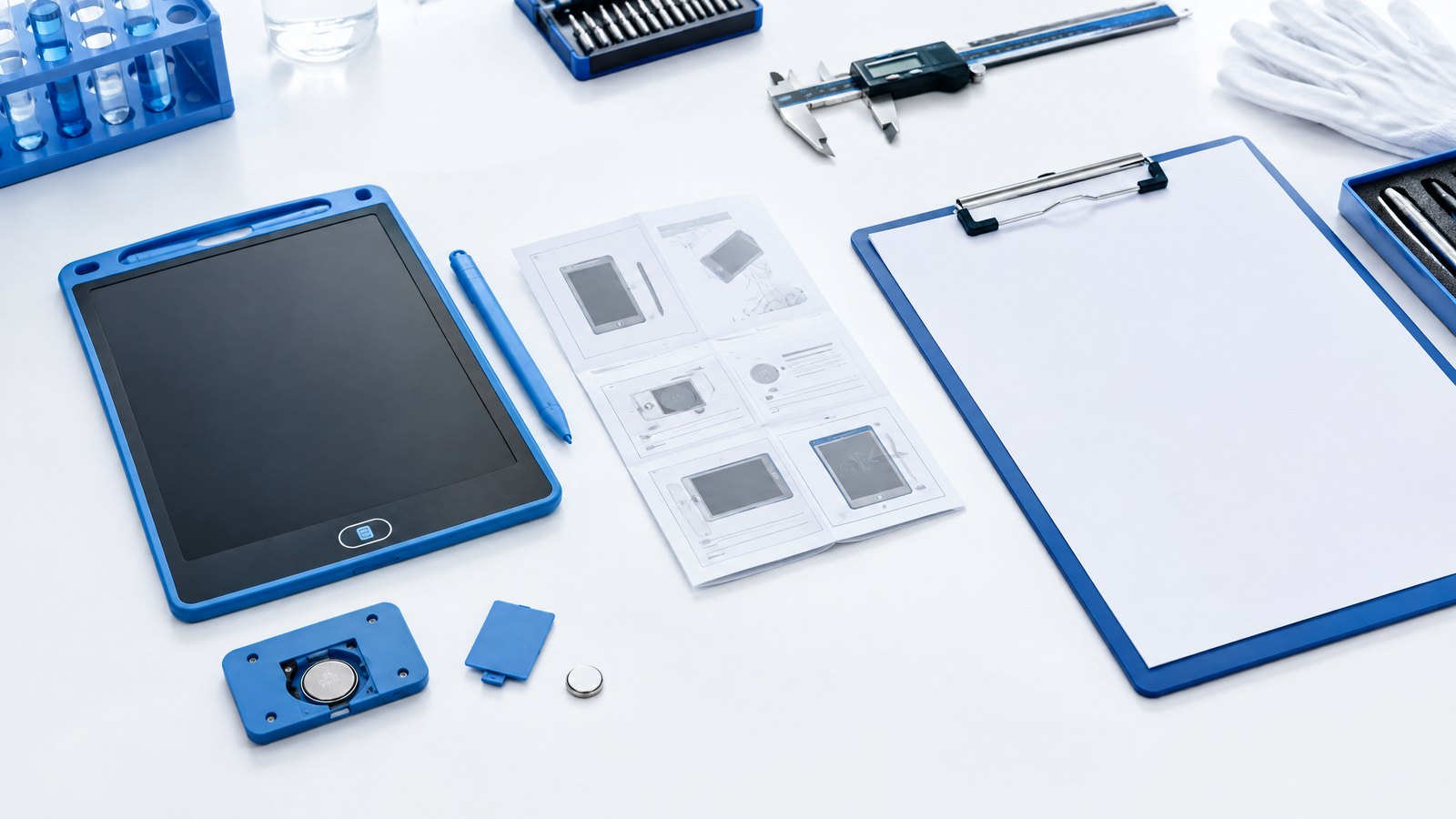
- Purpose: Show configuration-specific power review. Insertion position: After “Battery and charging details worth defining” (Module 5). English caption: “Confirm the battery compartment or charging interface on the approved model.” ALT text: “Tablet rear views showing coin-cell cover and USB-C port.” English AI image prompt: “Split-panel technical photograph: unbranded LCD tablet with secured coin-cell cover on left; different tablet with USB-C port and charge indicator on right; neutral background, realistic manufacturing detail.”
- Purpose: Visualize the quality workflow. Insertion position: After “Packaging checks and pre-shipment inspection” (Module 6). English caption: “Approved samples and documented inspection points create a clear reference.” ALT text: “Inspector checking tablet, stylus, and box against approved sample.” English AI image prompt: “Realistic organized Shenzhen factory quality-control table; inspector checks unbranded LCD writing tablet, stylus, retail box, approved sample and checklist; bright, no logos or readable personal data.”
Continue with the next sourcing decision.
Use these internal links to compare products, check common buyer questions, review compliance preparation, or send your requirements to the factory.
Turn this sourcing plan into a product brief.
Share your target market, product requirements, packaging preference and estimated volume for a practical OEM / ODM discussion.