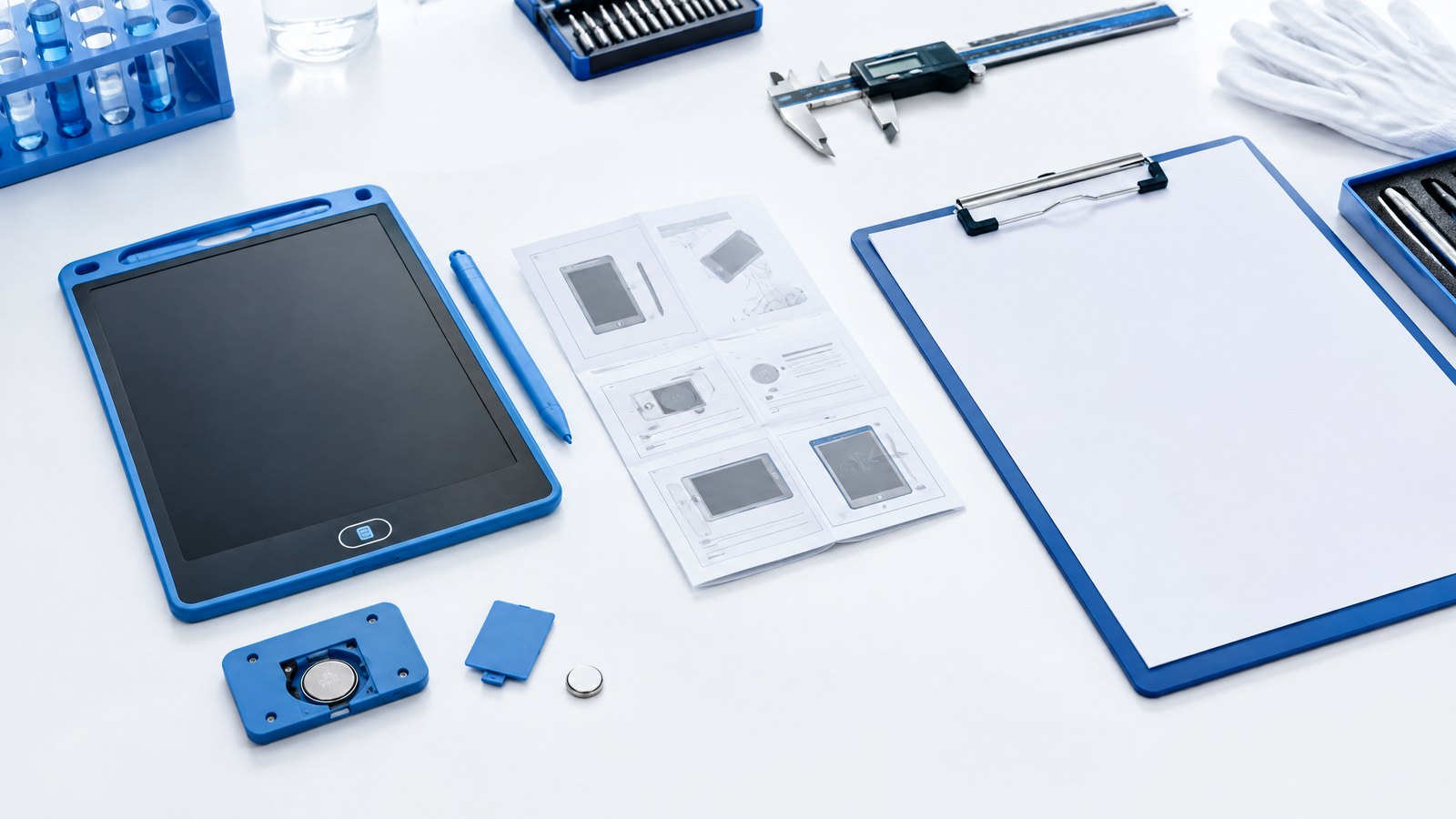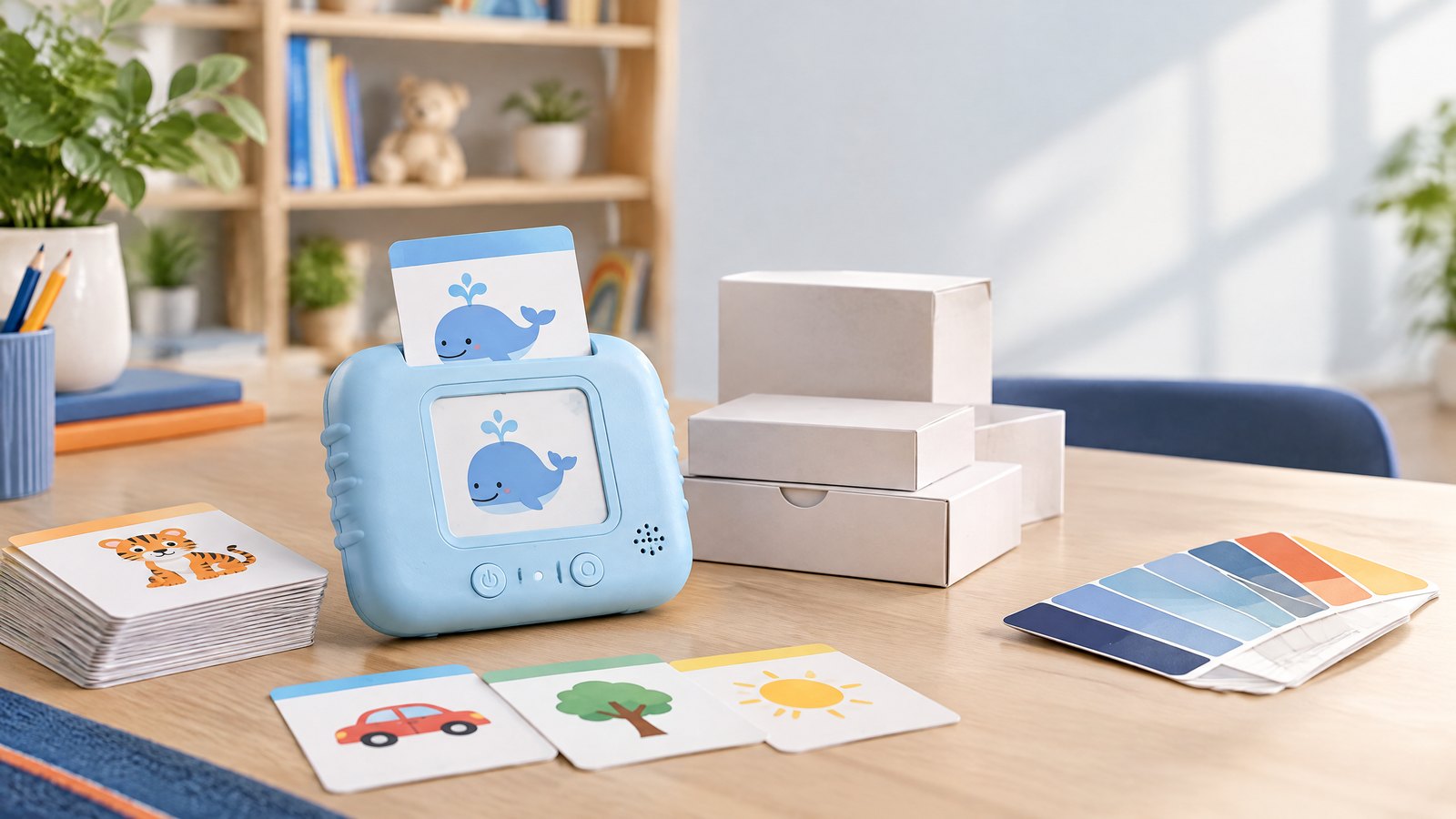

This guide provides a practical B2B decision framework. Final specifications, market obligations, testing scope, labels, packaging and shipment requirements must be confirmed for the exact finished SKU and destination.
2. Direct-answer introduction
LCD writing tablet MOQ planning should begin with the smallest quantity that can satisfy four tests: the supplier can produce the exact configuration, the quantity works with the agreed carton plan, the applicable product and shipping preparation is in place, and the buyer can fund the order until it sells and can reorder.
That is more useful than asking only for a low MOQ. Minimum order quantity is not a fixed trait of every LCD writing tablet. It can change with the model, component availability, colour, branding, accessory set, packaging, print process, production scheduling, and commercial terms. A small order may look inexpensive on a purchase order but become costly per saleable unit when setup, artwork, inspection, freight, customs, receiving, and unsold stock are included. A large order can reduce selected unit costs while tying up cash in a variant that has not proved demand.
The first order has two purposes: validate the product-market fit and validate the supply configuration. It should generate usable evidence about sell-through, returns, carton damage, functional consistency, and elapsed replenishment time. It is not a contest to obtain a theoretical minimum or the lowest quoted ex-factory price.
This guide explains how to make that decision without inventing a standing MOQ, price, certification, lead time, or product feature for LcdWritingTablet. Those details must be confirmed for the specified model, revision, destination, and order terms. Requirements differ by destination and intended user. In the United States, manufacturers and importers may need to test and certify applicable consumer products; products intended primarily for children can bring additional obligations.1 In the EU, relevant product requirements may concern design, labelling, marking, packaging, functionality, or performance.2
3. Who this guide is for
This guide is for businesses placing a first import order with a Shenzhen OEM/ODM manufacturer of LCD writing tablets, including distributors, retailers, brand owners, procurement teams, and import coordinators. It is most useful when the buyer has promising demand signals—such as customer interest, existing channel data, a launch allocation, or a seasonal plan—but no reliable reorder history for this product.
It also applies where an order may have a battery, a private label, a custom pack, or an intended child user. None of those facts automatically determines a rule or document requirement; each requires review of the actual configuration and market.
This is a commercial planning guide, not customs, product-safety, testing, freight, or legal advice. Classification, value, duty, tax, certification applicability, origin marking, battery transport, and import entry depend on the facts of the transaction. CBP notes that a customs broker may assist, but the U.S. importer of record remains responsible for the correctness of entry documents and applicable duties, taxes, and fees.3
4. Buyer decision framework
Define the saleable SKU before discussing quantity
Write a one-page SKU brief first. “An LCD writing tablet with our logo” is too vague to plan MOQ. The brief should identify the product model or baseline configuration, intended destination and user, writing area or size where relevant, housing and trim, erase and lock behaviour where applicable, battery arrangement if present, stylus and accessories, branding locations, product/retail-pack labels, pack language, and inner/master-carton quantity.
Attach a revision number to the brief. If a requested change affects a component, printing, packaging material, assembly step, test scope, or documents, treat it as a possible new MOQ, cost, and approval input until the supplier confirms otherwise. That avoids comparing a quote for one configuration with a sample for another.
Calculate a planning quantity using visible constraints
Use a working model rather than a single forecast number:
[ \text{planned first order} = \max(\text{demand cover},\ \text{supplier MOQ},\ \text{carton-rounded quantity},\ \text{launch/document requirement}) ]
This is not a factory formula. It makes the inputs testable:
- Demand cover: forecast saleable units during a defined coverage period, plus a stated buffer. Keep contracted B2B allocations separate from uncommitted demand.
- Supplier MOQ: the confirmed minimum for the complete SKU, not for a similar catalogue item.
- Carton-rounded quantity: the quantity rounded to the approved master-carton configuration.
- Launch/document requirement: a real requirement created by the intended market, product review, channel onboarding, or release plan. It is never a substitute for compliance work.
If the planned need is Q and a master carton holds U units, the next whole-carton quantity is ceil(Q ÷ U) × U. State the consequences of rounding: additional cash, storage, and sell-through exposure. Do not hide forecast uncertainty in a large unexplained safety-stock percentage. List the source of every assumption—customer commitments, sales rate, approval time, production, transport, clearance/receiving, and disruption buffer.
Choose the customization path before negotiating MOQ
| Route | What changes | MOQ and risk question to ask |
|---|---|---|
| Standard SKU | Existing configuration and standard/neutral presentation | Is the constraint stock, component allocation, schedule, or carton count? |
| Artwork-led SKU | Logo, insert, label, or approved pack artwork; hardware remains stable | Which print, artwork, label, or pack element creates the minimum? |
| Physical variant | Colour, material, accessory, component, display size, or housing detail | What new material, process, validation, or documentation review is required? |
| New development | Structure, electronics, function, or tooling | What feasibility, engineering, tooling, validation, and purchasing commitments are needed before MOQ can be confirmed? |
The further the order moves from a stable platform, the more risk shifts into pre-sale commitments. A new colour can need a material batch; a bespoke retail box can create print minimums; a component change can affect more than cost. First-time buyers usually learn faster by keeping the hardware stable and changing only the elements that support their route to market.
Ask what the MOQ is protecting: purchased components, line efficiency, print or label minimums, colour setup, packaging, engineering work, or a full-carton arrangement. The answer determines the right response. If printed packaging is the constraint, for example, a standard product with a suitable approved insert may reduce opening exposure; if the constraint is a physical variant, a standard finish may be the safer test.
For a model-specific discussion, email the SKU brief, destination, target quantity range, and requested customizations to info@lcdwritingtablet.com. Request that the MOQ drivers, carton data, sample route, and any changed configuration be shown separately rather than buried in one number.
5. Comparison, cost, quality, and specification table
Compare first-order routes on total exposure
| Planning route | Main cash-flow effect | Quality/specification controls | Appropriate first-order use |
|---|---|---|---|
| Standard SKU | More cash goes to saleable product rather than new setup, but freight and fixed charges still matter | Confirm current model identity, function, included items, labels, carton pack, and evidence relevant to destination | Testing demand while holding the fewest variables constant |
| Standard hardware + artwork | Separates hardware spend from artwork and printed-material exposure | Lock artwork, logo placement, copy, barcode ownership, label location, languages, and first-article approval | Building a visible brand without changing product architecture |
| Physical custom variant | More cash may be committed before demand is measured; residual materials may have limited reuse | Define every changed part; obtain a revised sample; review effects on testing/documents | Only when the physical difference is necessary to the sales proposition |
| New development | Highest pre-sale commitment and timing uncertainty | Controlled specification, change log, risk review, milestone approvals, validation plan, and clear ownership terms | When a differentiated design justifies a separately funded project |
Use landed cost, not a unit-price shortcut
Calculate an internal landed cost per saleable unit:
[ \text{landed cost per saleable unit} = \frac{P + S + I + F + D + H + C}{N} ]
P is the product amount; S is approved setup, artwork, or development spend; I is inspection, testing, or documentation cost where applicable; F is transport and agreed origin charges; D is duty, non-recoverable tax, and customs-related cost as applicable; H is destination handling/receiving; C is a separately identified contingency; and N is saleable units received. This is a commercial model, not a duty or tax calculation. Seek lane- and product-specific advice.
Fixed and semi-fixed costs can fall per unit as quantity rises, while carrying cost and obsolescence exposure rise with quantity. That is the MOQ trade-off. A lower ex-factory price does not automatically mean lower business risk.
Test carton economics with supplier data
Ask for master-carton external dimensions, net/gross weight, units per carton, inner-pack arrangement, product-pack dimensions, pallet information if relevant, and whether the quote assumes whole cartons. Do not estimate freight from display size.
| Carton question | MOQ-planning effect | Buyer control |
|---|---|---|
| Units per master carton | Determines whether the demand plan creates a partial carton or a rounding increase | Compare quantity options in whole-carton increments |
| Dimensions and gross weight | Affects freight, handling, storage, and damage exposure | Use the same data when obtaining freight quotes |
| Fixed inner packs | Can restrict warehouse allocation or mixed-customer fulfilment | Confirm partial-inner-pack options before ordering |
| Retail pack and carton relationship | Presentation and protection must work together | Approve the final pack, carton orientation, and marks together |
| Carton marks | Supports receiving and traceability | Approve the carton-mark revision and lot reference |
Illustrative arithmetic: if an approved master carton holds 24 units and the working need is 101, whole-carton rounding produces 120 units. Those additional 19 units are not free; they consume cash and require a sell-through plan. If 96 units still meets the coverage plan and supplier MOQ, it may be the more controlled choice.
6. Product and technical detail that affects MOQ
An LCD writing tablet is a category, not a complete specification. Do not assume an unfamiliar model has a particular active area, pressure response, erase method, lock arrangement, stylus retention method, battery type, or accessory set. Confirm the actual model against current supplier information and an approved sample.
Separate stable platform elements from change-sensitive elements. Stable elements may include the basic housing architecture, writing panel, erase function, standard stylus arrangement, and usual package structure. Change-sensitive elements can include colours, logo treatment, special accessories, pack artwork, translated inserts, labels, battery configuration, component choices, and carton marks. This makes the MOQ discussion specific: which requested item changes purchasing, production, testing, documentation, or carton economics?
| Specification area | Record before approving MOQ |
|---|---|
| Product identity | Model, revision, controlled photographs/drawings, intended use |
| Function | Writing, erase, lock, and other agreed acceptance sequence |
| Physical build | Dimensions, materials, finish, colour, edges, and assembly points |
| Power arrangement | Whether a battery is present, its type, installation/replacement method, and relevant markings |
| Accessories | Every included item and quantity per retail pack |
| Branding/packaging | Artwork revision, labels, languages, origin marking, warnings/instructions as applicable, barcode, and carton marks |
| Traceability | Lot or production reference, carton identifiers, and document cross-reference |
Private labelling is not merely a graphic choice. Under the EU General Product Safety Regulation, a person placing a product on the market under its own name or trademark can be treated as the manufacturer.4 The regulation requires an internal risk analysis and technical documentation proportionate to product complexity and risk, with documentation retained for market-surveillance authorities for 10 years after placement on the market.4 Lock the brand and configuration before making a large custom commitment.
For U.S. imports, CBP says foreign-origin articles generally must be legibly marked with the English name of the country of origin unless an exception applies.5 Review origin marking in the final product/pack artwork, rather than treating it as a last-minute label issue. The correct treatment depends on the facts.
7. Sample, testing, factory, and quality-control workflow
Use samples as decision gates
A sample should eliminate a named risk, not simply look good on a desk. Use four gates:
- Evaluation sample: verify product identity, basic writing/erase experience, visible finish, included items, and gaps against the brief.
- Artwork/label proof: approve wording, graphics, placements, languages, barcode data, and applicable product/pack markings before mass printing.
- Golden or pre-production sample: approve the complete product, accessories, packaging, carton marks, and specification revision that production will follow.
- Production verification: compare finished goods with the approved reference and agreed criteria before release.
Define a pass condition. Rather than “function must be good,” specify the sequence: apply writing in the agreed area; operate erase; verify the expected result; operate the lock where present; inspect body, printing, accessories, labels, and pack contents. Record test conditions, evidence requested, failure disposition, and the person who can approve a deviation.
Match evidence to the final configuration and destination
Regulatory evidence is not a generic supplier credential. CPSC states that manufacturers and importers must test many consumer products and certify compliance in a written or electronic certificate based on passing results; applicable certificates must accompany products or shipments and be supplied to retailers, distributors, and the government on request.1 For a children’s product subject to relevant CPSC rules, the CPSC requires third-party testing and a Children’s Product Certificate (CPC) based on results from a CPSC-accepted laboratory.6
CPSC identifies required CPC elements including product identification, applicable rules, certifying firm, record-holder contact, manufacturing date/place, testing date/place, and laboratory identification.6 It also states that, from July 8, 2026, importers of most regulated consumer products must electronically file certificate data with CBP through the applicable message set.6 Confirm current applicability and filing requirements for the actual item before shipment.
For the EU, the Commission says product requirements vary and may address design, labelling, packaging, functionality, or performance; CE marking is relevant where applicable requirements call for it, not as a blanket label.2 The GPSR framework is intended to ensure that only safe products are available on the market.7 Determine whether a requirement applies before requesting a mark or document.
If the selected tablet contains a lithium cell or battery, involve the freight provider before booking. IATA’s 2026 guidance says the applicable test summary generally applies to lithium cells and batteries shipped alone or contained in equipment, except equipment containing only lithium button cells.8 It also says manufacturers and subsequent distributors must make the applicable summary available on request.8 Request a summary that can be matched to the actual battery/product arrangement; the carrier or dangerous-goods provider must confirm classification, packing, marking, documents, and acceptance.
Apply inspection sampling with clear limits
ISO 2859-1:2026 provides AQL-indexed acceptance sampling schemes for lot-by-lot inspection, including single, double, and multiple sampling schemes.9 It is a structured quality-control method, not a promise that every unit is defect-free, proof of regulatory compliance, or a replacement for a written specification.
Before inspection, agree defect definitions and severity. A critical issue can include a safety, regulatory, identity, or document discrepancy; a major issue can include functional failure, wrong variant, missing item, material label error, or damage affecting saleability; a minor issue can be a limited agreed cosmetic deviation. Document the lot, sampling method, acceptance/rejection criteria, rework authority, re-inspection condition, release decision-maker, and link to the golden sample and artwork revision.
8. Ordering and implementation preparation
Build an executable purchase file
Before authorizing production, keep one controlled order file containing:
- quotation date, currency, validity, and commercial scope;
- product model/revision, quantity by SKU, and only explicitly agreed tolerance;
- approved artwork, labels, package, carton-mark, and sample revisions;
- product/pack contents, carton/pallet data, and shipment assumptions;
- quality plan, defect definitions, inspection timing, and release condition;
- document list with owner and due point;
- payment milestones and responsibilities written in the commercial agreement; and
- buyer-side owners for destination-market review, customs, freight, and receiving.
The purchase order alone should not be the specification. It may carry price and quantity but omit the files that define the saleable item. When a change is approved, log whether it affects MOQ, cost, schedule, testing, documentation, sample approval, packaging, or freight.
Model cash by date and set the reorder trigger early
Build a cash calendar for samples, setup/artwork, order payments, inspection or testing, transport, customs/destination charges, receiving, and channel-launch costs. Place expected customer receipts on the same timeline. This exposes a working-capital gap that a unit-price comparison cannot show.
| Scenario | Practical response |
|---|---|
| Downside: slower conversion, held stock, or a delayed account | Limit custom variants, retain a reserve, and know the smallest viable replenishment option |
| Base: forecast broadly holds | Track sales, available inventory, inbound stock, and lead-time performance weekly |
| Upside: fast sell-through or confirmed large allocation | Confirm current component, production, document, and freight capacity before committing |
Set a reorder trigger before the goods arrive:
[ \text{reorder point} = \text{expected demand during total replenishment time} + \text{documented buffer} ]
Total replenishment time includes revised-sample approval when needed, material availability, production, inspection/release, booking, transport, clearance where relevant, and receiving. Do not use a generic lead-time claim. Measure elapsed time on the first order and update the trigger from actual data. Track available-to-promise, not just physical stock: deduct confirmed allocations, quality holds, and unsaleable damage.
9. Practical applications and scenarios
Distributor testing a stable line
A distributor with interested accounts but no sales history should begin with the fewest stable SKUs that support the customer conversation. Use confirmed account allocations separately from open-market estimates, request whole-carton data, and keep a clear sample gate. The success measure is not merely an attractive opening price; it is learning which configuration earns a repeat order. Set a reorder trigger by SKU because success for one colour or size does not validate another.
Brand owner making an artwork-led launch
If differentiation comes from presentation rather than hardware, ask separately for the MOQ and cost effect of logo treatment, insert, label, packaging, and carton marks. This shows whether printed materials, rather than the tablet, are driving the commitment. Approve the golden sample with final pack content and copy; do not approve a tablet body in isolation and assume the production pack will match. Keep unsupported performance or origin claims out of the artwork.
Importer with battery and documentation gates
For a battery-containing model, the buyer maps the destination requirements, battery details, test-summary availability, freight-provider acceptance process, and carton marks before treating a small order as a reason to rush. Where the intended user or marketing places the item within children’s product rules, the buyer identifies applicable safety requirements before production lock-in. The quantity decision follows configuration and document confirmation; it does not replace them.
10. Frequently asked questions
What does MOQ mean for an LCD writing tablet order?
It is the minimum quantity a supplier will accept under stated technical and commercial conditions. Ask whether it applies to the base model, each colour, each artwork version, each packaging format, or the combined order.
Should a first-time importer always order the supplier’s MOQ?
No. Compare the confirmed MOQ with demand cover, carton increments, cash availability, and reorder capacity. If it exceeds prudent demand, simplify the SKU or ask which requested feature drives the minimum.
Is a standard SKU safer than a customized SKU?
Often, but not automatically. A standard SKU reduces configuration variables. Artwork-only changes may preserve branding while keeping hardware stable. Physical or functional changes can introduce new procurement, validation, documentation, and residual-stock exposure.
Can a sample reduce MOQ?
A sample primarily reduces decision risk. It lets the buyer identify specification gaps and approve criteria before production. Confirm sample terms and the production MOQ separately in writing.
How can I plan quantity without sales history?
Start with confirmed allocations, add a conservative forecast for a defined coverage period, add an explained buffer, then compare whole-carton quantities with supplier MOQ and cash capacity. Limit variants when the evidence is weak.
Does a generic certificate automatically cover my branded product?
No. Applicability depends on the final configuration, market, intended user, test scope, product identity, traceability, and changes. For applicable U.S. children’s products, CPSC requires a CPC supported by third-party CPSC-accepted laboratory results.6
Does AQL inspection mean every unit is defect-free?
No. AQL-based inspection is a lot-sampling method. It helps create a consistent release decision but does not inspect every unit or replace product requirements and a clear specification.9
When should I place the reorder?
When available-to-promise inventory reaches expected demand during total replenishment time plus the documented buffer. Update the calculation after the first order using actual sales and elapsed supply time.
11. Conclusion and final email-only CTA
Good LCD writing tablet MOQ planning is a documented business decision, not a catalogue number. It connects the final SKU, customization level, demand-cover assumption, carton plan, landed cost, product/shipping preparation, cash calendar, and reorder trigger. The right first order is the one that produces saleable inventory and useful evidence without creating an avoidable cash or configuration burden.
Define the SKU, identify the MOQ driver, approve the correct sample, verify what applies to the target market and shipment, calculate whole-carton alternatives, and measure the first cycle closely. That turns the second purchase order into a data-led replenishment decision instead of another first-order guess.
To request a model-specific MOQ review, email the defined SKU, destination, target quantity range, customization requirements, and desired carton information to info@lcdwritingtablet.com. LcdWritingTablet can then discuss the standard configuration and requested changes separately.
References
- [U.S. Consumer Product Safety Commission — Testing & Certification]1
- [European Commission Access2Markets — Product requirements]2
- [U.S. Customs and Border Protection — Tips for New Importers and Exporters]3
- [Regulation (EU) 2023/988 — General Product Safety Regulation]4
- [U.S. Customs and Border Protection — Marking of Country of Origin on U.S. Imports]5
- [U.S. Consumer Product Safety Commission — Children’s Product Certificate]6
- [European Commission — Product safety]7
- [International Air Transport Association — Guidance Document for Lithium Batteries and Sodium Ion Batteries, 2026]8
- [ISO — ISO 2859-1:2026 Sampling procedures for inspection by attributes]9
Footnotes
-
https://www.cpsc.gov/Business--Manufacturing/Testing-Certification ↩ ↩2 ↩3
-
https://trade.ec.europa.eu/access-to-markets/en/content/product-requirements ↩ ↩2 ↩3
-
https://www.cbp.gov/trade/basic-import-export/importer-exporter-tips ↩ ↩2
-
https://www.cbp.gov/trade/rulings/informed-compliance-publications/marking-country-origin-us-imports ↩ ↩2
-
https://www.cpsc.gov/Business--Manufacturing/Testing-Certification/Childrens-Product-Certificate ↩ ↩2 ↩3 ↩4 ↩5
-
https://commission.europa.eu/topics/business-and-industry/product-safety_en ↩ ↩2
-
https://www.iata.org/contentassets/05e6d8742b0047259bf3a700bc9d42b9/lithium-battery-guidance-document.pdf ↩ ↩2 ↩3
Turn this sourcing plan into a product brief.
Share your target market, product requirements, packaging preference and estimated volume for a practical OEM / ODM discussion.