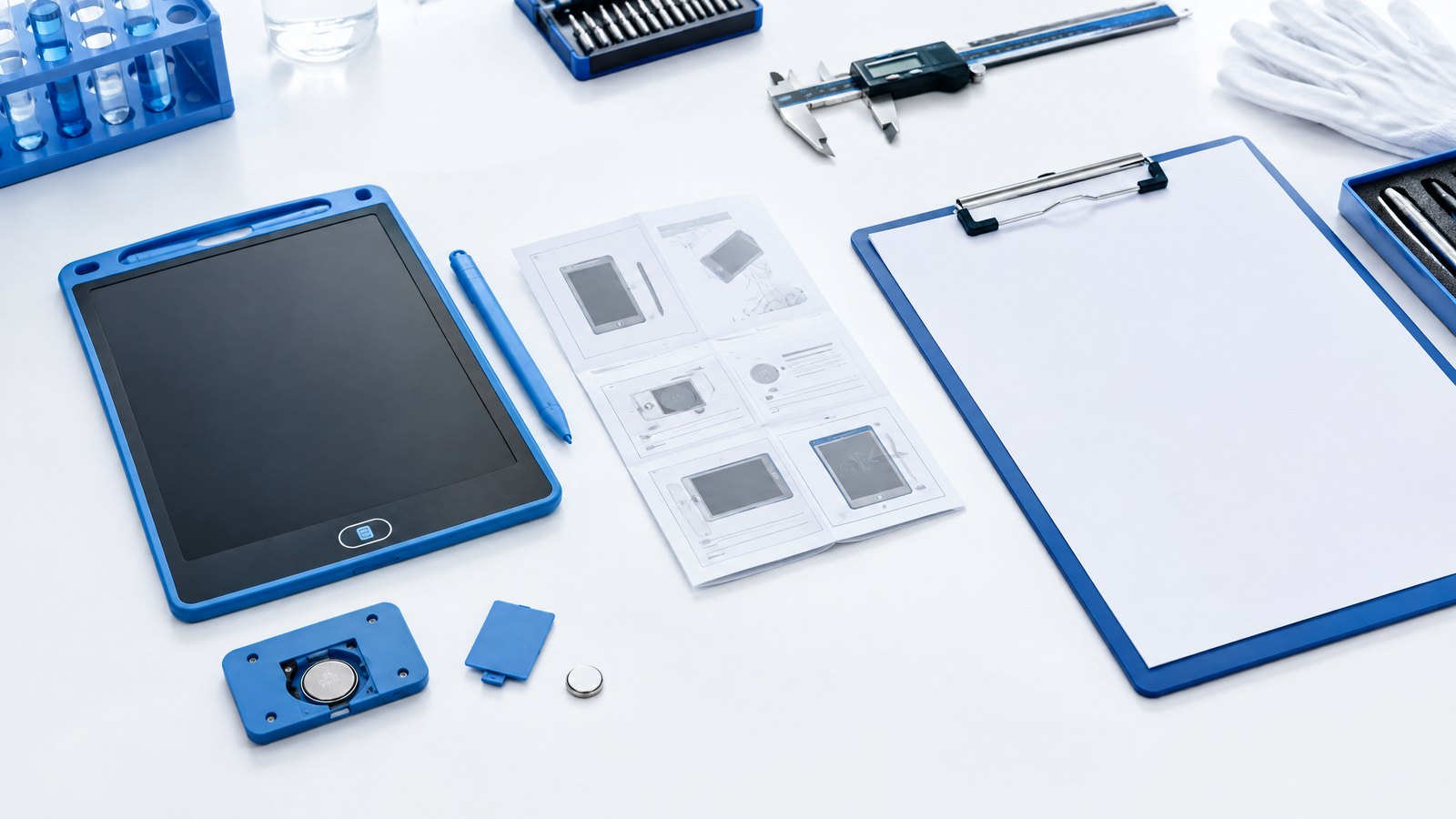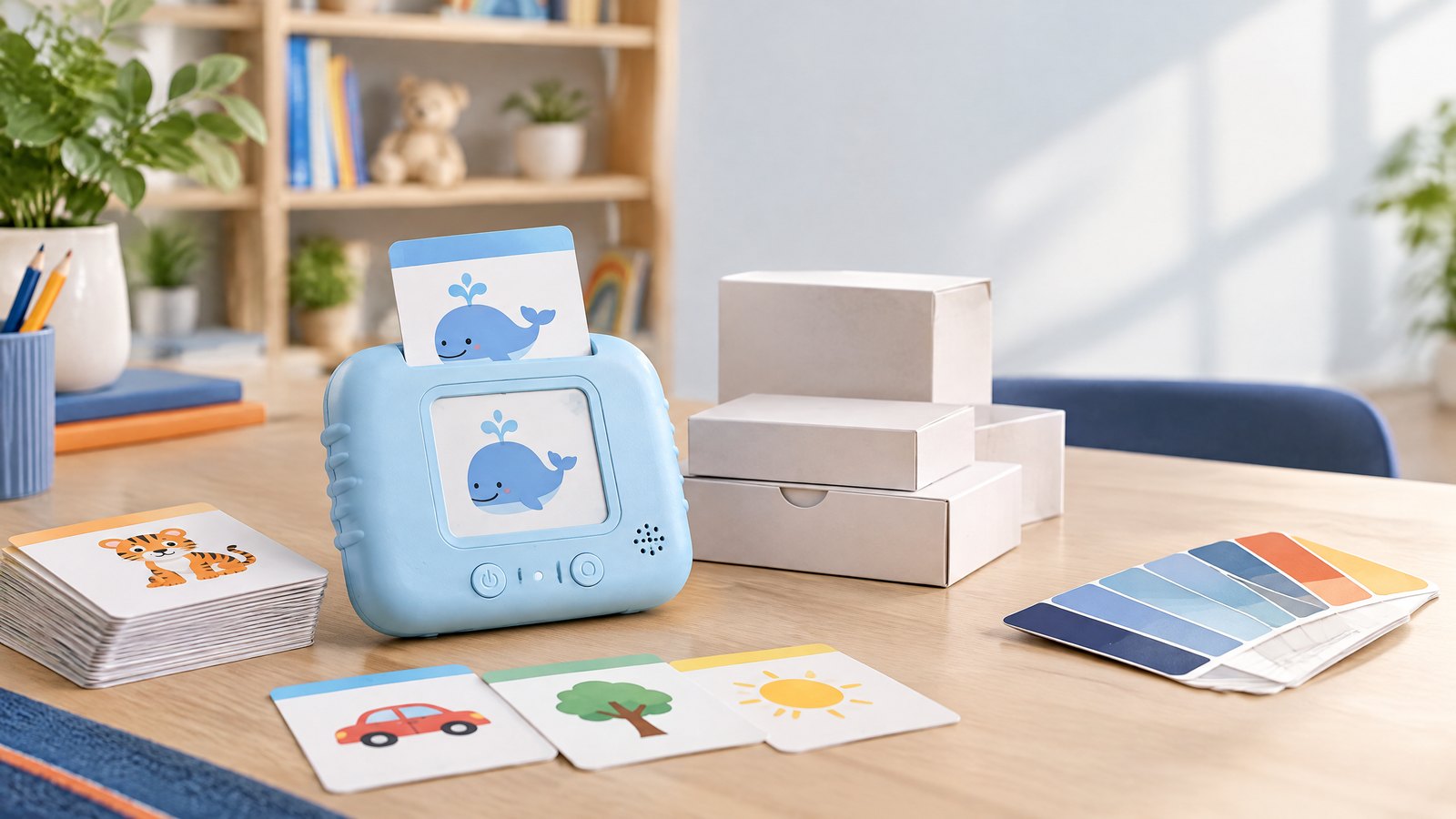

This guide provides a practical B2B decision framework. Final specifications, market obligations, testing scope, labels, packaging and shipment requirements must be confirmed for the exact finished SKU and destination.
2. Direct-Answer Introduction
A realistic LCD writing tablet OEM project timeline is not a single factory lead time. It is a controlled sequence of commercial, technical, regulatory and logistics decisions. For a platform-based private-label LCD writing tablet with settled specifications and print-ready artwork, buyers should normally plan roughly 12–22 weeks from a complete brief to goods-ready, then add the selected transport and destination receiving window. A project that changes the enclosure, display stack, battery system, electronics, firmware or wireless function should be budgeted as a product-development program rather than a relabelling exercise; it may take materially longer because the sample, verification and compliance work must be repeated.
The calendar becomes credible only when each phase has a defined owner, a written input and a clear release decision. The useful milestones are: approved brief; confirmed quotation and commercial terms; signed golden sample; locked artwork; compliance evidence plan; production release; in-process acceptance; pre-shipment inspection release; freight handover; and launch readiness. A date without its prerequisite is merely an estimate.
For LcdWritingTablet, a Shenzhen OEM/ODM manufacturer of LCD writing tablets, talking flashcard machines and smart electronic badges, the practical starting point is to decide whether the proposed tablet is a standard platform with brand customization or a true engineering change. That choice determines whether the critical path is artwork and materials preparation, or design validation and regulatory review. It also prevents a common mistake: treating a request for a rechargeable battery, new housing colour, different stylus retention, child-oriented packaging or a new radio feature as a simple logo order.
This guide uses planning ranges, not a promise of a production date. Actual timing depends on the confirmed bill of materials, order quantity, country of sale, seasonal capacity, testing laboratory queues, carrier rules and the buyer’s speed of approval. Regulatory duties also attach to the product and market, not to a generic label. In the EEA, for example, the manufacturer is responsible for conformity assessment, technical documentation, an EU declaration of conformity and CE marking when applicable; the CE mark is not an approval certificate issued by the EU.1 If a U.S.-bound version is a children’s product subject to CPSC rules, the domestic manufacturer or importer must support a Children’s Product Certificate with required evidence, often including testing by a CPSC-accepted laboratory.2
The objective is therefore not to rush every step. It is to remove uncertainty early, freeze the right inputs once, and preserve enough time to correct an issue before mass production or shipment. Buyers who want a milestone-based feasibility review can send their intended market, target launch date, quantity and customization scope to info@lcdwritingtablet.com.
3. Who This Guide Is For
This guide is for procurement managers, brand owners, retailers, distributors, educational suppliers and marketplace operators planning a first or repeat order of LCD writing tablets. It is particularly useful when the purchasing team needs to translate a marketing launch date into a supplier schedule that the quality, compliance, logistics and commercial teams can all accept.
A standard-platform buyer may be sourcing an 8.5-, 10- or 12-inch pressure-sensitive LCD writing tablet with a replaceable coin cell or a rechargeable configuration, a stylus, erase function, lock control and retail packaging. The buyer’s timeline question is usually operational: “How quickly can a market-ready version of an established model be branded, approved, made and delivered?” The answer depends less on the tablet’s nominal size than on whether the exact configuration, graphics and destination requirements are fixed at the start.
An OEM buyer may request a differentiated moulding colour, enclosure texture, logo application, packaging structure, accessory set, battery arrangement or small functional change. Those changes may affect materials, assembly instructions, artwork, test samples or transport documents. They should be described precisely in the brief and released in a controlled change record.
An ODM or engineering buyer is proposing a new industrial design, a new printed circuit board, firmware behavior, a rechargeable power system, data connection or wireless feature. This party needs more than a purchase order timeline. It needs a design-input baseline, engineering builds, validation criteria, applicable-market assessment and a formal rule for what happens if a design change occurs after testing. A connected tablet should never be treated as equivalent to a passive writing tablet: U.S. intentional radiators generally require FCC Certification, while devices containing only digital circuitry may follow the Supplier’s Declaration of Conformity route when the applicable rules allow it.3
The guide is also appropriate for buyers who will sell through Amazon or another channel that can request documentation after listing. Marketplace readiness is not achieved by creating a listing. Amazon states that sellers must be able to demonstrate, through valid compliance documentation, that their offered products meet regulatory and policy requirements.4 The documents, product markings and approved production configuration must therefore align before inventory is dispatched.
4. Buyer Decision Framework
Start with the launch date and work backwards
Begin with the date when sellable inventory must be available at the warehouse, fulfillment centre or distributor—not the date when the supplier finishes assembly. Work backwards through destination receiving appointments, customs clearance allowance, international transport, inspection, production completion, materials readiness and final approval. Then add a management buffer for a failed sample, document correction, artwork query or carrier disruption. The buffer is not wasted time; it is the time that prevents a small exception from consuming the launch window.
Separate three dates in the purchase plan. Goods-ready date means the accepted order is packed and available for handover. Shipment handover date means the cargo is released to the agreed forwarder under the agreed Incoterm. Launch-ready date means inventory has been received, channel documents and product pages are complete, and the responsible selling entity can support the product records. Conflating these dates is a frequent source of missed launches.
Classify the project before asking for a date
Use the following classification at the quotation stage. It should be confirmed in writing with the supplier because a “minor” request can change the critical path.
| Project class | Typical scope | Critical path | Planning implication |
|---|---|---|---|
| Platform private label | Existing tablet configuration; logo, carton graphics or standard colour options | Artwork approval, component allocation, packaging materials | Usually the shortest route once all files and commercial terms are complete |
| Configured OEM | Changes to colour, accessory kit, battery option, stylus treatment, packaging format or specification combination | Sample acceptance, material confirmation, documentation alignment | Allow time for configuration-specific sample review and any required retesting |
| ODM / engineering change | New housing, tooling, PCB, firmware, power architecture, wireless function or non-standard display | Engineering builds, validation, tooling and market assessment | Treat as a development program; do not publish a launch date before a verified plan exists |
The decision is not just semantic. It controls the version of the bill of materials (BOM), the sample identity, the test specimen and the inspection checklist. If the production version is not traceable to the approved version, a “passed” sample cannot reliably release a mass order.
Use decision gates, not informal approvals
A decision gate is a point at which the buyer explicitly accepts the available evidence and authorizes the next irreversible commitment. A disciplined LCD writing tablet project has at least seven gates.
Gate 1 — Brief complete. The buyer confirms the intended user and sales market, model or target dimensions, power format, content of the pack, language, branding method, packaging, quantity, desired delivery point, target launch date and required documents. The supplier confirms which requests are standard, configurable or developmental. No quote should silently assume a standard model when the brief describes a new electrical feature.
Gate 2 — Quote and responsibility complete. The parties align on the product configuration, price basis, payment milestones, Incoterm, sample cost treatment, lead-time assumptions, inspection standard, warranty or claims process, and who owns each document. This is also the moment to identify the importer, seller of record and party responsible for marketplace submissions. Cost is only comparable when the product, packaging and delivery basis are comparable.
Gate 3 — Golden sample approved. The buyer approves a uniquely identified physical sample and its companion specification sheet. It should show the screen response, erase and lock functions, body color, stylus, logo position, labels, packaging and instruction wording applicable to the order. Approval must state either “approved for production” or list deviations. A casual message such as “looks good” is not an adequate production release.
Gate 4 — Artwork and labeling locked. The buyer signs off final editable and production-ready files, including dielines, barcodes, country-specific warnings, traceability fields, battery or disposal information where applicable, manual and outer-carton markings. The artwork gate is often later than buyers expect because labels must reflect the final legal entity and exact product configuration.
Gate 5 — Compliance route accepted. The buyer and responsible economic operator agree on the applicable-market assessment, existing evidence that may be relevant, gaps requiring testing, sample allocation, report naming, declarations or certificates, and document custody. For EU sales, GPSR applies to consumer products and requires a responsible economic operator in the EU to be entrusted with product-safety tasks; it also strengthens lifecycle risk assessment.5 This gate is not a legal opinion. It is a project-control point that identifies which competent advisers, laboratories or authorities must be consulted.
Gate 6 — Production release. The buyer releases the approved BOM, quality agreement, final artwork, quantity split and inspection plan after confirming that materials and components match the accepted configuration. After this gate, changes should be controlled through a written change order with explicit impact on cost, sample, testing, documents and date.
Gate 7 — Shipment release. The buyer reviews the final inspection outcome, quantity reconciliation, packing list, shipment marks, battery transport evidence where relevant, commercial documents and freight booking. The order should not be shipped merely because it is complete; it should be shipped because it is demonstrably the released version.
Identify the time killers while they are still reversible
Four risk categories recur. Definition risk arises when the buyer has not specified which exact product is being purchased. Approval risk arises when several internal stakeholders can reject artwork or samples but no owner has deadline authority. Evidence risk arises when test reports are sought only after production has begun, or when the submitted sample differs from the sellable configuration. Logistics risk arises when the booking, battery classification, carton data, destination appointment or customs paperwork is considered only after the goods are packed.
A realistic project plan does not solve these risks with optimistic dates. It assigns a decision owner, a due date and a fallback decision. If an instruction manual translation is late, for example, the fallback could be to move the launch or keep that market out of the first shipment—not to ship an unapproved version.
5. Comparison, Cost, Quality and Specification Planning Table
The table below is a buyer planning model for a standard, non-wireless LCD writing tablet project. The ranges are illustrative working windows after the preceding gate is complete, not factory commitments, and they can overlap only where the supplier confirms that work is independent. The project manager should replace them with a written critical-path schedule after the quotation and sample scope are agreed.
| Phase and release | Buyer deliverable | Supplier / project output | Typical planning window | Main cost or quality lever | Gate that prevents rework |
|---|---|---|---|---|---|
| Brief and feasibility | Market, quantity, target date, product and packaging requirements | Scope classification, assumptions and open-question list | 2–5 business days | Choosing platform vs development scope | Brief complete |
| Quote and commercial alignment | Delivery basis, payment expectations, responsibility matrix | Configured quotation, sample plan and provisional schedule | 3–7 business days | Configuration, MOQ, packaging complexity, destination | Quote accepted |
| Sample build and review | Approved specification and artwork draft | Identified sample, photos/specification record, exception list | 1–3 weeks for a platform configuration | Number of iterations, special finishes, non-standard parts | Golden sample approved |
| Artwork and label release | Final copy, legal entity details, barcodes, translation approval | Print proofs and released production files | 1–3 weeks, often concurrent with sample review | Carton construction, number of languages, late copy changes | Artwork locked |
| Compliance preparation | Destination-market plan and responsible party details | Evidence matrix, sample allocation, document list | 1–2 weeks to define; testing time varies | Battery type, children’s positioning, wireless or electrical changes | Compliance route accepted |
| Materials and mass production | PO release, final BOM, signed approvals | Material readiness, line plan, finished goods | 3–6 weeks after materials are ready | Component availability, seasonality, quantity, change control | Production release |
| Inspection and shipment release | AQL or acceptance plan, forwarding instructions | Inspection records, packing data and release package | 3–7 business days plus booking time | Inspection scope, rework, carton accuracy, freight mode | Shipment release |
| Transit, receipt and launch | Booking, import setup, channel assets | Handover, arrival, receiving and listing activation | Mode- and route-dependent | Carrier capacity, customs, warehouse appointment | Inventory and documents ready |
The most useful cost control is not the lowest unit price. It is scope stability before materials are committed. A buyer can usually compare quotations only after standardizing the model, quantity, power source, display size, casing, accessories, logo method, packaging, testing responsibility, Incoterm and delivery point. A lower unit price with no specified inspection, incomplete carton work or an excluded battery document can move cost and risk to the last week of the plan.
Quality should likewise be expressed as acceptance criteria rather than as a slogan. For an LCD writing tablet, define the sample’s expected writing visibility and erase behavior under agreed viewing conditions; lock-button operation; battery-compartment or charge-port condition as applicable; stylus fit and retention; cosmetics; logo location; packaging count; label legibility; carton drop or handling requirements if agreed; and traceability marking. Do not make pass/fail acceptance depend on a vague statement such as “high quality.”
6. Product, Application and Technical Detail That Changes the Timeline
The LCD writing tablet is simple only when its configuration is stable
A typical LCD writing tablet uses a pressure-sensitive writing surface, a display stack, a controller or erase circuit, a protective enclosure, a stylus and a power source. In many models, the erase action applies a voltage to clear the writing surface. A lock function may prevent accidental erasure. These characteristics make the device useful for notes, drawing, checklists, low-stakes learning activities and reusable messaging, but they also make exact configuration important: the perceived screen contrast, erase behavior, case fit and stylus experience should be evaluated on the sample, not assumed from a generic product photograph.
The quickest projects retain an existing platform’s electrical and mechanical architecture. Branding, print and retail-packaging work can be planned around a known product. The schedule changes when a request alters the product’s safety, transport or electromagnetic profile. Examples include changing from a coin cell to a rechargeable lithium-ion battery, adding a USB charging interface, altering the battery compartment, changing the PCB, adding Bluetooth or another transmitter, or proposing a new enclosure with child-use claims. Each may require a new review of documents and test sample relevance.
A rechargeable model also creates a logistics workstream. IATA classifies lithium-ion batteries contained in equipment as UN 3481 and states that, except for certain button cells installed in equipment, manufacturers and subsequent distributors of cells or batteries and equipment powered by them must make available the applicable UN 38.3 test summary.6 The 2026 IATA guidance identifies the information expected in that summary, including manufacturer and laboratory details, report ID and date, battery description, test results and the responsible person. A buyer should request the evidence during compliance preparation, not after a forwarder asks for it at pickup. The exact classification, packing instruction, labels and carrier acceptance remain matters for the shipper and forwarder to confirm for the actual battery and route.
Marketing language can reclassify the work
The intended user and claims made on packaging, manuals and online listings can change the project’s regulatory and quality-control tasks. A general desk accessory is not necessarily evaluated the same way as a product designed or marketed primarily for children aged 12 or under. CPSC explains that children’s products subject to a safety rule require third-party testing and a written CPC from the domestic manufacturer or importer, supported by results from a CPSC-accepted laboratory.2 A buyer should therefore freeze the target age, the product’s use position and child-directed claims before the first compliance sample is dispatched.
Similarly, calling a tablet “wireless,” “connected,” “app-enabled” or “Bluetooth” is not a cosmetic copy change. It can introduce radio approval, firmware control and antenna-related verification work. For U.S. market planning, the FCC distinguishes the more rigorous Certification process for certain RF devices from SDoC and states that intentional radiators are generally certified, while unintentional radiators are generally authorized through SDoC unless a rule says otherwise.3 Confirm the applicable rule and responsible party with appropriate technical and legal resources before freezing any radio specification.
Compliance evidence must match the production version
Compliance preparation should create an evidence matrix rather than a pile of PDFs. The matrix should list the SKU, product revision, markets, applicable requirements confirmed for the product, test or assessment needed, named document, issuing party, sample identity, issue date, document holder and renewal or review trigger. It should also identify the importer or EU economic operator where relevant. This enables the team to discover a mismatch, such as a report for a non-rechargeable model being offered to support a rechargeable variant, before an order is locked.
For EEA placement, CE marking applies only to products covered by the relevant harmonisation rules; it must not be used as a generic quality badge.1 A buyer should not ask a factory to “add CE” as artwork. The proper sequence is to identify the applicable requirements, carry out the relevant assessment, compile the technical file and declaration where required, and then apply the marking correctly. For EU consumer-product sales, GPSR is complementary to specific safety law and places responsibilities on economic operators, including an EU-based responsible economic operator for each covered product.5
7. Sample, Testing and Quality-Control Workflow
Build a sample ladder, not a single approval moment
A reliable sample workflow has three levels. The first is a reference sample or off-the-shelf model used to establish the platform’s intended baseline. The second is a pre-production or customized approval sample that shows the intended BOM, color, logo, labels, stylus and packaging. The third is the production reference, often called the golden sample, retained and identified so that inspection and claims discussions can compare the mass order against the released standard.
At every level, record model number, revision, power source, screen size, casing color, logo method, accessories, packaging version and date. Photograph the front, rear, battery or charging area, stylus, key labels, carton panels and contents. If a feature cannot be observed in a photo, note the functional check. This small record prevents the familiar dispute in which the buyer approved one version and production follows another.
Test the product, the pack and the information
The product-functional review should define practical checks appropriate to the selected configuration. These may include writing response across the active area, clearing action, lock function, stylus and tether condition if fitted, sharp-edge or loose-part observation, battery-compartment accessibility and closure, charge/indicator behavior if rechargeable, power-on behavior for any electronic module, and cosmetic inspection under agreed lighting. No generic list replaces the product-specific specification; a rechargeable, connected or child-directed SKU requires additional, tailored review.
The packaging review is equally important. Confirm the SKU and barcode mapping, carton count, product orientation, inserted manual, language version, warning text, internal protection, outer-carton marks and final dimensions and weights. These inputs are needed by the buyer’s warehouse and forwarder. A compliant product in incorrect packaging can still be rejected at receiving or produce an inaccurate marketplace listing.
The information review confirms that labels, instructions and online claims agree with the approved product. It catches errors such as a battery statement that does not match the actual power source, a model number different from the test document, or a children’s claim added after the compliance plan was made. For CPSC-covered children’s products, the certificate needs specific product identification, cited rules, certifying firm details, record keeper, manufacture data, testing data and laboratory identification.2 Those fields are easier to produce accurately when the final SKU and manufacturing-location information were controlled from the beginning.
Convert quality expectations into an inspection release
Before production, issue an inspection checklist and acceptance plan that link back to the golden sample. State the sampling method or acceptance level, critical defects, major defects, minor defects, measurable tests, carton verification, rework rule and re-inspection rule. If a third-party inspection is desired, book it before the order is complete so there is time for corrective action. The factory’s internal checks and an independent pre-shipment inspection serve different governance purposes; the buyer may choose either or both depending on risk appetite.
An effective pre-shipment release package includes the inspection result, defect summary and corrective-action evidence where needed; final quantity; packing list; carton markings; approved artwork reference; production lot or traceability information; and the transport and compliance documents required for the destination. It should show whether the inspected units match the released configuration. A passed inspection does not cure a regulatory mismatch, and a test report does not prove that cartons contain the approved SKU. Both checks are necessary.
8. Ordering and Implementation Preparation
Assign one owner for each decision
The buyer should create a simple responsibility matrix before accepting the quote. Commercial procurement owns price, payment and contractual terms. Product or brand owns the brief and golden-sample approval. Regulatory or external advisers own market-specific interpretation and evidence review. Quality owns acceptance criteria and inspection release. Logistics owns the forwarding instruction, delivery point and customs readiness. Marketplace operations owns listing copy, images and document submission. One named project lead should own the integrated timeline and escalate overdue approvals.
The purchase order should identify the exact model/SKU, revision, quantity, color or configuration split, accessory set, packaging version, approved artwork, price and currency, delivery term, inspection condition, document package and change-control rule. Attach or reference the current specification, BOM summary, approved sample record and quality plan. A PO that says only “LCD writing tablet” is too broad to protect either party against an avoidable version dispute.
Prepare launch assets before the cargo departs
The final weeks should be used for tasks that do not require the shipment to have arrived: listing content, accurate product measurements and weights, user instructions, product images based on the approved sample, barcode mapping, warehouse labels, inbound booking, return-handling plan and customer-service answers. These materials must be version-controlled. Do not reuse a competitor’s claims or use a generic listing image that shows features absent from the approved model.
Marketplace teams should maintain a retrieval folder with the final invoice, packing list, test reports and declarations where relevant, certificate records, product labels, manuals and product photographs. Amazon’s public seller guidance says sellers must be able to demonstrate compliance through valid documentation.4 Keeping authentic, original records that correspond to the SKU reduces the risk of a rushed, inconsistent response if a document is requested later.
Responsible sourcing should also be treated as a project input where the buyer’s policy requires it. The OECD describes due diligence as a way for businesses to understand and implement responsible business conduct across impacts involving workers, human rights, environment, bribery, consumers and corporate governance.7 It is not a substitute for product compliance, but it can inform supplier onboarding questions, escalation channels and record retention.
Apply change control to protect the launch
After production release, any change should be documented against five questions: What changes? Which SKU/BOM/artwork/document changes with it? Does it affect testing or market obligations? Who must approve it? What is the cost and date impact? The safest answer to a late “small change” is sometimes to defer it to the next batch. This is not inflexibility; it protects the evidence and quality record of the batch that is already released.
9. Practical Applications and Scenarios
Scenario A: A retailer needs a branded standard tablet for a seasonal program
A retailer selects an existing non-wireless platform, a standard color option and a printed carton. The critical path is a complete brief, barcode and packaging copy, branded sample approval, materials reservation, production, pre-shipment inspection and delivery to the retailer’s nominated warehouse. The retailer should set its internal copy and legal review deadline ahead of sample completion, because a delayed warning or translation can stop packaging release even when the tablet itself is ready. This is the project type most likely to fit the 12–22-week planning envelope if approvals are prompt and compliance requirements are known.
Scenario B: An education supplier wants a rechargeable version
The buyer has a standard platform in mind but asks for USB charging and a rechargeable lithium-ion battery rather than a coin cell. The battery choice creates a different technical, safety and freight documentation path. The team should first establish whether the selected configuration is an existing, evidenced model or a modification; then obtain the applicable battery information and UN 38.3 test summary before freight booking. The launch plan should include enough time for configuration-specific sample evaluation, evidence review and carrier confirmation. The project should not inherit the lead time of the coin-cell SKU by default.
Scenario C: A U.S. brand positions the tablet for young children
The brand intends to market the item primarily to children 12 and under. The project starts by defining product use, age grading, materials, packaging claims and applicable CPSC rules with qualified support. If the product is subject to a children’s product safety rule, CPSC’s framework requires third-party testing by an accepted laboratory and a CPC from the domestic manufacturer or importer.2 The team allocates compliant production-representative samples and verifies that labels, certificates and final product identity align. The decision to make child-directed claims therefore belongs before—not after—the packaging artwork is locked.
Scenario D: A distributor wants a connected premium model for multiple markets
The distributor requests a custom enclosure, rechargeable battery and Bluetooth connectivity for sale in the United States and EU. This is an engineering and market-entry program, not a quick private-label order. The schedule needs design inputs, engineering samples, firmware control, radio review, power-system evidence, market-by-market documentation, packaging, validation and a pilot or pre-production approval stage. For the U.S., the transmitter function generally invokes the FCC Certification route; for EEA sales, the manufacturer’s conformity assessment and technical documentation responsibilities apply under the relevant rules.1 3 The buyer should only announce the launch after the plan for the exact connected configuration has passed its technical and compliance gates.
10. Detailed FAQ
How long does an LCD writing tablet OEM project really take?
For a standard-platform private-label order, plan approximately 12–22 weeks from a complete brief to goods-ready, plus transportation and destination receiving time. The lower end assumes fast decisions, available materials, one accepted sample and a known compliance path. The upper end is more prudent when artwork, labels, testing, production capacity or shipping require coordination. New tooling, electronics, firmware, rechargeable batteries or radio features can extend the timeline substantially. Ask for a schedule that names dependencies rather than accepting a single undifferentiated lead-time number.
When should I request a quotation?
Request it after you can state the intended market, target quantity, product configuration, power source, branding method, packaging scope, target delivery point and desired launch date. You do not need every graphic file to receive a preliminary quote, but you do need enough specificity for the supplier to identify assumptions. Request that the quotation separate standard elements from custom or developmental elements and identify what would change price or lead time.
What should a golden sample include?
It should represent the production-intended configuration as closely as practical: the tablet model and revision, screen and casing, battery or charging arrangement, stylus and accessories, logo application, labels, manual, retail packaging and carton markings. It should also have an identifier and an accompanying specification record. If a sample uses temporary artwork, substitute parts or a different power system, record the deviation and require another approval when the production-intended element becomes available.
Can existing test reports be used for my branded order?
Possibly, but only after confirming that the report applies to the exact configuration, components, markets and regulatory question at issue. A report for an earlier product variant, a different battery, another factory location or another intended use may not answer the question that your selling entity must support. Do not alter reports. Build an evidence matrix and seek qualified regulatory and laboratory guidance where appropriate. In the EEA, CE marking is the manufacturer’s declaration that relevant legal requirements have been met, not a transferable generic certificate.1
What documents should be ready before production and shipment?
Before production release, maintain the approved specification, BOM or configuration record, golden-sample approval, artwork files, quality plan, market evidence plan and any required product labels/manuals. Before shipment release, add inspection results, packing list, final commercial and freight documents, lot or traceability details and battery transport evidence where relevant. For lithium batteries, IATA says the applicable UN 38.3 test summary must be made available for covered cells, batteries and equipment, subject to the stated exception for certain button cells installed in equipment.6
Who is responsible for EU and U.S. compliance?
Responsibility depends on the product, supply chain and market role. For EEA sales, manufacturers are responsible for conformity assessment, the technical file, EU declaration of conformity and CE marking where CE rules apply; importers and distributors also have obligations to ensure compliant products are placed on the market.1 GPSR additionally calls for an EU responsible economic operator for each covered product.5 For U.S. children’s products subject to CPSC rules, the domestic manufacturer or importer issues the CPC, backed by required evidence.2 Contractual allocation with a supplier does not remove statutory duties, so confirm roles with qualified advisers.
When should I book a pre-shipment inspection?
Book it before production completion, based on the agreed date when a sufficient quantity is packed and available. Provide the golden-sample record, acceptance criteria, SKU split and carton requirements to the inspection party. Leave time for a corrective action and re-inspection if a material problem is found. Do not wait for the forwarder’s pickup date; that leaves no recovery window.
What is the biggest avoidable timeline risk?
The biggest avoidable risk is releasing production while the product definition is still moving. Late changes to power source, child-use positioning, wireless functions, artwork, legal entity information or packaging can invalidate a sample, evidence plan or booking assumption. Use written change control and decide whether the change belongs in the current batch or the next one.
11. Conclusion and Final Email-Only CTA
A dependable LCD writing tablet OEM project timeline is built from releases, not optimism. Start with a complete commercial and technical brief; classify the work as platform private label, configured OEM or engineering development; approve a traceable golden sample; lock artwork and compliance preparation before production; inspect against agreed criteria; and separate goods-ready, freight handover and launch-ready dates. That sequence makes the project easier to manage because every stakeholder can see the next decision and the consequence of delaying it.
The buyer’s most valuable contribution is early clarity: intended market, user positioning, exact power configuration, product claims, packaging content, delivery point and ownership of compliance records. The supplier’s most valuable contribution is a transparent scope, a configuration-specific sample path, controlled production records and timely shipment information. Neither side should use a generic document, an unapproved sample or a vague “same as usual” instruction to bridge a gap in the record.
For a milestone-based review of an upcoming LCD writing tablet, talking flashcard machine or smart electronic badge program, email LcdWritingTablet at info@lcdwritingtablet.com with your target market, planned quantity, preferred configuration and required launch date.
References
Turn this sourcing plan into a product brief.
Share your target market, product requirements, packaging preference and estimated volume for a practical OEM / ODM discussion.