This guide provides a practical B2B decision framework. Final specifications, market obligations, testing scope, labels, packaging and shipment requirements must be confirmed for the exact finished SKU and destination.
2. Direct-answer introduction
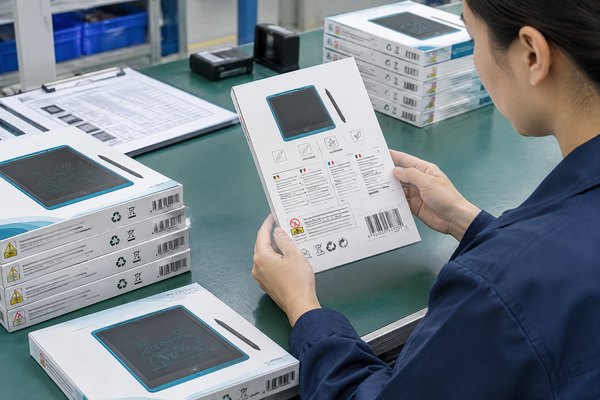
Buyers should review an LCD writing tablet label as a market-specific evidence sheet, not as a final graphic decoration. Before mass production, reconcile the product itself, consumer package, instruction leaflet, online listing data, and master-carton identifiers against one controlled label matrix. The review should confirm product identity, intended age and classification, required warnings, country of origin, responsible economic-operator details, traceability code, retail barcode, disposal marks, instructions, languages, and the exact artwork version approved for print.
The key decision is not whether a package looks complete. It is whether every statement and mark is correct for the precise SKU, battery configuration, target market, sales channel, and intended user. A reusable board supplied to a school, an adult office memo pad, and a child-directed drawing tablet may have similar hardware yet create different labeling and documentation questions. Treating every unit as a toy—or, conversely, assuming a child-directed product is general use—creates avoidable risk.
This LCD writing tablet packaging label checklist is designed for B2B buyers sourcing from LcdWritingTablet, a Shenzhen OEM/ODM manufacturer. It is a procurement workflow, not legal advice or a conformity assessment. The importer, brand owner, and other responsible economic operators must determine the applicable law, product classification, warnings, language versions, registrations, and test/certification route for each destination. Requirements change, and country-level rules can add to the United States and EU examples below.
A practical first step is to send the destination markets, product photos/specification, intended age, battery details, retail channels, barcode owner, and draft artwork to info@lcdwritingtablet.com. Ask for a label-zone drawing and a pre-production proof; retain external compliance advice where the product or claim requires it.
3. Who this guide is for
This guide is for procurement, product, packaging, quality, regulatory, and e-commerce teams buying or private-labelling LCD writing tablets for resale. Use it when changing a brand, model, screen-size description, stylus/attachment, age claim, battery configuration, destination, importer, carton, retail barcode, language panel, or compliance-related claim.
It applies to retail, promotional, educational, and distributor programmes. A reusable board sold to a school, an adult office memo pad, and a child-directed drawing tablet can share hardware but have different product-classification, warning, documentation, and channel needs. Decide by intended use, marketing, target user, configuration, and destination, not by a generic factory pack.
Working assumptions and limits
This article assumes a conventional electronic LCD writing tablet with an erase function, stylus or comparable input, and possibly a battery. It does not assume every model is a toy, uses a button/coin cell, needs the same symbols, or is regulated identically in every country. It is a procurement guide, not legal advice or a conformity assessment.
In the U.S., a children’s product is one designed or intended primarily for children 12 or younger; covered products generally require applicable third-party testing and a Children’s Product Certificate (CPC).1 A toy must comply with applicable provisions of ASTM F963-23 under 16 CFR Part 1250.2 In the EU, toys need CE marking and the required safety process; Directive 2009/48/EC remains relevant during the transition to Regulation (EU) 2025/2509, which applies from 1 August 2030.3 The responsible brand/importer must validate the classification and country-specific requirements for each SKU.
4. Buyer decision framework
Step 1: Freeze the commercial truth
Before reviewing graphics, make a one-page label facts brief for each sellable SKU: internal SKU; model/version; brand owner; product name; exact contents; intended user and age grade; destination countries; origin-decision owner; battery facts; applicable documentation owner; GTIN owner/digits; importer/contact data; languages; and proposed claims. A designer should never complete missing facts by assumption.
Claims such as “educational,” “safe,” “non-toxic,” “eco-friendly,” “CE certified,” or “Made in USA” need an evidence owner. An unqualified Made in USA label claim requires an “all or virtually all” basis; a U.S. brand or address is not enough.4 The FTC also cautions against broad, unqualified environmental-benefit claims and says a recyclability claim may need qualification where suitable facilities are not available to at least 60% of relevant consumers or communities.5
Release rule: If a statement cannot be supported by a specification, supply-chain record, test/certification file, licence, or written owner approval, remove it or hold the artwork.
Step 2: Classify every item in the label matrix
Build a matrix with element; target market/legal basis; approved wording/location; evidence owner; artwork revision. Give each item one status:
- Legal/regulatory requirement — applies only if the product, market, and circumstance trigger it.
- Channel/customer requirement — retailer, marketplace, fulfilment, or distributor instruction.
- Contractual/OEM requirement — a purchase-order, golden-sample, or quality-agreement control.
- Buyer best practice — a useful control such as a QR link to a controlled instruction page, but not a universal legal requirement.
This distinction stops both under-labelling and the misleading practice of printing every possible symbol.
Step 3: Map the information to the correct surface
| Surface | Purpose | Review test |
|---|---|---|
| Product | Durable identity, model/lot and origin where appropriate | Does the mark stay readable through normal handling? |
| Consumer package | Purchase-stage facts, warning, retail scan | Is decision-critical information visible before purchase? |
| Insert/instructions | Detailed safe use, care, disposal, languages | Does it match the delivered configuration exactly? |
| Master carton | Shipment, quantity and logistics traceability | Does it identify the packed SKU/lot without replacing consumer information? |
For EU toys, purchase-decision warnings, including applicable age limits, must be visible on consumer packaging or otherwise before purchase, including online.6 A warning only inside an insert is therefore not an adequate default.
Step 4: Control the artwork release
Approve two things separately: content (every word, mark, code, address, claim, and language) and production (size, material, placement, legibility, and scanning). The release must identify filename, revision, date, dimensions, colours, placement drawing, language list, and permitted variable fields. Reapproval is required for a change to product label, battery label, mold marking, carton, printer, material, barcode rendering, text, importer, or product configuration. “Same as last order” is not a controlled specification.
5. Comparison, cost, quality, and specification table
Use the following table to compare label choices during quotation and pre-production. The cost observations are relative planning considerations, not price quotations; ask for a written, SKU-specific costed specification.
| Label element | What good looks like | Requirement status to verify | Cost/quality trade-off | Pre-production acceptance evidence |
|---|---|---|---|---|
| Product identity | Brand, accurate product name, model/SKU and box contents agree across device, pack, insert and listing | Market/channel dependent; identity and traceability can be regulated | More variants increase artwork and inventory-control complexity | Annotated artwork and SKU master match |
| Age grading and warnings | Target age is evidence-led; wording/pictogram and placement match applicable rule | Potentially legal for a child-directed/toy product | Small print area can compromise readability; do not shrink required content to preserve graphics | Age rationale, regulatory review, marked proof |
| Origin statement | Correct country and method/location are conspicuous and durable enough for the market | U.S. origin marking commonly required unless an exception applies | Mold/print marking costs more to change than a carton panel; removable stickers can fail | Origin determination and physical label sample |
| Manufacturer/importer details | Correct legal identity, postal and electronic contact details; no obsolete entity | Potentially legal in the EU and elsewhere | Variable-data label permits destination changes but adds controls | Contact owner’s written approval and market matrix |
| Traceability code | Human-readable lot/run/date logic linked to production records | Potentially legal; always valuable best practice | Thermal/inkjet coding is flexible but needs contrast and rub testing | Code schema, first-off sample, record lookup test |
| Barcode | Buyer-owned, correct GTIN encoded and human-readable digits; scannable at intended point of use | Usually channel requirement, not proof of safety | Poor contrast, truncated height or glossy distortion causes rejection/rework | ISO/IEC-compliant verifier report and retail scan check |
| Disposal/recycling marks | Only applicable, licensed, correctly sized marks; instructions do not overclaim recyclability | Can be legal, national, or licence-based | Extra marks add plate space and legal review; misuse can create liability | Market review, licence/registration confirmation where applicable |
| Instructions and languages | Clear, configuration-specific, translated/checked for destination markets | Potentially legal; varies by market | More languages add panels/pages and proofing effort | Approved source text, translation sign-off, folded sample |
| Artwork governance | Controlled files, zones, revision, approval initials and change log | Buyer best practice/contractual | Upfront document control prevents scrapping and shipment holds | Final production PDF, approval register, sealed sample |
A lower unit packaging cost is not automatically lower landed risk. The apparent saving from one generic, English-only back panel can be overwhelmed by a relabel operation, channel refusal, withdrawal, or inability to isolate a batch. Conversely, printing every conceivable mark “just in case” may create false claims or trademark exposure. Buy the right, evidence-backed panel for each market, not the fullest-looking panel.
6. Product and technical detail: the label content buyers must reconcile
Product identity and claims
Use one product identity across the device, consumer pack, insert, GTIN record, purchase order, invoice description, and online listing. A practical format is brand + product family + verified descriptor + model code + colour/variant. Match pictures and the box-contents list to what ships. A marketing name alone is not adequate traceability.
Link every printed performance, material, compatibility, or environmental claim to the current specification and evidence owner. That is a content-control discipline; it is not a replacement for product testing.
Age grading, warnings, and instructions
Age grading must follow the product’s intended use and risk assessment, not a stock “3+” icon. CPSC staff explains that age determinations match product characteristics to children’s skills, play behaviours, and interests, and encourage marketing and labelling to the determined age group.7 ASTM F963-23 contains toy age-grading guidance and labelling/instruction provisions within its scope.8
Keep a short age-grade rationale for each child-directed SKU: intended play/use; accessible or detachable components; stylus/attachment design; battery access; required user ability; foreseeable use/abuse; and warning decision. In the U.S., children’s products for under-threes that present a small-parts choking, aspiration, or ingestion hazard are banned; certain products containing small parts, balloons, small balls, or marbles need a choking-hazard warning under 16 CFR 1500.19.9 Do not copy a warning from another model.
For EU toys, applicable warnings must be clearly visible, legible, understandable, and accurate, on the toy, label, packaging and, as appropriate, instructions.6 The leaflet should identify the exact model and give only verified operating, care, supervision, battery, storage, and disposal information. It needs a new review when the battery arrangement or included parts change.
Origin and responsible operators
A brand address, factory address, “designed by” line, and country-of-origin statement solve different problems. CBP states that foreign articles entering the U.S. must be legibly marked with the English origin country unless an exception applies; the mark must be conspicuous and as permanent as the article permits.10 Origin is generally the country of manufacture, production, or growth; a secondary-country process changes it only where the relevant origin rules, including substantial transformation where applicable, are met.11 The importer or customs adviser should own a complex origin decision before print.
Under the EU GPSR, manufacturers must provide a type/batch/serial or equivalent identifier and their name/trade name or mark plus postal and electronic address; importers must provide their own equivalent contact details without obscuring manufacturer information.12 EU toy guidance separately highlights manufacturer identity, traceability, importer name/address, instructions, and warnings.13 Use a destination-specific data block rather than an improvised over-sticker.
Traceability, barcode, and disposal marks
A GTIN barcode is not a production lot code. GS1 explains that UPC/EAN symbols encode a GTIN, while other data carriers can carry batch/lot, serial, or date attributes.14 For U.S. children’s products, CPSIA Section 103 calls for permanent distinguishing marks on product and packaging, to the extent practicable, enabling manufacturer/private-labeler, location/date of production, and cohort/run information to be determined.15 Specify a human-readable code—such as model / factory / month-year / run—and verify that it retrieves production and inspection records.
Use a brand-owner-issued GTIN, validate its digits, and verify the printed barcode rather than only the artwork. GS1 recommends an ISO/IEC-compliant verifier that measures symbol parameters and issues an overall grade.16
Do not use environmental or certification marks as decoration. In the EU, the WEEE separate-collection symbol is the crossed-out wheeled bin and must be visible, legible, and indelible; scope and national producer obligations still require assessment.17 Battery markings are separate: Regulation (EU) 2023/1542 requires the separate-collection symbol for batteries and sets implementation dates and small-battery placement rules.18 The Green Dot is a protected financing trademark, not a general eco-label, and normally requires a licence.19
7. Sample, testing, factory, and quality-control workflow
Do not approve labels from screenshots alone. Use this pre-production sequence:
- Open the matrix. Buyer supplies market list, facts brief, GTIN, origin direction, approved contacts, languages, channel manual, and claim/requirement decisions. Factory confirms label zones, print method, variable-code method, and product/package marking locations.
- Mark the proof. Number every panel and call out SKU, model, lot field, origin, contacts, warnings, marks, barcode, leaflet revision, and languages at 100% scale.
- Complete content review. The responsible brand/importer validates requirements and claims. Quality checks that age grade, warnings, instructions, and artwork correspond to the current bill of materials and supporting file; do not assume a report for a different variant covers this SKU.
- Inspect a physical proof and first-off unit. Check contrast, typography, folds, adhesion, placement, symbol clarity, barcode verification, device marking, battery information, and insert accuracy.
- Test record retrieval. Provide one first-off lot code and require retrieval of the production date/cohort, relevant inspection record, and shipment linkage. A traceability code without a retrieval path is not recall-ready.
- Seal the golden sample and inspect production. Record final revision and permitted variable fields. During production/pre-shipment inspection, compare units to that standard and stop release for a critical identity, required-information, or wrong-market-language defect.
This process supports but does not replace legal compliance. A U.S. CPC is written certification based on applicable testing and, for covered children’s products, CPSC-accepted third-party laboratory results; the CPC and supporting reports must be in English.1 CE marking is a manufacturer declaration within the applicable EU conformity process—not evidence created by printing the logo.3
8. Ordering and implementation preparation
Attach a Packaging Label Schedule to the purchase order. List each SKU/market pack, filename/revision, languages, material/finish, product-marking method, variable-code format, barcode specification, leaflet revision, master-carton mark, inspection criteria, and change-control rule. Attach the final PDF and placement drawing; do not rely on an editable shared link.
Before release, answer these questions:
- Who owns every statement, mark, translation, GTIN, origin determination, importer block, and claim?
- Which fields are fixed and which are factory-variable? Who approves the variable-data template?
- Does a separate destination SKU or language pack protect legibility better than a “universal” carton?
- What test/declaration/licence/registration/retailer document supports each assertion?
- Which change—battery, component, supplier, configuration, language, market, importer, printer—requires reapproval? How will obsolete stock be quarantined or destroyed?
Online information must match the package. GPSR Article 19 requires distance-sale offers to visibly provide manufacturer contact/identification information, relevant responsible-person information, and applicable product/warning/safety information.20 Do not assume a carton or QR code can correct missing pre-purchase data.
For an OEM/ODM review, email info@lcdwritingtablet.com with the market matrix, SKU list, intended user, battery configuration, barcode data, and artwork. Ask that every open assumption is marked in the proof, not silently completed.
9. Practical applications and scenarios
Child-directed U.S. retail tablet
Start with product classification and an age-grade rationale, then assess small parts and other applicable requirements before adding a “3+” label. Align the tested/approved configuration with device and package tracking marks, origin treatment, warning, insert, and buyer-owned UPC. A physical proof should confirm that the stylus, lot code, barcode, and box contents all match the SKU.
EU private-label tablet across languages
Build a country/language matrix rather than reducing four languages to unreadable type. For an in-scope toy, complete the applicable safety assessment/conformity path, CE marking, warnings, identity, traceability, importer data, and instructions. Review WEEE/battery obligations and national producer responsibilities rather than copying a bin icon. Check that the importer block does not cover another required element and that folds leave purchase-stage warnings visible.
Adult corporate giveaway or late importer change
An office-oriented tablet may centre on identity, origin, traceability, contact data, and battery/disposal information rather than toy language; classification still depends on the actual intended use and marketing. A QR link can be a useful controlled instruction aid, but not a way to hide information that must be on-pack.
If the importer changes after artwork approval, stop release. Update the market data block and online information, check placement and legibility, issue a new revision, and quarantine prior print stock. Treat it as a product-pack configuration change, not a minor administrative edit.
10. FAQ
1. Is a barcode enough for product traceability?
No. A UPC/EAN normally identifies the trade item through a GTIN. Production traceability needs a lot, run, date, serial reference, or equivalent linked to records. Use both controls.
2. Can we put “3+” on every LCD writing tablet?
No. Age grading follows intended use and product evidence. It does not replace small-parts analysis, required warnings, testing/certification, or product design controls.
3. Does a CE mark mean the EU has approved the package?
No. For an in-scope toy, CE marking is the manufacturer’s declaration after the applicable conformity process. It does not remove the need for correct warnings, identity, traceability, economic-operator information, instructions, and language treatment.
4. Can the factory address serve as the importer address?
Only if it is genuinely the required responsible operator for the destination. Verify the importer’s exact legal name and postal/electronic contact details and keep manufacturer and importer information distinct.
5. Can we say “Made in China” because final packing happens in Shenzhen?
Not automatically. The applicable origin determination must support the statement. Packing is not a universal origin rule; ask the importer or customs specialist to confirm a complex supply chain before artwork is released.
6. Are WEEE, battery, recycling, and Green Dot symbols interchangeable?
No. They have different legal, technical, and trademark meanings. Apply only a mark that is applicable, substantiated, correctly rendered, and authorised.
7. Do instructions have to be on the retail box?
Not always. Placement depends on the applicable rule and information type. But purchase-stage warnings may need to be visible before purchase, and instructions/safety information may need to accompany the product in specified languages.
8. What makes an artwork sign-off valid?
A controlled record linking the final file and revision to SKU, markets, languages, controlled text/marks, variable fields, placement drawing, barcode proof, approvers, and release date. Any controlled change requires reapproval.
11. Conclusion and final email-only CTA
A defensible packaging-label review is an early procurement control: establish the product and market facts, classify each label element, map it to the correct surface, validate it on a physical proof, and release only a controlled revision. The most valuable output is not a more crowded box. It is a traceable, readable, evidence-backed set of product, package, insert, online, and carton identifiers that stays aligned through production.
Before mass production of an LCD writing tablet, require a final review of identity, claims, age grade, warning logic, origin, manufacturer/importer details, traceability, barcode, disposal marks, instructions, languages, and artwork change control. For a packaging label-zone drawing or pre-production artwork review, email info@lcdwritingtablet.com with your target markets, SKU list, battery configuration, intended user, and current artwork. Use email for the complete approval trail.
References
Footnotes
-
U.S. Consumer Product Safety Commission, “Children’s Product Certificate” (accessed September 30, 2026). ↩ ↩2
-
16 CFR Part 1250, “Safety Standard for Toys” (current eCFR page accessed September 30, 2026). ↩
-
European Commission, “Toy Safety in the EU” (accessed September 30, 2026). ↩ ↩2
-
Federal Trade Commission, “Complying with the Made in USA Standard” (accessed September 30, 2026). ↩
-
Federal Trade Commission, “Environmental Claims: Summary of the Green Guides” (accessed September 30, 2026). ↩
-
Directive 2009/48/EC on the safety of toys, Article 11 and Annex V (EUR-Lex, accessed September 30, 2026). ↩ ↩2
-
CPSC Staff, Age Determination Guidelines: Relating Consumer Product Characteristics to the Skills, Play Behaviors, and Interests of Children (2020) (accessed September 30, 2026). ↩
-
ASTM International, “ASTM F963-23: Standard Consumer Safety Specification for Toy Safety” (scope summary accessed September 30, 2026). ↩
-
CPSC, “Small Parts Ban and Choking Hazard Labeling” (accessed September 30, 2026). ↩
-
U.S. Customs and Border Protection, “Marking of Country of Origin on U.S. Imports” (accessed September 30, 2026). ↩
-
U.S. Customs and Border Protection, “Marking of Country of Origin on U.S. Imports”—origin and substantial-transformation guidance (accessed September 30, 2026). ↩
-
Regulation (EU) 2023/988 on general product safety, Articles 9 and 11 (EUR-Lex, accessed September 30, 2026). ↩
-
European Commission, “Placing Toys on the EU Market” (accessed September 30, 2026). ↩
-
GS1, “GS1 Barcodes” (accessed September 30, 2026). ↩
-
Consumer Product Safety Improvement Act of 2008, Section 103, Tracking Labels for Children’s Products (GovInfo, accessed September 30, 2026). ↩
-
GS1, “How can I measure the quality of my printed barcodes?” (accessed September 30, 2026). ↩
-
Directive 2012/19/EU on waste electrical and electronic equipment, Article 14 and Annex IX (EUR-Lex, accessed September 30, 2026). ↩
-
Regulation (EU) 2023/1542 concerning batteries and waste batteries, Article 13 (EUR-Lex, accessed September 30, 2026). ↩
-
PRO Europe, “The Green Dot Financing Symbol” (accessed September 30, 2026). ↩
-
Regulation (EU) 2023/988 on general product safety, Article 19 (EUR-Lex, accessed September 30, 2026). ↩
Turn this sourcing plan into a product brief.
Share your target market, product requirements, packaging preference and estimated volume for a practical OEM / ODM discussion.