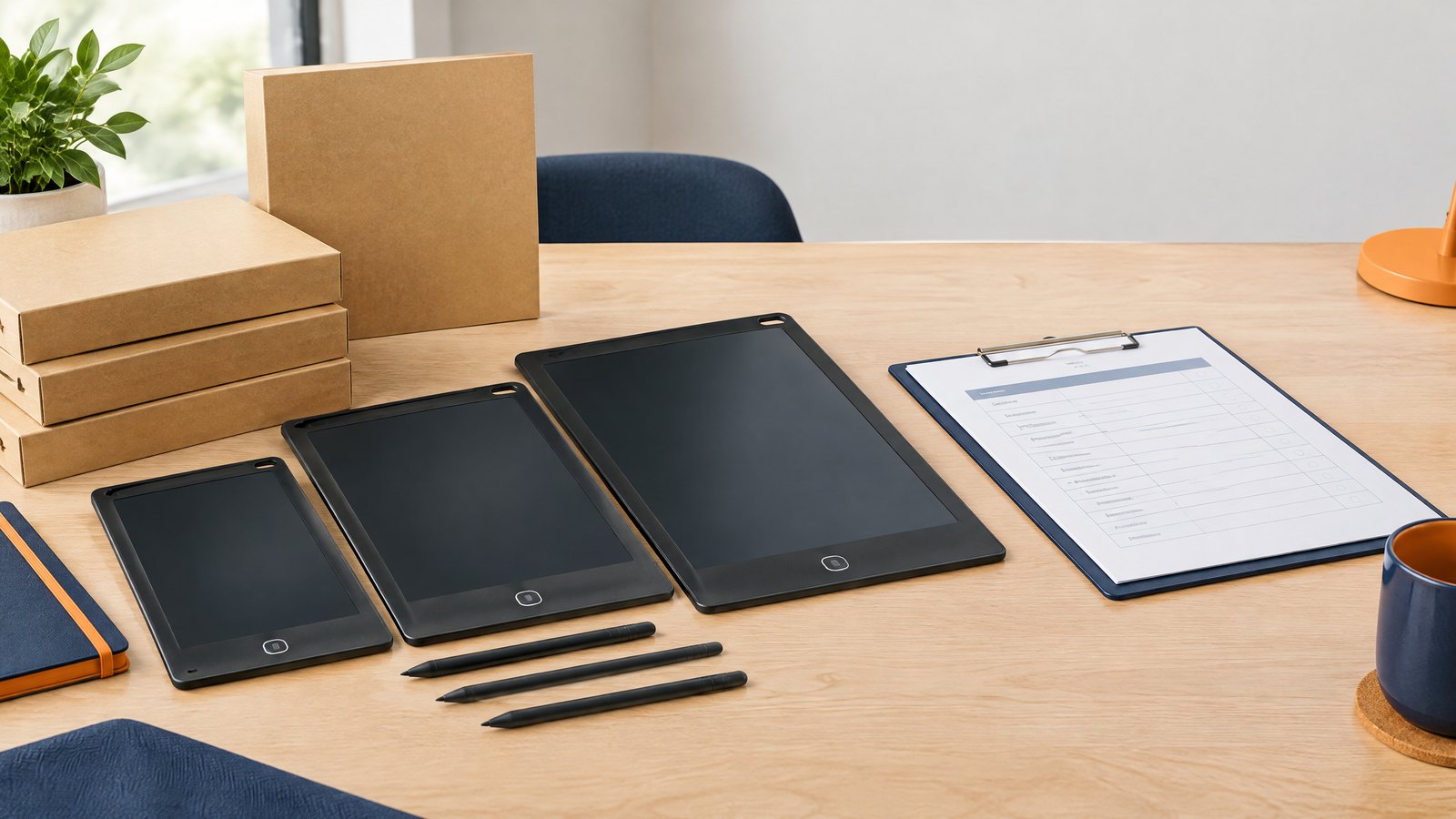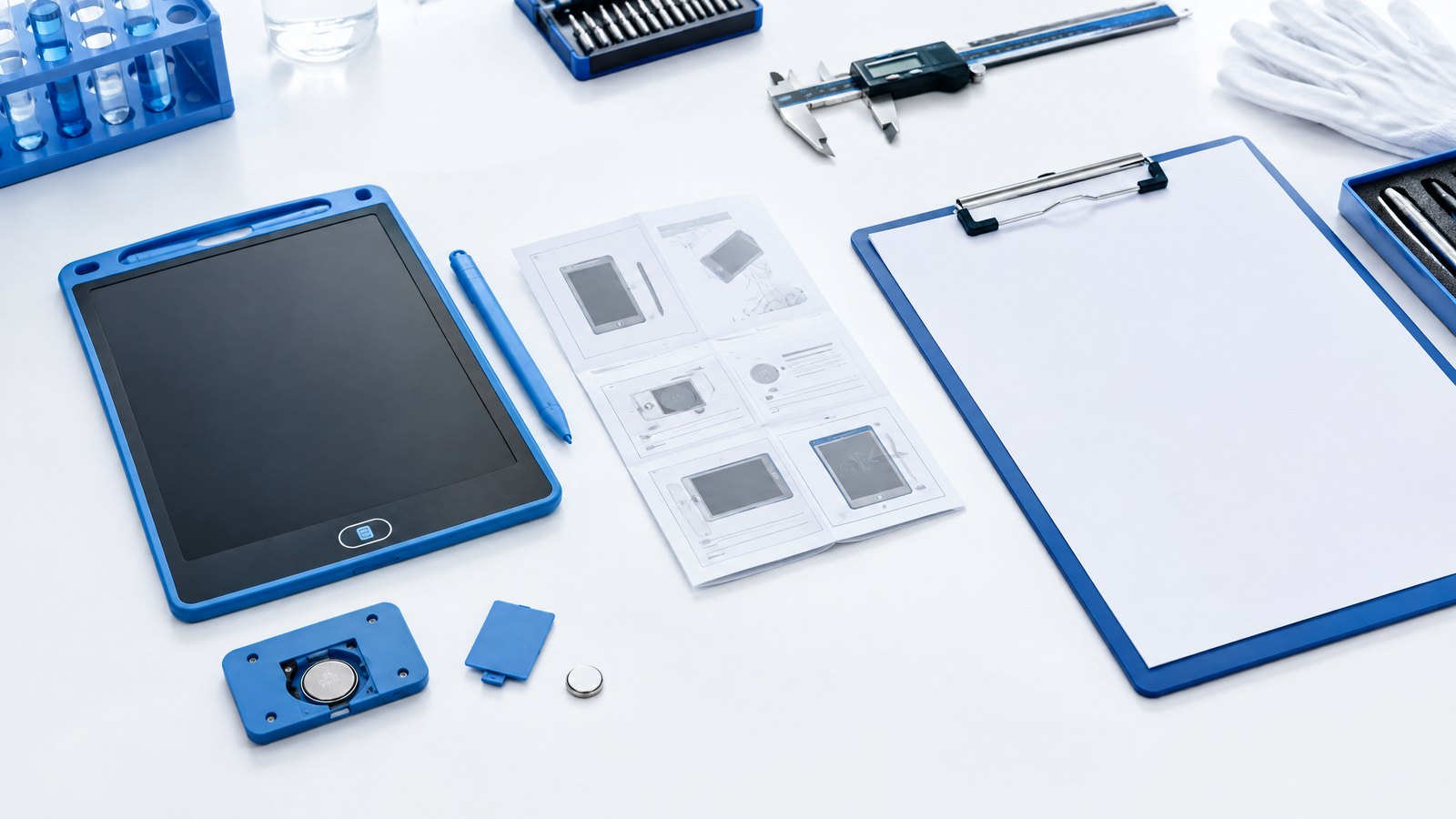

This guide provides a practical B2B decision framework. Final specifications, market obligations, testing scope, labels, packaging and shipment requirements must be confirmed for the exact finished SKU and destination.
Introduction
Direct answer: Buyers should approve an LCD writing tablet screen by testing the exact production-intent sample in the intended lighting, at the intended viewing distance, with the intended stylus and packaging—not by judging a catalog image. Compare the visibility of fresh marks, the completeness of erase, lock operation, screen tint, and cosmetic consistency. A monochrome or rainbow panel is not automatically better; the right choice depends on the product application, user age, retail claim, and sales channel.
LCD writing tablets are reflective writing surfaces. Their appearance changes with room light, viewing angle, the color of the writing trace, bezel color, and the amount of content on the screen. A product that looks clear under a photography light can feel faint in a retail aisle, a school desk position, or a home near a window. This is why screen color and contrast deserve a written approval method.
For an importer, contrast is not just a design preference. It affects whether a child can follow a tracing card, whether a retail customer understands the product on first use, whether a promotional recipient keeps using it, and whether a support team receives “screen does not work” complaints when the screen is behaving as designed. This guide explains how to create a practical evaluation process without promising a performance value that has not been validated on the final SKU.
1. What “screen color” and “contrast” mean on an LCD writing tablet
An LCD writing tablet normally creates a visible mark when pressure from a stylus changes the appearance of the writing layer. The board is not a backlit computer display and is not designed to behave like a conventional tablet screen. Its useful performance is the visible difference between the unwritten background and the fresh mark under normal intended conditions.
Monochrome, rainbow, and transparent formats
Monochrome LCD writing tablet models normally show one dominant writing color against a darker background. They can suit note-taking, office, school, and simple drawing use where a consistent, readable line is the primary goal.
Rainbow LCD writing tablet models show several writing colors across the panel. They can support a more playful product application, drawing, gift sets, and child-directed retail concepts. Color boundaries and perceived brightness can vary by panel design, so the buyer should approve the exact sample rather than relying on a generic “multicolor” description.
Transparent or tracing-oriented formats place extra importance on how a guide card remains visible through or behind the working surface. That use case should be evaluated with the approved card, not with handwriting alone. See our transparent tracing tablet guide for card-fit and visibility questions.
Contrast is an application question
A high-quality commercial decision starts with a task. A compact memo board might only need short notes visible at arm’s length. A school activity may need letters and arrows visible to a learner at desk distance. A counter-sign application may need larger writing viewed from farther away. Write the intended task into the product brief before evaluating samples.
Avoid terms such as “HD,” “bright screen,” or “high resolution” for a standard LCD writing tablet unless they accurately describe a substantiated technical feature. A more useful product claim is factual and observable: “reusable pressure-writing surface with one-button erase,” followed by the approved size and function.
2. Start with a sample-approval test environment
Direct answer: The sample test should reproduce likely use, not a factory showroom. Use ordinary indoor lighting, a second lighting condition relevant to the channel, the approved stylus, and a short written test sheet. Record the sample identifier, panel type, date, conditions, and reviewers.
Prepare the same conditions for each candidate
For each LCD writing tablet sample, record:
- model or supplier sample code;
- nominal screen size and active writing area;
- panel option, background tint, and claimed writing colors;
- stylus type and tip shape;
- lighting condition and approximate task location;
- viewer distance and user group;
- lock, erase, and battery configuration;
- packaging and retail artwork revision, if available.
Place samples side by side only after each has been tested individually. A side-by-side comparison is useful, but it can exaggerate small differences that may not matter in actual use. The decision should connect to the intended product application.
Use task-based writing, not random scribbles
Ask reviewers to write a short shopping list, a name, several numbers, a simple shape, and a small drawing. For a child-focused program, include a representative letter-tracing or drawing card. For an office program, include a meeting note or desk sign. The test should reveal whether thin strokes, longer lines, and normal handwriting remain useful.
If the item will be marketed to children, align the product test with the intended age and market review. The U.S. Consumer Product Safety Commission explains that products designed or intended primarily for children age 12 and under may have specific requirements; final obligations depend on the exact product and claims. CPSC children’s products guidance is a useful starting point, but it does not replace review of the final configuration.
3. A practical contrast and erase checklist
Check fresh writing across the usable area
Write in the center, near each corner, and alongside the edge of the active area. Review whether the mark remains sufficiently visible for the defined task. Do not require every panel to look identical to a product photograph. Instead, agree what the user must be able to do.
Useful acceptance wording can be: “Under the agreed indoor-light sample test, a reviewer can write and read the predefined test content across the usable writing area without an abnormal faint area or an unintended blank zone.” The factory and buyer should agree what “abnormal” means through the approved sample and inspection reference.
Check erase behavior after short and full writing
Clear a small note, then clear a screen filled with ordinary writing and drawings. Confirm that the intended erase control works, that the screen returns to its normal appearance, and that there is no unexpected persistent content that would affect ordinary use. Do not promise “zero ghosting” unless the final panel and acceptance method support that statement; faint residual appearance can be application-dependent and should be judged against the approved sample.
Check the erase lock as a user-control feature
Where an LCD writing tablet erase lock is included, activate it, press the erase control, then deactivate it and test again. Check that the lock position is distinguishable and that instructions explain it accurately. A lock can prevent accidental clearing, but it does not convert the board into a digital storage device. Avoid wording that suggests saved memory unless the exact product architecture provides it.
Check viewing angle and reflections
Move the board from flat on a desk to a normal hand-held angle. View it near a window and under typical room lighting. Note any reflection, color shift, or apparent decrease in mark visibility that could affect the approved use. No single angle suits every buyer; classroom, travel, counter, and e-commerce use create different expectations.
4. Select a screen option by channel and application
| Buying situation | Useful screen discussion | What to test before approval |
|---|---|---|
| School handwriting or tracing | Clear guide visibility, writing room, lock operation | Actual worksheets/cards, normal desk light, stylus retention |
| Gift or children’s retail | Color experience, quick understanding, pack presentation | Full-color artwork, representative child-safe workflow, complete pack |
| Office or promotional use | Readable notes, portable form, brand presentation | Short note task, logo position, individual pack and event lighting |
| Marketplace retail | Product-page accuracy and return prevention | Listing images, instruction wording, unit pack, real first-use test |
| Counter sign or reception task | Visible larger marks at ordinary viewing distance | Sign message, angle, counter light, erase/lock operation |
Screen choice should never be separated from packaging. A rainbow LCD writing tablet may need visual examples that accurately show its panel behavior. A monochrome model can benefit from a simple “write, lock, erase” graphic. Product photos should show the actual approved model and should not digitally intensify the writing trace to a level that consumers will not see in normal use.
Mid-article CTA
Need to compare screen options with your own retail or school use case? Send your requirements with the intended application, target market, expected quantity, screen size, and any artwork direction. We can help frame a sample checklist around the final SKU rather than a generic catalog description.
5. Turn the sample into a factory-testing reference
Direct answer: A good factory test does not merely say “screen checked.” It names the sample, the test content, the functional controls, the cosmetic reference, the sampling method, and the packaging revision.
After sample approval, create a controlled reference package. It should include the approved product sample or photos, dimensioned specification, current artwork, label positions, accessory list, and defined functional checks. The supplier’s factory testing can then compare production units against a reference that purchasing, quality, and sales understand.
Factory testing items to define
- Visual review of frame, panel, printing, stylus, and accessory fit.
- Writing response in representative positions across the active area.
- Erase response after the defined short and full-screen test.
- Lock-switch operation where fitted.
- Battery door, charging port, or battery label checks as relevant to the model.
- Screen-protection film, insert, and retail-pack inspection.
- Carton count, carton markings, and transit-protection review.
The level of sampling and applicable safety or compliance testing should be agreed for the destination market and exact model. A functional factory check is not a substitute for regulatory testing or documentation where those are required.
Include the panel in shipment inspection
Shipment inspection should use production units and current packaging—not an old showroom sample. Inspectors can write the same defined content, test the erase and lock functions, compare visible screen appearance to the approved reference, count accessories, and verify that the right labels and artwork are present.
If a buyer plans an independent inspection, share the approved test sheet in advance. This reduces the chance that an inspector evaluates the product against an uncommunicated personal preference rather than the agreed customer requirements.
6. Use honest product-page language
The most credible listing explains what the item does, how to operate it, and what it is not. For example:
- “Reusable LCD writing surface for notes and drawing.”
- “Write with the included stylus; press erase to clear when the lock is off.”
- “Panel color effect and mark visibility are model-specific; review the product images and instructions for the selected version.”
Avoid universal durability, lifetime, eye-health, storage, or sustainability statements unless they can be supported for the specific product and market. The UK Competition and Markets Authority’s Green Claims Code is a useful reminder that environmental claims should be clear, truthful, and substantiated. “Reusable” is generally more precise than a broad statement that a product is automatically environmentally friendly.
7. Buyer FAQ
Is a rainbow LCD writing tablet easier to read than a monochrome model?
Not necessarily. Rainbow panels create a different visual experience, while monochrome panels may better suit some note or learning tasks. Evaluate the final sample in the intended lighting and with the intended content.
How should I test LCD writing tablet contrast?
Test normal handwriting, thin lines, a simple drawing, and the intended application at realistic viewing angles and lighting. Agree the acceptable result against an approved production-intent sample.
Does an erase lock save writing?
No. An erase lock generally prevents the clear function from operating while engaged. It does not mean the device stores, syncs, or transmits writing unless the product specification expressly includes those functions.
Can screen color be changed after sample approval?
It may be possible, but a panel change can affect appearance, artwork, testing, price, timing, and documentation. Treat it as a controlled change and approve a new sample where necessary.
What should an inspector check on the screen?
Inspect writing response, erase response, lock behavior, visible defects, panel fit, protective materials, stylus function, accessories, packaging, and the agreed reference appearance.
Conclusion
The right LCD writing tablet screen is the one that supports a defined task and passes a repeatable sample test. Rather than selecting a model from a product photo, buyers should use an application-led review, test contrast and erase performance in representative conditions, document the approved reference, and carry those requirements into factory testing and shipment inspection.
That process improves product accuracy, helps retail teams communicate the real experience, and gives both supplier and buyer a clearer standard for production decisions.
Final CTA
Ask for product catalog and sample options when you are ready to compare monochrome, rainbow, or tracing-oriented LCD writing tablet configurations. Include your market, user group, screen size, desired functions, packaging direction, and estimated quantity.
Turn this sourcing plan into a product brief.
Share your target market, product requirements, packaging preference and estimated volume for a practical OEM / ODM discussion.