This guide provides a practical B2B decision framework. Final specifications, market obligations, testing scope, labels, packaging and shipment requirements must be confirmed for the exact finished SKU and destination.
Introduction
For importers, private-label brands and promotional-product buyers, choosing a writing tablet format is more consequential than choosing a number printed on the box. The screen diagonal affects how a child draws, whether an adult can read a checklist, how many units fit in a master carton, the perceived retail value, and the likelihood of damage or returns. It also changes the trade-off between a compact, impulse-buy item and a more visible desk, classroom or meeting tool.
LcdWritingTablet is a Shenzhen OEM/ODM manufacturing partner serving buyers in the United States, United Kingdom, Germany and France. This guide is written for the procurement team that needs to turn a broad request—“we need a tablet for children” or “we need a larger memo board”—into a clear product brief, sample plan and inspection standard. It explains the practical differences among common diagonals without implying that one size or specification fits every product program.
Important procurement note: Product dimensions, active writing area, display color, battery configuration, erase-lock design, material, packaging, applicable rules and test documents vary by model and destination. Confirm every requirement in the supplier’s current quotation, approved drawing and pre-production sample; do not rely on a generic online listing.
1. Direct answer: which screen size should a buyer choose?
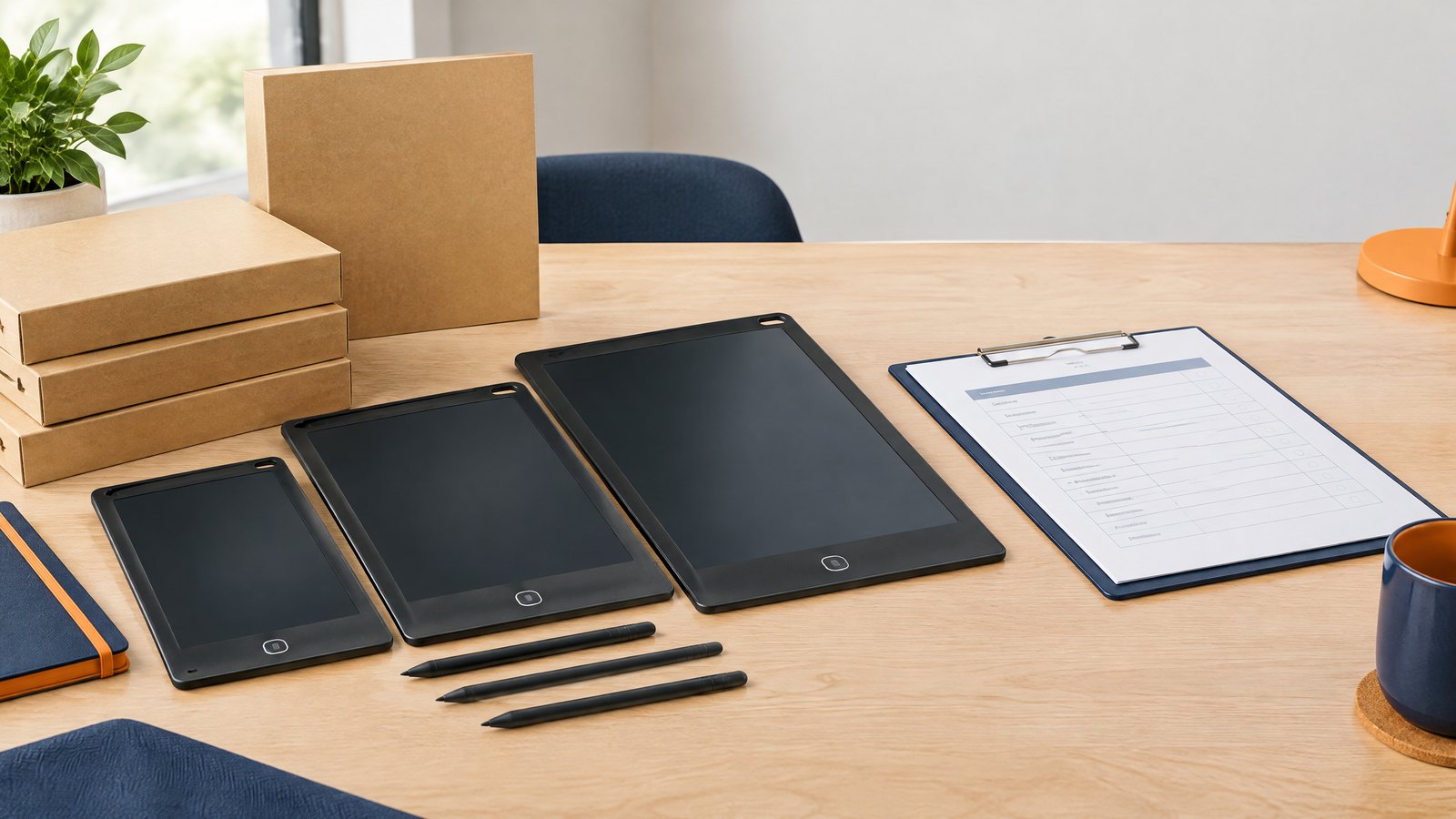
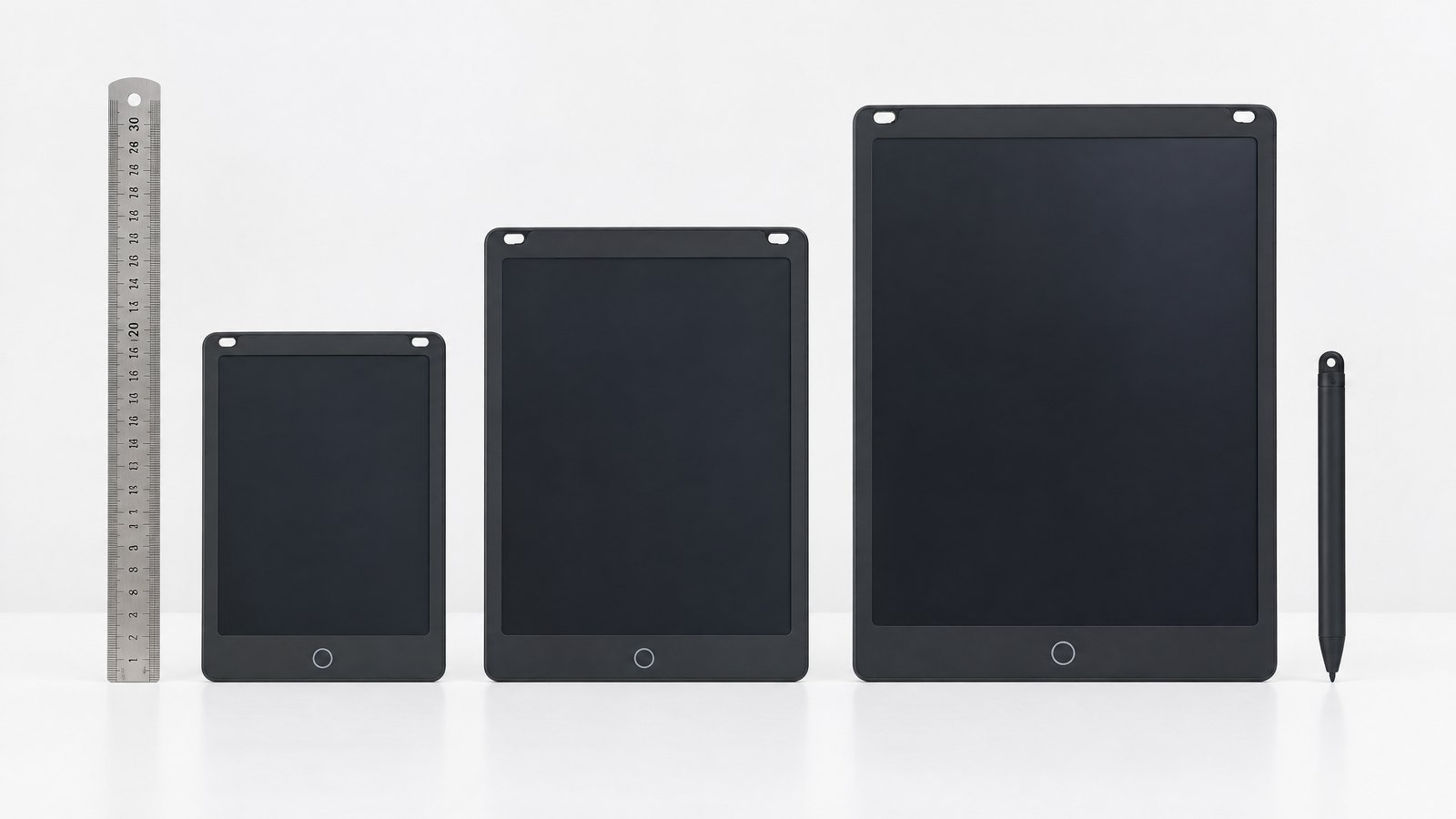
For most volume programs, 8.5 inches, 10 inches and 12 inches form a useful starting range. An LCD writing tablet 8.5 inch is usually the most bag-friendly and price-conscious choice for party favors, travel, take-away retail and younger children’s quick doodling. A 10-inch model is often the flexible middle ground: enough usable space for letters, sums and shopping lists, while still comfortable in a backpack. A 12-inch model gives a noticeably roomier canvas for learning activities, meeting notes and home message boards, although it needs more deliberate packaging and shelf planning.
Select by the job to be done, not by diagonal alone:
- Choose a compact format when portability, low unit volume and a simple retail price point lead the brief.
- Choose the mid-size format when the product must work across several age groups or use cases.
- Choose a larger board when legibility, drawing space, shared visibility or premium positioning matters more than pocketability.
- Ask for the active writing area, outer dimensions and net weight before comparing models. Two products sold under the same nominal diagonal can feel materially different once bezel width, handle shape and protective frame are considered.
A well-defined request might state: intended user, expected writing task, target outer-size range, desired active area, display behavior, color/stylus preference, power arrangement, pack configuration, destination market and acceptable price band. That brief is more actionable than “send your best size.”
2. Buyer context: screen size is a merchandising and logistics decision
A nominal screen size does not stand alone in B2B sourcing. The buyer is balancing user value with shelf footprint, carton cube, freight cost, fulfillment handling and branded presentation. In a mass-retail program, a compact board can hang easily or sit in a small window box. In a school-supply or gift channel, a larger board may support a stronger “learn, draw, erase, repeat” story and make the product easier to see at a distance.
An LCD writing tablet 10 inch is frequently a sensible starting sample because it illustrates the middle of these trade-offs. However, do not let “most common” substitute for consumer insight. A travel-oriented brand may need the smallest unit that still permits legible handwriting; an education distributor may prioritize a landscape writing field that accommodates early handwriting practice; a corporate-gift buyer may prefer a wider notepad form for meeting notes.
3. Product definitions: understand what is—and is not—being compared
An LCD writing tablet is generally a reusable pressure-responsive writing surface. A stylus or fingernail leaves a visible mark; an erase command clears the surface electronically. It is not normally a full-color backlit computer tablet, a scanning device, or a substitute for a durable archive. Exact behavior depends on the model, so claims about color, brightness, memory, erase function and lock function must be tied to a specific approved version.
Nominal diagonal versus usable surface
The quoted inch value normally refers to a diagonal measurement, but suppliers’ naming conventions can differ. Procurement should therefore record four separate measures:
- Nominal screen diagonal used in the commercial model name.
- Active writing area in millimetres or inches, where available.
- Overall product dimensions, including bezel, handle and stylus holder.
- Packaged dimensions and gross weight for fulfillment and carton planning.
Form factor, orientation and accessories
Tablet designs can be portrait, landscape or near-square. Portrait supports lists and letter practice; landscape can feel more natural for drawing, equation work or desk messages. Stylus docks, lanyard holes, carry handles, magnetic backs, fold-out stands and protective covers all change the product’s practical size and target user.
An LCD writing tablet 12 inch should not automatically be treated as merely a scaled-up child’s toy. Some larger formats are better specified as desk boards or home planners. Ask how the device will be held, stored and displayed, and select a frame and accessory set that fits that behavior.
4. Selection criteria: choose the right size with a decision framework
The most reliable size decision combines user task, environment and channel economics. Use the following criteria in your comparison sheet.
Usable writing space and hand position
Children draw with wider hand movements than adults making a short list. Very small boards can create frustration if a user’s hand covers the work area or if letters must be squeezed together. Larger boards offer more freedom, but can be less manageable for a toddler using the product while seated in a car or restaurant. Request a photo or dimensioned drawing that shows active area, not only the front silhouette.
Portability, storage and breakage exposure
A slim compact unit is easier to place in a handbag, school bag or activity kit. Bigger formats are more visible but have more edge length exposed in transit and more opportunity for corner damage if packaging support is inadequate. The correct LCD writing tablet screen size is therefore the smallest format that lets the intended user complete the main task comfortably.
Age range and supervision context
Age suitability is a product, packaging and compliance decision—not only an ergonomic decision. Younger users may value a chunky perimeter, tethered or stowed stylus and a simple erase interaction. Older children and adults may prefer a thinner, more desk-like product. Never assign an age grade merely from a diagonal; evaluate small components, battery access, instructions, foreseeable use and applicable destination requirements.
Retail and brand positioning
Compact options support entry-price, checkout, travel and multipack concepts. Mid-size products are flexible for seasonal gifts and general stationery. A large LCD writing tablet may support classroom, family-calendar, creative or premium-office messaging, but the merchandising plan must pay for its greater cube. Consider a family where the visual language, packaging and display message are consistent across sizes; this makes future line extensions easier.
Total cost rather than ex-works price alone
Compare unit price with retail box volume, carton quantity, dimensional freight, damage allowance, inserts, batteries where included, and compliance/testing budget. Ask for separate quotations for each screen option using the same pack configuration. A low factory price can be offset by inefficient carton utilization or higher retail damage risk.
Mid-article CTA — build a comparable sample brief: Send LcdWritingTablet your target market, preferred diagonal range, use case, artwork concept, pack quantity and must-have functions. Request a model-by-model quotation that identifies active area, outer size, battery arrangement, packaging assumptions and lead-time assumptions, then approve a physical sample before production.
5. Technical specifications: the data points to place on the quotation
Treat specifications as an approval matrix, not marketing copy. The following fields are useful for comparing 8.5-, 10-, 12-inch and larger models. Values must be confirmed against the current quotation and sample because they vary by model.
| Specification | Why it matters | What to confirm with the supplier |
|---|---|---|
| Nominal diagonal and active area | Determines actual writing comfort | Diagonal convention; active width × height; tolerance if offered |
| Overall dimensions and thickness | Determines packaging and shelf fit | Finished dimensions including bezel, stand and stylus dock |
| Screen type and writing appearance | Influences consumer expectation | Monochrome or multi-color effect; line visibility; pressure response |
| Erase mechanism | Core product interaction | Single-button or other design; expected response; lock behavior |
| Lock function | Helps prevent accidental clearing | Lock location, icon, user instructions and any limitations |
| Power system | Affects safety, service and packing | Battery type/quantity, replaceability, battery inclusion and compartment design |
| Housing and stylus material | Influences feel and durability | Resin, finish, color, seams, stylus retention and decoration method |
| Orientation and mounting | Changes application fit | Portrait/landscape; stand, magnet or hanging feature if applicable |
| Retail and master packaging | Determines landed cost and damage control | Box material, insert, unit count, carton dimensions, marks and drop-protection concept |
Avoid ambiguous performance claims
Words such as “unbreakable,” “waterproof,” “eye-safe” and “eco-friendly” need substantiation and a defined scope. Do not promise battery life or erase cycles without a model-specific basis; use sample-verifiable language instead.
Sample-level functionality checks
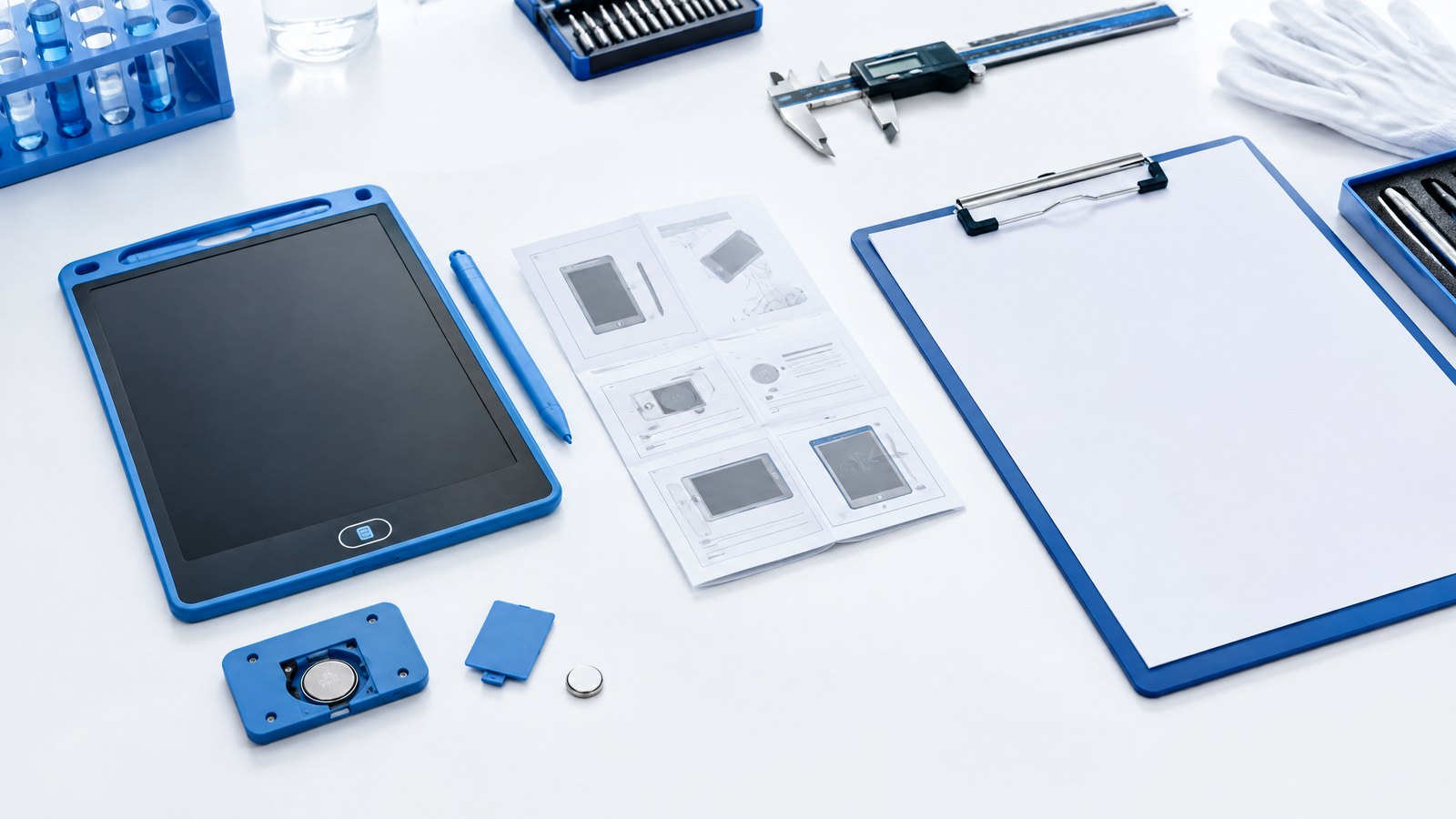
During sample review, check writing visibility in representative indoor lighting, the feel and reach of the erase button, lock behavior, stylus fit, seam finish, sharp-edge risk, front artwork alignment and the interaction between tablet and retail insert. If a product includes a replaceable button/coin cell, pay particular attention to compartment access and instructions for the intended market.
6. Factory and quality evidence: turn approval into traceable control
Responsible OEM/ODM buying relies on agreed evidence rather than general assurances. A realistic development flow begins with a written specification and artwork brief, followed by an engineering or sales confirmation of the proposed model. The buyer should approve the relevant sample—often a decorated or packaging sample where branding is involved—before bulk output is released. This is the point to catch a size misunderstanding, an inconvenient stylus location or a misleading box claim.
For a screen product, define the writing pattern, visual conditions, erase action, lock check and acceptable cleared appearance in the inspection plan. Use the agreed sample as the functional reference for the purchase order.
Recommended evidence package
Ask the supplier to provide or agree on the following as appropriate to the order and market:
- Approved product specification, dimensioned drawing or model sheet.
- Signed-off product, color and packaging sample record, including revision/date.
- Bill-of-material or component confirmation when it affects safety or compliance.
- Incoming, in-process and final inspection checkpoints agreed in advance.
- Screen-writing, erase and lock-function checks against the approved sample.
- Packaging checks: barcode placement, language copy, warnings, carton marks, insert fit, count and edge/corner protection.
- Pre-shipment inspection report, defect classification and corrective-action path when an issue is found.
- Destination-relevant declarations, test reports or labels only when they apply to the final configuration.
Pre-shipment inspection that reflects real risks
An inspection should sample finished packed goods, not only loose devices. Verify screen appearance, erase operation, lock operation where included, housing/stylus assembly, decoration, pack count, barcode scan, packaging presentation, sealing and master-carton markings. Compare carton dimensions and gross weight to the freight booking assumptions. If an independent inspector is used, provide the approved sample, checklist, acceptable-quality-level approach if agreed, and the precise revision of artwork; otherwise the inspection result can be difficult to interpret.
No factory process can eliminate every defect. The commercial value comes from defining checks before production, recording results, and resolving discrepancies before the goods leave rather than relying on a post-arrival dispute.
7. Compliance and safety considerations: market rules before artwork release
Compliance depends on product classification, age grading, claims, battery configuration, materials, destination and sales channel. A writing tablet marketed as a plaything for children may be assessed under toy requirements; a general stationery or office item may follow a different route. Classification should be reviewed with the importer, responsible economic operator and qualified testing/compliance adviser. Do not assume a document for a similar-looking model covers a new battery, color, material, age claim or packaging revision.
For the EU market, the European Commission states that toys placed on the market must carry CE marking and must meet applicable essential safety requirements. The current framework is evolving: the Commission notes that Toy Safety Regulation (EU) 2025/2509 enters into force in 2026 and is scheduled to apply after transition from 1 August 2030. Buyers should confirm the rules in force at the intended placing-on-market date rather than treating this guide as legal advice.
For the United States, CPSC guidance on button/coin batteries explains requirements under Reese’s Law and 16 CFR part 1263 for covered consumer products. It describes secure battery-compartment access, warnings and instruction requirements, among other points. CPSC also distinguishes covered products from toys that comply with the relevant toy battery-accessibility and labeling requirements. This is especially important where a tablet uses a replaceable coin cell.
Practical compliance questions to ask early
- Is the final product being marketed as a toy, educational product, stationery item or general consumer product in each destination?
- What age grade, warnings, languages and responsible-party details will appear on the final pack and instructions?
- Does the exact final bill of materials—including batteries, pigments, coating, magnet or accessories—match the scope of available documentation?
- Which regulations, harmonised/recognized standards, retailer requirements and labeling rules apply at shipment and sale date?
- Who will hold the technical file, declarations and test evidence, and what is the revision-control process?
IEC 62368-1 is a safety standard for certain audio/video, information and communication technology equipment and business/office machines; it is not a blanket certificate for every writing board. Use it only if the product scope and destination route make it relevant. Similarly, request test evidence and certifications by exact model/configuration—never market a product as certified unless valid documentation supports that claim.
8. Application examples: match format to use, not stereotypes
Children’s travel and activity retail
For car rides, restaurants and holiday packs, compact formats keep weight and packaging modest. A robust bezel, secure stylus storage and simple instructions may matter more than maximum drawing area. Test with a realistic child hand and travel bag, not just a tabletop photo.
Early learning, tutoring and home practice
A mid-size or larger board can provide more room for letter formation, number work and drawing prompts. Consider portrait versus landscape based on the activity cards or curriculum. If marketing to children, align age claims, safety review and pack messaging with the actual classification—not the desired consumer impression.
Family command centers and home notes
Larger products can work as reusable shopping-list, chore or reminder boards when a clear viewing field and mounting approach are appropriate. Confirm that any magnet, hanging point, stand or cover is present in the exact SKU. A “household message board” claim should not suggest permanent storage or connectivity unless the product truly provides it.
Office gifts, events and promotional programs
A portable writing tablet can be a useful branded giveaway for simple notes, event games or meeting prompts. Corporate buyers should prioritize logo treatment, readable brand contrast, individual presentation and the intended gift-use context. Screen size should support the message without making the packed unit expensive to ship in large quantities.
Multi-SKU retail programs
A coherent 8.5-/10-/12-inch assortment can segment by use case or price rather than simply “small, medium, large.” Give each SKU a distinct role: travel sketch pad, everyday learning board and home/desk message board. Standardize styling where it helps recognition, but create individual pack claims and photos that honestly reflect each format.
9. Buyer checklist: ready-to-quote and ready-to-order questions
Use this checklist before issuing a purchase order.
Product and commercial brief
- Target user, use case, age framing and market position are documented.
- Preferred nominal diagonal, active area, orientation and maximum outer dimensions are stated.
- Screen behavior, erase method, lock function, stylus, color, material and accessory requirements are confirmed.
- Required quantities, target price basis, incoterm, destination port/warehouse and requested delivery window are supplied.
- Retail box, inner-pack and master-carton requirements are defined, including barcode and language copy.
Sample, quality and logistics controls
- Product and artwork samples are approved by revision, date and retained reference.
- Writing, erase and lock tests are described against the approved sample.
- Cosmetic standards define acceptable screen, bezel, seam and print appearance.
- Packaging checks cover insert fit, protection, count, barcode, carton marks and packed dimensions.
- Pre-shipment inspection scope, timing, report format and discrepancy procedure are agreed.
- Freight quote uses final carton dimensions, carton count and gross weight—not estimates from another model.
Compliance ownership
- Product classification and age grading have been reviewed for every sales market.
- Exact SKU/configuration is mapped to required testing, documents, warnings, labels and local-language materials.
- No unverified environmental, safety, durability or certification claim appears in artwork or listings.
- The importer/responsible party and document-retention responsibilities are clear.
10. FAQ
What size LCD writing tablet is best for kids?
There is no universal answer. For brief doodling and travel, a smaller format can be easier to carry and hold. For handwriting practice, drawing and shared activities, a mid-size or larger format gives more working room. Choose after observing the intended age group’s hand size, use duration, supervision context and storage constraints. Confirm age grading and safety obligations independently of size.
Is a 10-inch board always better than an 8.5-inch board?
No. A larger screen provides more room, but the smaller model may better fit an impulse-price target, travel kit or compact retail fixture. Compare usable area, outer dimensions, battery arrangement, pack cube and consumer task. The best choice is the one that satisfies the brief at a viable landed cost.
How should I compare “12-inch” products from different suppliers?
Request active writing dimensions, full outer dimensions, thickness, net weight, orientation, bezel width, retail-box size and master-carton data. Then evaluate the same writing/erase/lock sample checks for each candidate. A nominal diagonal alone is not a complete comparison.
Can I claim that the board saves paper or is environmentally friendly?
Only make claims that can be supported and clearly scoped. Reusable use may reduce the need for some single-use notes in particular applications, but it does not by itself prove a broad environmental claim. Consider the full product, batteries, packaging and intended use, and obtain appropriate substantiation before publishing claims.
What quality checks are most useful for this product category?
Use the approved sample as the benchmark, then examine screen appearance, writing response, erase function, lock behavior where equipped, stylus retention, housing finish, decoration, retail packaging and master-carton information. Perform checks on final packed goods as well as functional units so shipment risk is considered.
Can an OEM quote be based on an online product photo?
A photo is helpful for initial direction but insufficient for a binding quote or production release. Supply target dimensions, active area, material/finish, power arrangement, functions, decoration artwork, packaging, quantity and destination. Approve a physical sample and written specifications before mass production.
11. Conclusion and CTA: specify the experience, then verify the SKU
Screen size should be chosen as part of a complete product and supply-chain decision. Compact boards can excel in travel, value retail and promotions. Mid-size boards are versatile across learning and everyday notes. Larger formats can create a more useful writing field and stronger premium presence when packaging, display and freight are designed around them. The winning SKU is not necessarily the largest or cheapest: it is the version whose usable surface, form factor, safety route, branding, packaging and quality controls match the intended buyer and market.
Ready to compare formats? Contact LcdWritingTablet with your target markets (US, UK, Germany or France), planned use case, estimated quantity, preferred screen range, desired branding and packaging concept. Ask for a current quotation and sample options, then confirm all dimensions, features, compliance responsibilities and production checkpoints against the final SKU before placing an order.
Sources and verification note
This guide is general procurement information, not legal or testing advice. For current market requirements, consult the European Commission’s toy-safety guidance, the U.S. CPSC’s button cell and coin battery business guidance, and the IECEE description of IEC 62368-1. Verify the applicable editions, national implementations, retailer rules, product classification and final-configuration scope with qualified advisors and the responsible importer before market placement.
Image plan
| # | Purpose | Insertion position | English caption | ALT text | English AI image prompt |
|---|---|---|---|---|---|
| 1 | Establish the size-comparison topic at a glance | Below the introduction | Three common LCD writing tablet formats shown side by side for size comparison. | 8.5-inch, 10-inch and 12-inch LCD writing tablets displayed side by side on a clean white background. | Photorealistic commercial product comparison, three generic unbranded LCD writing tablets in 8.5 inch, 10 inch and 12 inch sizes, portrait and landscape mix, blank dark writing surfaces, small styluses, clean white studio background, soft shadows, no text, no logos, accurate scale relationship. |
| 2 | Show how usable area and bezel affect procurement comparison | In Module 3 after “Nominal diagonal versus usable surface” | Compare active writing area, outer dimensions and bezel width before choosing a model. | Technical comparison illustration of an LCD writing tablet showing active writing area, outer dimensions and bezel width with measurement arrows. | Clean B2B technical infographic, generic LCD writing tablet front view, unobtrusive measurement arrows pointing to active writing area, overall width, height and bezel, restrained blue-gray annotation accents, white background, no brand logos, no unreadable text. |
| 3 | Support the quality-control discussion with a realistic factory scene | In Module 6 after “Recommended evidence package” | Sample approval and functional checks help align bulk output with the agreed specification. | Quality inspector checks writing and erase functions on a generic LCD writing tablet beside approved sample paperwork and packaging. | Realistic Shenzhen electronics factory quality-control workstation, gloved inspector testing writing and erase on generic unbranded LCD writing tablets, sample board, simple checklist clipboard and open retail box nearby, orderly professional environment, neutral lighting, no logos, no identifiable people. |
| 4 | Help buyers visualize different use cases without overpromising | In Module 8 before “Multi-SKU retail programs” | Match tablet format to the user task: travel doodling, home notes and branded events. | Three-panel lifestyle scene showing a child traveling with a compact board, a home note board, and a branded event giveaway tablet. | Premium editorial triptych, generic unbranded LCD writing tablet use cases: child doodling in a car with compact board, adult writing grocery list at home with larger board, business event table with simple tablet giveaway, warm natural lighting, diverse hands only, no brand logos, no visible copyrighted text. |
Continue with the next sourcing decision.
Use these internal links to compare products, check common buyer questions, review compliance preparation, or send your requirements to the factory.
Turn this sourcing plan into a product brief.
Share your target market, product requirements, packaging preference and estimated volume for a practical OEM / ODM discussion.