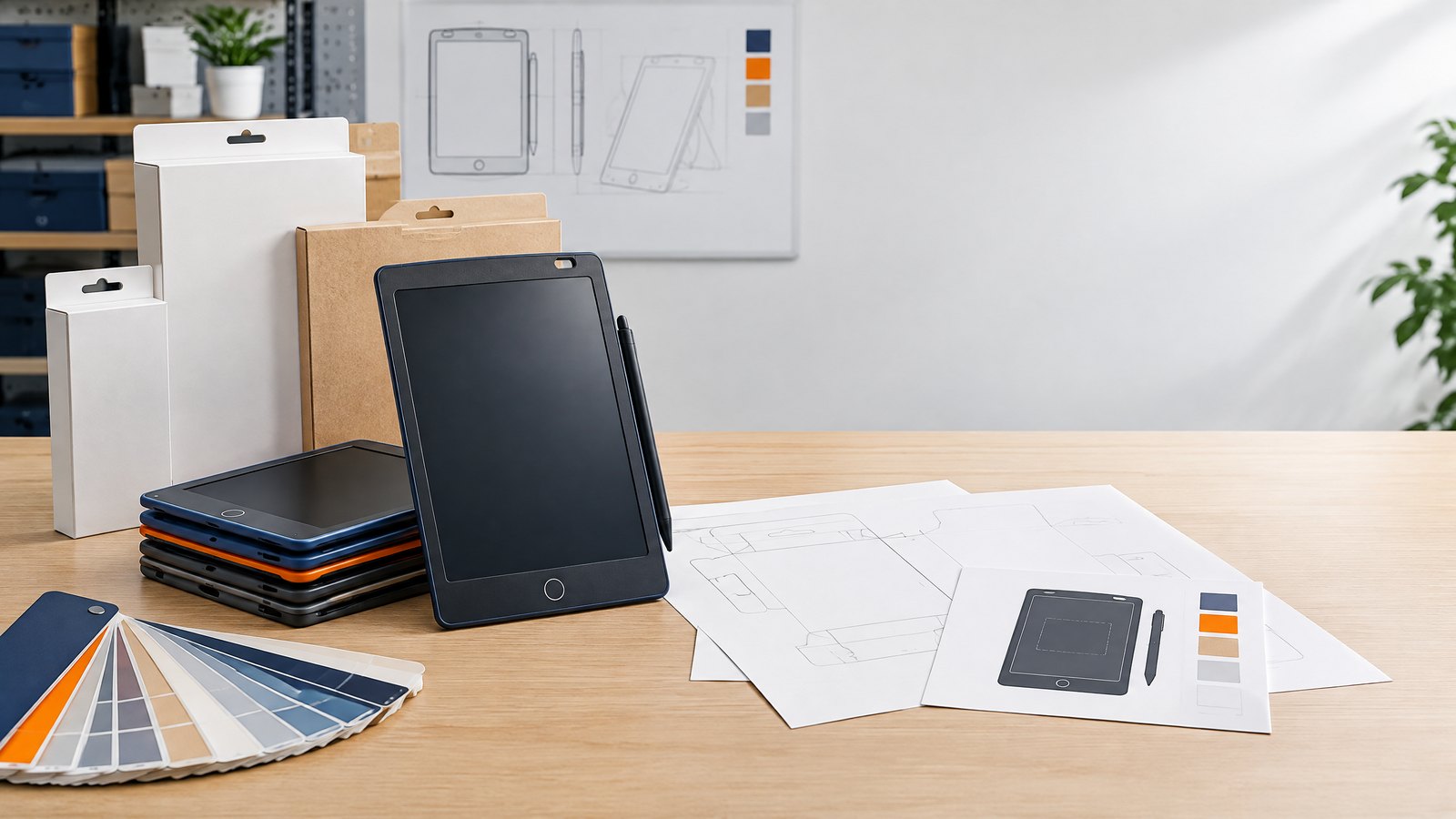

This guide provides a practical B2B decision framework. Final specifications, market obligations, testing scope, labels, packaging and shipment requirements must be confirmed for the exact finished SKU and destination.
LCD Writing Tablet Wholesale: MOQ, Pricing, and Order Planning for Importers
Direct answer: A successful LCD writing tablet wholesale purchase starts with a written product brief, not a target unit price. Define the model, market, packaging, quantity by SKU, delivery term, quality standard, and destination requirements first. Then compare like-for-like quotations, approve a production-ready sample, and release the order only when the commercial, quality, and import responsibilities are clear.
For importers in the US, UK, Germany, and France, the practical decision is not simply where to source. It is how to match the right product configuration and order quantity to the real landed cost, retail channel, and compliance work that your business—not just the factory—must manage. The best plan makes space for samples, document review, inspections, transport handover, customs clearance, and corrective action. It does not assume that an attractive factory quote includes all of them.
This guide is for distributors, retailers, promotional-product buyers, e-commerce operators, and private-label teams evaluating an LCD writing tablet bulk order. It is procurement guidance, not legal, customs, or product-safety advice; confirm applicable requirements with qualified local advisers.
The importer’s one-page planning brief
Before approaching a supplier, turn an informal request—“we need writing tablets for the back-to-school season”—into a brief that can be quoted and tested. This one-page document is the control point for the entire purchase. It reduces price comparisons based on different assumptions and makes changes visible before they become expensive.
Include the following information:
- Product and user: intended user, retail positioning, proposed product name, screen size or format, colour options, enclosure material, stylus, erase control, lock function, accessories, and any batteries supplied.
- Commercial scope: requested quantity by SKU, whether the quantity is a trial or replenishment, target arrival window, destination market, and whether the goods are for resale, a promotion, education, or another channel.
- Brand and artwork: logo position, colour references, packaging copy, languages, barcode owner, warning/instruction copy, inserts, and what artwork files are available. Do not treat a logo mock-up as final artwork approval.
- Quality definition: agreed sample reference, acceptable cosmetic standard, required functions, packaging requirements, inspection method, and how a defect or shortage will be handled.
- Shipping basis: named origin or destination, requested Incoterm® version, freight mode if known, consignee, delivery point, and who appoints the freight forwarder and customs broker.
- Documentation request: commercial documents, packing list, product identification data, test or technical documents where applicable, battery/shipping information if batteries are included, and country-specific labelling information.
A brief does not lock every choice permanently. It creates a version-controlled baseline. Give each revision a date and have the buyer and seller refer to the same revision number in the purchase order (PO), artwork approval, and inspection instructions. If the product or packaging later changes, assess whether the price, test evidence, labels, documents, or approval must also change.
Start with the market and the product claim
The same physical tablet can have different obligations depending on how it is sold. A product presented for very young children, sold with an age claim, packaged with accessories, or marketed as an educational toy may need a different regulatory assessment than a general office memo board. An importer should give the supplier the intended claims and target age early, rather than asking for generic “certificates” after production.
For the United States, the Consumer Product Safety Commission (CPSC) provides importer resources, a regulated-product database, and testing and certification information; it also works with Customs and Border Protection on imported consumer-product shipments.4 Identify the exact category and applicable rules before ordering, especially for children’s products.
For Great Britain, government guidance makes businesses responsible for consumer-product safety and labelling and points importers to technical documentation, labels, safe-use instructions, and traceability records.3 Northern Ireland must not be assumed to follow the same framework.
For Germany and France, the EU General Product Safety Regulation (GPSR) requires importers to ensure a product meets the general safety requirement before placing it on the market and to verify specified manufacturer obligations. It also addresses product identification, economic-operator information, and understandable consumer warnings or safety information.2 Product-specific rules may add duties.
Procurement rule: Ask “What evidence and labelling are required for this exact configuration and market?” rather than “Does the factory have a certificate?” A report, test result, mark, or declaration has value only if it is relevant to the actual product, revision, claim, and destination.
What an LCD writing tablet MOQ really means
LCD writing tablet MOQ is not a single universal number. It is the minimum the supplier requires for a stated configuration, production condition, and commercial model. If any of those inputs change, the minimum may change as well.
A buyer may encounter several separate thresholds:
| MOQ type | What it usually relates to | What the buyer should confirm |
|---|---|---|
| Stock-model MOQ | A standard item with existing specifications and packaging | Available colours, warehouse status, carton pack, current product revision, and whether stock is reserved |
| SKU or colour MOQ | A specific colour, size, or feature combination | Whether quantities can be mixed and which components must be common |
| Custom-artwork MOQ | Printed retail box, insert, label, or logo application | Setup method, artwork cut-off, approved proof, language versions, and reprint policy |
| Tooling or component MOQ | A new housing, screen format, accessory, or proprietary part | Tool ownership, tooling maintenance, sample stages, and what happens after discontinuation |
| Export-carton MOQ | The practical shipping unit | Units per inner and master carton, carton dimensions and weight, and mixed-carton restrictions |
The useful question is therefore: “What is the minimum for the exact product and packaging I want, and what cost or lead-time changes if I order less?” Ask for the answer in writing by SKU. A quotation that states only “MOQ: available” is not enough to plan inventory or cash flow.
Ways to lower risk without forcing an unrealistic MOQ
A lower minimum is not automatically lower risk: tiny custom runs can add setup cost, fragmented packaging, or an unproven process. Preserve repeatability instead:
- Use an existing platform first and keep the core tablet and standard parts unchanged.
- Limit variation to a short colour and SKU list with common accessories.
- Customise the visible layer—an approved insert, sleeve, label, or retail box—before redesigning electronics or housing.
- Phase the commitment: approve a sample, place a defined first order, then use sales, defect, and return data for replenishment.
- Confirm service-part availability for styluses, batteries where applicable, or packaging components.
The goal is not to win an MOQ negotiation at all costs. It is to buy a configuration that can be replenished consistently. That is particularly important for wholesale writing tablets sold to stores, schools, or resellers who expect a repeatable SKU, packaging, and function.
How to evaluate LCD writing tablet price beyond the unit quote
An LCD writing tablet price is meaningful only when the quotation scope is explicit. A low factory unit price can omit artwork preparation, individual packaging, export cartons, inspection support, freight, duties and taxes, brokerage, or delivery from the port to your warehouse. A higher quote may include components or services that prevent later expense. Do not compare price columns until the scope is normalized.
Ask every candidate supplier to quote the same specification and itemise product version and accessories; unit and master-carton packaging; sample, artwork, and setup charges; quantity by SKU and price breaks; lead-time trigger; payment terms; named Incoterm® 2020 place; and documentation, inspection, spare-parts, and after-sales scope.
Build a landed-cost view, not a guess
A simple internal landed-cost model is more useful than a single “delivered price.” Use an input line for each cost that belongs to the order:
Estimated landed cost = goods + agreed packaging/customisation + quality and document work + origin charges + freight/insurance + import duties/taxes/fees + clearance + destination transport + receiving/rework allowance + market-specific compliance and packaging obligations.
This is a planning equation, not a substitute for a broker’s classification or tax advice. Duty treatment and taxes depend on classification, declared value, origin, trade arrangements, and local rules. Ask your customs broker to confirm the correct classification and import approach for the actual goods before finalising margin calculations. Keep the broker’s written advice with the order file.
Use scenarios—such as an expedited launch, a replenishment route, or inspection rework—rather than one precise-looking total. Separate one-time, per-order, and per-unit charges so setup fees and freight assumptions do not distort a unit-price comparison.
Incoterms are an operating instruction, not a price label
Incoterms® allocate tasks, costs, and risks between seller and buyer for international transactions. They clarify responsibility for matters such as carriage, insurance, documentation, customs formalities, export packing, pre-shipment inspection costs, delivery, and risk transfer; they do not settle every condition of the sale or replace a complete contract.1
For that reason, record the term exactly: for example, the rule, named place, and “Incoterms® 2020.” Avoid using “FOB,” “delivered,” or “door to door” as shorthand without defining the point. Confirm who books transport, who is importer of record, who supplies data to the broker, who pays destination charges, and when cargo risk transfers. A supplier’s freight quote can be useful, but compare it with an independent forwarder’s scope before treating it as a landed-cost total.
Choosing an LCD writing tablet supplier: evidence over promises
The right LCD writing tablet supplier is not necessarily the one with the longest catalogue or the fastest reply. Look for a partner that can show control over the configuration you are buying and can communicate changes before they affect your shipment.
Start with a structured RFQ and ask every supplier the same questions:
- Are you the manufacturer or trader, which site makes this model, and who controls the bill of materials?
- What is the product revision and exact supplied configuration, including display, housing, stylus, battery arrangement, and packaging?
- Which elements are custom, and how do they affect MOQ, lead time, sample approval, and artwork control?
- Which in-process and final checks are recorded, and can the buyer review the agreed results?
- What is the process for shortages, damage, function failures, replacement parts, documents, and claims?
Responses matter, but consistency matters more. Compare whether the quotation, sample, product photos, carton data, and document names all describe the same version. A mismatch is a reason to pause. It may be a normal revision issue, but it should be resolved before the PO is released.
Create a supplier scorecard
Use a scorecard rather than choosing only on ex-works price. Score product fit, sample accuracy, configuration and quality control, documents, packaging, commercial transparency, delivery communication, and corrective action; weight them for your channel. Keep the selection rationale for repeat buying and traceability.
Sample approval and factory testing: make “good quality” measurable
“Good quality” is too vague to inspect. Convert it into observable requirements before production. The approved sample, signed specification, artwork proof, and packaging proof should function together as the golden reference. If there is a conflict, define which document controls.
For an LCD writing tablet, review writing response and legibility; erase and lock functions where included; screen, housing, edges, fasteners, and stylus fit; battery/power arrangement; accessories, instructions, warnings, identification, and barcode; unit-box protection and carton count. Check that the sample matches the specification, quote, and proposed claims.
These checks are not a certification programme and they do not establish legal compliance. They are buyer acceptance criteria. Any laboratory testing or technical assessment required for the target product and market should be scoped separately with qualified professionals and tied to the final production configuration.
A sensible production-control sequence
Ask the supplier how it will control the run, then document the agreed checkpoints. A practical sequence is:
- Pre-production: Freeze PO revision, artwork, labels, instructions, documents, and the approved sample.
- First-off: Compare early units and actual print with the reference before full output.
- In-process: Check that agreed controls, component identification, and rejected-goods segregation are working.
- Final random inspection: Before release, inspect packed goods against an agreed sampling plan for function, appearance, accessories, labels, packs, counts, and marks; define rework and re-inspection.
- Shipment release: Reconcile final packing data, invoice/packing-list details, inspection result, photos, documents, quantity, and SKU mix with the booking.
Avoid demanding a “100% tested” statement unless the exact test, acceptance criteria, recording method, and product revision are agreed. If the supplier performs an individual functional check, ask what it consists of and how failures are controlled. A vague assurance is difficult to audit and difficult to use in a claim.
Need a quotation-ready buying brief? Email info@lcdwritingtablet.com with your destination, target quantity, product configuration, and packaging requirements.
Packaging and labelling: protect the product and support the channel
Packaging has two jobs: protect the goods through the chosen route and present the correct information to the next handler or consumer. It should be designed as part of the product plan, not after the goods are finished.
Separate the packaging levels in the PO:
- Retail or unit pack: the box, sleeve, polybag, insert, instructions, product label, barcode, and visible consumer information.
- Inner pack: any intermediate grouping used for retail replenishment or handling.
- Master carton: export carton construction, quantity, carton marks, dimensions, gross/net weight, orientation or handling marks where appropriate, and palletisation requirements.
Provide controlled artwork and require a proof before print. Check text, language, model identity, economic-operator information where applicable, warnings, barcode, traceability, and any required origin marking. Review the actual first print, not only a render.
For products containing a battery, agree who supplies the battery information needed by the carrier and forwarder. The applicable handling, declaration, packing, and transport requirements depend on the actual battery chemistry, configuration, quantity, mode, and route. Do not book on a generic assumption; provide the forwarder with accurate product and battery details early.
Germany deserves a dedicated packaging check. The German Central Agency Packaging Register says a producer under the EU Packaging and Packaging Waste Regulation (PPWR) must register with LUCID and may have financing, participation, and reporting duties. Certain foreign direct sellers without a German branch must appoint an authorised representative.5 Confirm your role before goods are made available.
For France, confirm in advance which producer-responsibility, packaging, electrical/electronic-equipment, battery, language, and product-information obligations apply to your product and selling model. The responsible party can change depending on whether you import, sell under your brand, sell through a marketplace, or supply another business. Include that review in the launch plan rather than treating it as a freight-forwarder task.
Plan the LCD writing tablet bulk order from launch date backwards
When you buy LCD writing tablets in bulk, the shipping date is not the delivery date. Work backward from the date inventory must be available to sell or to reach a customer. Add decision gates rather than relying on a generic lead-time promise.
A robust order calendar typically includes these stages:
- Demand forecast, target SKU mix, and destination decision.
- RFQ comparison, supplier due diligence, and landed-cost scenarios.
- Sample request, evaluation, product/claim review, and changes.
- Artwork and packaging development, translation review, document and market-readiness review.
- PO issue, deposit or agreed commercial trigger, material allocation, and production scheduling.
- Pre-production approval and first-off confirmation.
- Production monitoring, final inspection, rework reserve, and shipment-release decision.
- Freight booking, export handover, customs entry preparation, transit, clearance, destination delivery, and warehouse receiving.
- Post-arrival audit: count, carton condition, sample function check, document filing, and first-return monitoring.
Timing varies with configuration, season, transport, document completeness, and rework. Do not make a customer date promise from a generic lead time; protect first custom runs with contingency.
Plan quantity by sell-through, not factory convenience alone
Use demand by SKU, channel, and market alongside carton quantity; consider warehouse capacity, replenishment, cash tied up, and slow colours. For a first order, limit the assortment and capture return reasons, service requests, and carton damage to improve the next order.
Receiving goods and managing the order after arrival
Set a receiving plan before dispatch. Warehouse staff need the PO, SKU list, carton count and marks, barcode format, and photo instructions for damage. Reconcile receipt to the packing list, retain lot samples, perform the agreed incoming check, and notify supplier and carrier promptly with evidence of problems. Keep the specification, quote, PO, artwork, approvals, inspection, shipping/customs, relevant safety, change, and after-sales records in one order file.
Frequently asked questions
What is a reasonable LCD writing tablet MOQ?
There is no single reasonable figure. It depends on whether the item is a stock model, how many colours and SKUs are required, whether the packaging is custom, whether components or tooling change, and how the supplier packs the goods. Ask for MOQ by finished SKU and packaging configuration, plus the cost and lead-time implications of smaller or mixed quantities.
Should I choose the lowest LCD writing tablet price?
No. Choose the quotation with the best verified scope and total commercial fit. Compare product revision, accessories, packaging, artwork, quality checkpoints, documentation, Incoterm® place, freight scope, payment terms, and after-sales process. Then use a landed-cost scenario that includes import, delivery, and contingency items rather than comparing only ex-works unit prices.
Can I place a bulk order before approving the final retail box?
It is risky. The retail box affects barcode placement, consumer information, languages, warnings, carton dimensions, and sometimes the product’s protection. Approve the production-ready proof or sample before the related print run and ensure the PO identifies the artwork revision. If a commercial deadline requires a decision, document the risk and change-control procedure rather than relying on verbal approval.
What documents should an importer request from a supplier?
The correct set depends on the product and destination. At minimum, plan the commercial invoice, packing list, shipping information, final product and packaging specification, and agreed inspection evidence. For regulated products or specific market claims, obtain the technical, safety, test, certification, declaration, battery, and labelling materials that qualified advisers confirm are relevant to the exact product. Keep them version-controlled and tied to the shipment.
Does an inspection replace product testing or regulatory review?
No. Inspection checks whether a shipment matches agreed acceptance criteria. It does not itself establish that a product meets all laws, technical standards, or product-safety obligations. Likewise, a test document does not replace checking final production, labels, packaging, and supply-chain responsibilities.
How should I manage a defect discovered after delivery?
First contain the affected stock and identify the relevant PO, lot, cartons, and sales channels. Gather photos, counts, function observations, and customer feedback. Notify the supplier under the agreed claim process and assess whether the issue is isolated, packaging-related, systemic, or safety-relevant. For a potential safety issue, follow the appropriate market procedures and obtain qualified advice promptly. Preserve traceability records and document corrective actions before reordering.
Conclusion: make the order repeatable
An LCD writing tablet wholesale programme is strongest when every decision can be traced to an agreed requirement: the product brief explains what is being bought; the quotation explains what is included; the golden sample explains what acceptable goods look like; the inspection plan explains what will be checked; and the shipping plan explains who does what, where, and when.
Treat MOQ as a configuration decision, price as a landed-cost exercise, and supplier selection as evidence-based risk management. For US, UK, Germany, and France sales, also build product-safety, labelling, packaging, and importer-role review into the order timeline before goods are produced. That discipline creates a more dependable first shipment and a cleaner basis for the next one.
Ready to plan your order? Email info@lcdwritingtablet.com to discuss samples, specifications, packaging, and order documentation.
Image Plan
Image 1: Importer order-planning desk
- Purpose: Establish the article’s practical B2B procurement context and visually introduce the direct-answer section.
- Placement: Immediately below the opening direct answer.
- English caption: “A written product brief aligns the LCD writing tablet specification, packaging, quality checks, and delivery responsibilities before a purchase order is issued.”
- ALT text: “Procurement manager reviewing LCD writing tablet samples, packaging artwork, and an importer order checklist on a desk.”
- English AI image prompt: “Photorealistic editorial B2B procurement scene in a bright modern office: a diverse purchasing manager reviewing a slim LCD writing tablet sample, retail carton artwork, carton specification sheet, and logistics checklist on a clean desk; neutral blue and charcoal palette; no visible brand logos, no readable confidential text, realistic product proportions, landscape composition with negative space for website heading.”
Image 2: MOQ configuration comparison
- Purpose: Explain that MOQ varies by stock model, colour/SKU, custom artwork, and tooling rather than being one fixed number.
- Placement: Beside or directly after the “What an LCD writing tablet MOQ really means” table.
- English caption: “MOQ changes with the product configuration: standard items, colour variants, custom artwork, and new components create different production thresholds.”
- ALT text: “Four LCD writing tablet order configurations showing standard product, colour options, custom retail box, and custom component.”
- English AI image prompt: “Clean isometric business infographic illustration showing four non-branded LCD writing tablet sourcing configurations arranged left to right: stock black tablet in plain package, tablets in several colours, tablet with custom printed retail box, and exploded-view tablet components with a new casing; minimal labels as simple icons only, white background, professional procurement presentation style, no brand marks.”
Image 3: Quality-control checkpoint
- Purpose: Make the sample-to-final-inspection process concrete and reinforce buyer-controlled acceptance criteria.
- Placement: In the “Sample approval and factory testing” section after the production-control sequence.
- English caption: “An agreed reference sample and version-controlled checklist help inspectors compare packed goods with the approved product and packaging.”
- ALT text: “Quality inspector checking an LCD writing tablet erase function, stylus, packaging label, and master carton against an approval checklist.”
- English AI image prompt: “Realistic factory quality-control station: inspector wearing standard clean work attire examines a non-branded LCD writing tablet, tests erase function, compares it with an approved sample and checklist, with open retail box and export carton nearby; clean organized production environment, no certification logos, documentary photography style, landscape.”
Image 4: Packaging-to-shipment flow
- Purpose: Show the relationship between retail packaging, export cartons, freight handover, and destination receiving.
- Placement: In the “Plan the LCD writing tablet bulk order from launch date backwards” section.
- English caption: “Order planning continues from approved unit packaging through master-carton packing, freight handover, customs preparation, and warehouse receipt.”
- ALT text: “Flow diagram of LCD writing tablet unit packaging, export carton, freight shipment, customs documents, and warehouse receiving.”
- English AI image prompt: “Professional flat-vector supply-chain infographic with a clear left-to-right flow: LCD writing tablet in retail box, grouped master carton, cargo handover at container terminal, customs document folder, warehouse receiving shelf; navy, teal, and light gray palette; simple universal icons, no company logos, high legibility, widescreen.”
References
Continue with the next sourcing decision.
Use these internal links to compare products, check common buyer questions, review compliance preparation, or send your requirements to the factory.
Turn this sourcing plan into a product brief.
Share your target market, product requirements, packaging preference and estimated volume for a practical OEM / ODM discussion.