This guide provides a practical B2B decision framework. Final specifications, market obligations, testing scope, labels, packaging and shipment requirements must be confirmed for the exact finished SKU and destination.
LCD Writing Tablets for Museums and Science Centers: Visitor Activity Procurement Guide
Direct answer: Buy an LCD writing tablet for museums as a reusable visitor-activity system, not as a generic low-cost board. Define the learning action first, then specify the active writing area, screen visibility, erase response, stylus retention, cleaning method, battery access, printed prompt, packaging, and final sales market. Approve a representative pre-production sample and match it to a product-specific compliance and receiving plan before mass production. This approach gives museums a practical, reusable activity tool while controlling public-use durability, documentation, and total operating cost.
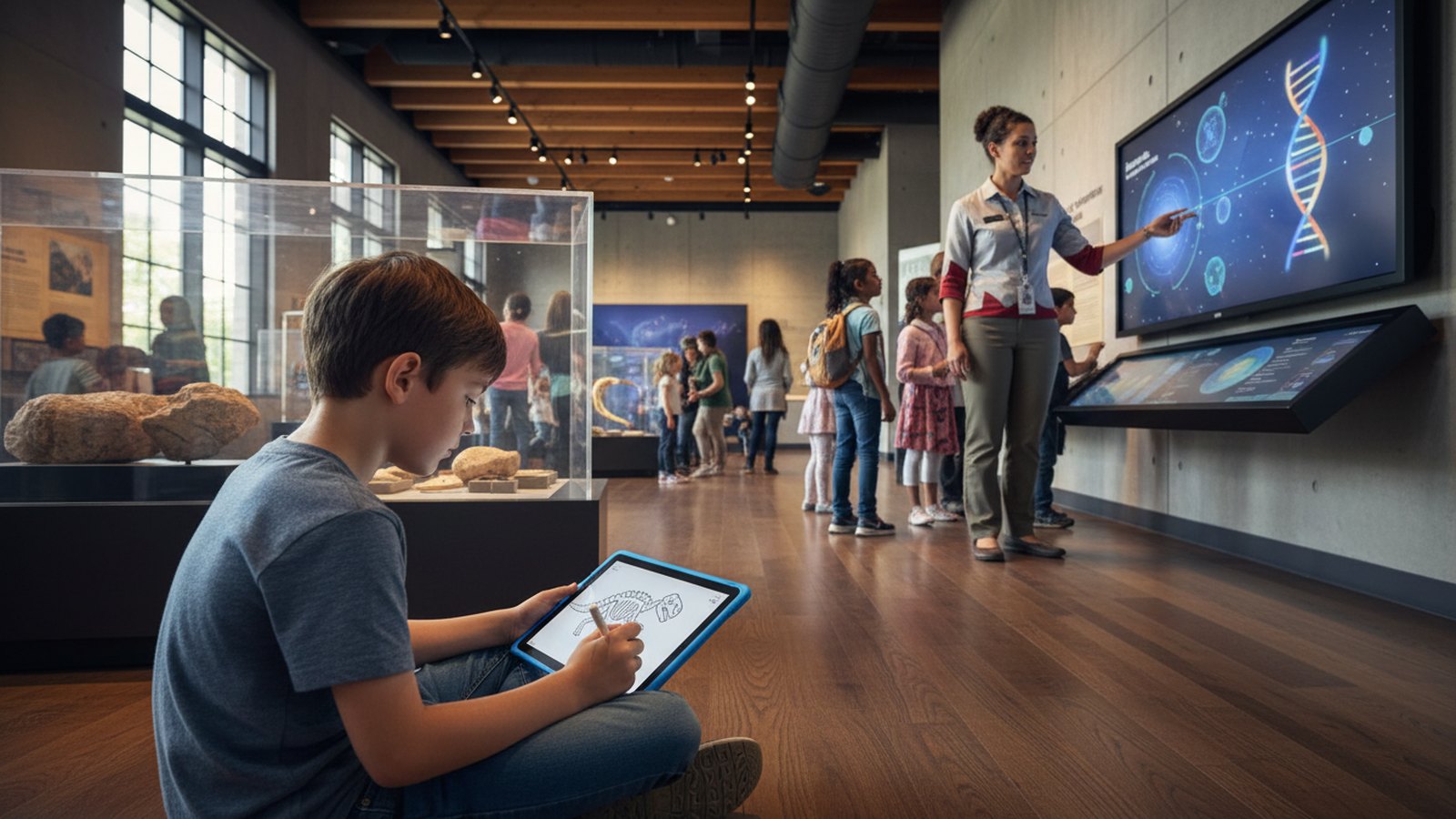
A well-specified LCD writing tablet for museums lets families observe, draw, compare, predict, vote, and share an idea without disposable worksheets or a backlit screen. It can be reset in seconds for a gallery trail, a school workshop, a discovery cart, a queue-line activity, or a museum-shop bundle. It does not replace interpretation or facilitation. It gives visitors a simple surface for responding to those experiences.
This procurement guide is for education teams, exhibit developers, visitor-experience managers, retail buyers, and distributors sourcing from LcdWritingTablet, a Shenzhen OEM/ODM LCD writing tablet manufacturer serving US, UK, Germany, and France buyers. It focuses on the decisions that make a museum kids activity tablet work in public circulation rather than simply look good in a sample box.
Module 1: Start with the visitor job
Start with a behavior, not a catalogue size. Write one sentence stating what visitors should do, where, and for how long. For example: “At the fossil case, children and caregivers sketch one texture and circle the clue that supports their dinosaur hypothesis in three minutes.” This brief informs the board size, prompt, language, reset method, stylus arrangement, and likely wear far better than asking for “an 8.5-inch tablet.”
Family audiences vary by age, confidence, language, and access need. The Museums Association highlights welcoming families, encouraging them to share stories, and creating sensory, stimulating experiences as practical engagement measures.1 A board supports that conversation when the prompt is brief and completes without staff interpretation. It becomes a barrier when it requests lengthy writing, dense instructions, or a single “correct” result.
Choose the ownership model before quoting. An exhibit-response board helps visitors sketch, compare, or vote. A facilitated-learning set supports an educator-led prediction or experiment. A trail/event board directs wayfinding or a timed challenge. A retail extension becomes a take-home branded product. One shell may serve several purposes, but shared-floor boards need retained styluses and fast reset; workshop sets need numbered asset control; retail units need shelf-ready packs. Do not write one vague specification for all three.
Build an activity brief a factory can use
State the age band, session duration, location, daily turns, facilitator role, cleaning routine, activity languages, expected storage, and whether users keep the board. Attach a simple drawing of the bezel or back-panel prompt. State the intended-use claim: exhibit prop, educational activity, toy/plaything, or retail product. Design and marketing language can affect the compliance route.
For a science center writing tablet, use an observable action: draw a bridge load path, mark a shadow position, map a wind-test result, or record one prediction before erase. In history, art, or natural-history galleries, prompts can direct looking: “Find three repeated patterns,” “Draw the missing half,” or “What evidence can you see?” The learning prompt is the product’s purpose; the board is its reusable interface.
Module 2: Match hardware to the activity and gallery
LCD writing tablets use pressure-sensitive liquid-crystal film rather than a conventional backlit tablet display. They create a trace when pressed and generally use a small battery to power full-screen clearing, not writing. They are quiet, low-energy, and easy to hand over, but they do not provide stored files, animation, live data, or precise colour work. If the activity needs records, build a staff photo step or another capture method rather than assuming the board saves work.
Choose size by task and circulation space. Smaller formats suit short “draw one thing” prompts, discovery bags, and retail. Mid-size boards work well for family tables and gallery trails. Large boards help educator demonstrations but are heavier, take more storage space, and have a greater drop exposure. Require both overall dimensions and active writing area; a wide bezel can make a nominally large product feel restrictive.
Test the exact writing film under actual exhibit lighting. Single-colour traces may be clearer for diagrams, adult text, or low-stimulation settings. Rainbow/multi-colour film can attract young visitors but can weaken contrast for detailed maps and letters. Ask adults and children to complete the real prompt under daylight, low-light immersive, and bright science-floor conditions where relevant.
Full-screen erase is familiar but can clear a finished trail accidentally. An erase lock can protect a result until a facilitator views it, but adds another operating step. Partial erase is not a standard feature of ordinary pressure LCD boards; require a sample demonstration before including it in an activity design or sales copy.
| Decision area | Ask in the specification | Practical museum default |
|---|---|---|
| Screen and shell | What are the active area, overall size, material, edge finish, and weight? | Select a board a primary-school child can hold or use flat on a table. |
| Writing and erase | How dark is the trace and how consistently does it clear in gallery light? | Approve against the finished activity, not a blank-screen demonstration. |
| Stylus | Is it docked, tethered, replaceable, or omitted? | Retain it for shared-floor use; verify finger response if stylus-free use is proposed. |
| Power | Which battery is fitted and how is the compartment secured? | Document the design, warning, and sample inspection method. |
| Cleaning | Which agents, cloths, concentrations, and contact times are approved? | Match instructions to the venue’s own cleaning protocol. |
A standard rounded rectangle normally offers lower cost, lower packing risk, and a simpler service plan than a novel shape. Custom silhouettes can fit a theme but may add tooling cost, uneven wall thickness, and longer development. Spend customization first on learning value: clear prompt graphics, multilingual copy, asset numbers, color coding, and a storage method.
Module 3: Design the reusable visitor activity board
A good reusable visitor activity board has one clear entry point and delivers a satisfying result in two or three minutes. Treat permanent print as a micro-exhibit: one action verb, generous blank space, icons before dense text, and a visible erase instruction. Avoid asking families to copy a full label or complete a worksheet that should remain on paper.
A useful pattern is look–make–share. An icon indicates where to look, a picture shows what to make, and a cue invites conversation. A space-science activity might show three crater shapes and ask visitors to draw the impact path. A transport-gallery activity might ask a family to sketch the route from factory to port. The outcome can have many answers, but it should relate directly to an exhibit object or demonstration.
Keep durable print outside the active LCD area whenever possible. A bezel, back panel, sleeve, or companion card preserves writing space and makes content revisions less risky. If an overlay is proposed, test glare, lifting, stylus drag, and screen visibility. Confirm whether artwork is pad print, UV print, in-mould decoration, label, or paper insert, because abrasion resistance, colour control, setup cost, and rework differ.
Accessibility is a design input, not a compliance afterthought. ASTC recommends practical, iterative accessibility work and includes mobility, visual, auditory, and neurocognitive considerations in its museum guidance.2 For a physical board, use high-contrast instructions, uncluttered hierarchy, clear icons, simple handling, seated-use options, and a non-stylus alternative where appropriate. Pilot the prompt with families and educators, including disabled visitors where feasible, then revise the obstacles they identify.
Localize brand, language, and traceability
Lock US, UK, German, and French variants before artwork approval. Check spelling, measurement units, safety wording, responsible-party details, product identifiers, and recycling information required for the destination. Translation must preserve an action, not merely translate words. The buyer should supply approved final copy; the OEM should confirm printable area, font size, colour limits, and a proof revision.
Use one SKU, artwork revision, and lot or production date that connects the board, pack, invoice, inspection report, and compliance file. This is essential when one shell supports multiple exhibitions or language variants.
Module 4: Control the OEM/ODM sample path
Separate proven elements from new development. A standard shell, film, and erase circuit usually reduce risk. New colour, logo treatment, printed bezel, localized leaflet, revised tether, or custom box are manageable changes. A first order that combines a new shape, mould, electronic function, four-market pack-out, and short deadline is a development project and should be costed and scheduled accordingly.
Use three approvals. First, evaluate an unbranded reference for hand feel, screen response, erase behavior, and cleaning. Second, approve a digital or decorated proof for copy, icons, colours, and markings. Third, approve a pre-production sample made with the final material, tooling state, print process, battery arrangement, and pack-out. Do not authorize mass production from a rendering or from a sample whose shell, film, or battery cover differs from the quotation.
For ODM, ask which elements change without a new tool: shell colour, logo, bezel print, back label, stylus colour, tether, sleeve, leaflet, inner box, and master-carton marks. For OEM, state ownership of artwork, CAD/design files, dedicated tooling, and any release conditions in the supply agreement. “Custom” is not a usable specification.
A capable museum education supplier asks for destination market, age grade, intended use, battery configuration, cleaning method, artwork language, quantity, packing method, and deadline. It identifies unknowns and does not pass a generic report off as evidence for a changed product. Buyers should assign one artwork approver and name the applicable customer, retailer, or laboratory requirements early.
For a specification sheet, sample route, and OEM/ODM quotation aligned to your activity brief, email info@lcdwritingtablet.com.
Module 5: Specify durability for public use
An LCD tablet exhibit activity faces drops, hurried handling, compressed tote bags, contaminated tables, and missing styluses. Define durability by use: daily cycles, floor type, standing or seated use, travel between venues, cleaning frequency, and expected program life. This lets the factory propose shell structure, tether, protective pack, and spare-unit plan against a real need.
Test predictable failures. Verify clearing after repeated writing/erase cycles, trace visibility, stylus docking, tether attachment, and battery-door alignment. Drop samples in representative ways: from a child’s hand, visitor table, and storage trolley. Check the product after cleaning cycles, not only fresh from the carton. A board is not public-use ready if the compartment becomes loose, print wears off, or the display fails after normal treatment.
Write a field-maintenance procedure with the order. Name who checks boards at opening and close, removes damaged units, holds spares, changes batteries, and quarantines nonconforming product. Numbering each board lets staff track losses by gallery or program. Specify cleaning agents, concentration, contact time, cloth, and prohibited solvents, then validate the plan locally on approved samples. Unqualified “waterproof” or “sanitizer-proof” language is not enough.
Module 6: Make compliance product- and market-specific
Compliance is not a logo request. It starts with final classification, age grade, intended use, configuration, and destination. In the US, an object designed, manufactured, or marketed as a plaything for children under 14 can be a toy even when a museum calls it an educational tool. ASTM F963 is a mandatory consumer-product safety standard for children’s toys, and CPSC says the relevant third-party testing and Children’s Product Certificate requirements apply to toys intended primarily for children 12 and under.3 Tracking labels on product and packaging may also be required.3
Battery access requires particular care. CPSC guidance describes requirements for covered US consumer products containing button or coin batteries, including secure compartments, access after use-and-abuse testing, warnings, and instructions. Its guidance also explains that toys meeting the relevant ASTM F963 battery provisions have a different treatment within that framework.4 A qualified laboratory or compliance adviser should determine the final route. A competitor listing, standalone battery report, or report for another shell/battery door is not sufficient evidence.
For EU placement, identify every applicable requirement for the final configuration. The European Commission explains that CE marking only applies where harmonized EU rules require it; the manufacturer must identify requirements, compile technical documentation, and sign an EU declaration of conformity.5 A buyer having a product made and sold under its own name or brand can be the manufacturer for these responsibilities.5 Toy safety, electrical/electronic rules, batteries, chemical restrictions, and general safety obligations can overlap. This guide is not legal advice; obtain a product-specific assessment.
The EU General Product Safety Regulation has applied since 13 December 2024, covers consumer products including online sales, and requires a responsible EU economic operator for each covered product.6 For Germany and France, agree in writing who is the importer or responsible person, who retains technical files, how product information is displayed, and who handles safety complaints.
For Great Britain, government guidance permits either UKCA or CE marking for listed toys and electrical equipment, while Northern Ireland follows its own CE/UKNI framework.7 Confirm the exact route, declaration, language, markings, and local information for the actual destination. Germany’s LUCID Packaging Register states that producers under the PPWR must register, and system participation/reporting can also be required; some foreign direct sellers require an authorized representative.8 France lists packaging, electrical/electronic equipment, batteries, and toys among its producer-responsibility categories, with obligations that can include an eco-organization or individual scheme, an IDU, and annual declaration.9
Request a final-product document pack
Before release, request applicable test reports; appropriate declarations/certification; material or bill-of-material declarations where needed; battery details; final label/instruction artwork; traceability data; and named importer/economic-operator information. Verify that the report photo, model, construction, age grade, factory, date, and standard match the shipment. A report supports a defined product; it is not permission to apply a mark to later variations.
Module 7: Build quality assurance into production
Quality begins at the specification and ends after receiving. Define measurable critical points: shell colour, print placement and legibility, LCD active-area condition, erase function, stylus/tether installation, battery-door closure, label content, and carton count. “Good screen” is subjective. “Fully clears after three specified writing patterns under agreed lighting” is testable.
Approve a dated golden sample and signed specification. During production, review first-off units and artwork. For significant orders, use an agreed pre-shipment sampling plan and defect classification. Critical defects can include accessible battery, sharp edge, wrong safety/market marking, incorrect language, or non-functioning erase. Major defects can include cracked housing, missing included stylus, severe print error, or display failure. Set the definitions before inspection, based on public activity use rather than a generic template.
Require lot traceability to LCD film, resin/colour, battery, and print run. Ask how rejected screens are segregated and how rework is controlled. Changes to approved components or construction require written approval and, where relevant, a renewed compliance review. Retain a sealed reference unit, approved artwork, reports, and carton photos.
Module 8: Compare total landed and operating cost
The ex-works figure is only part of a family museum activity product budget. Normalize quotations for board configuration, battery inclusion, print positions, tooling/amortization, samples, inner and export packing, testing, inspection, freight term, delivery, duty/tax, producer-responsibility costs, spares, and replacement parts. A low-cost quote may omit the tether, asset label, protective pack, or documentation that prevents field losses.
Separate recurring price from one-time costs such as artwork setup, tooling, inserts, translations, and laboratory work. Repeat orders may reduce setup cost but can still need reassessment when material, battery, shell, factory, intended use, or destination changes. Ask for MOQ and volume pricing at each configuration so a 500-unit workshop kit is not falsely compared with a 5,000-unit retail campaign.
Calculate expected cost per completed activity: divide landed cost, planned spares, and maintenance by forecast uses. Compare it with printed worksheets, storage, and disposal. Reuse is not automatically sustainable; boards still include plastic, electronics, batteries, packaging, and transport. The benefit depends on real reuse, maintenance, and responsible end-of-life. In the US, EPA notes that EPR is frequently state implemented and can cover packaging, batteries, and e-waste, so check destination-specific obligations.10
Module 9: Engineer packaging for the route
Packaging must protect the display, communicate the correct information, and fit daily operations. Bulk educational sets prioritize count accuracy, protected stacking, easy issue/return, and low unpacking time. Retail packs need visibility, barcode placement, brand presentation, instructions, and tamper resistance. A floor activity later sold in the shop may need a separate SKU pack-out rather than one compromised dual-use pack.
Request a packing specification with units per inner and export carton, net/gross weight, dimensions, orientation, screen/corner protection, packing materials, drop/stack assumptions, pallet pattern, and carton marks. Test a packed sample through representative handling. Thin LCD surfaces can be damaged by compression or abrasion even when the outer carton looks acceptable.
Use no more packing material than is required to protect the product. If paper inserts replace trays, test scuffing, movement, humidity, and pack-line handling. Any pack or insert that carries safety information, legal markings, or activity instructions must be revision-controlled. Assign Germany and France packaging obligations to the legally responsible entity, not merely the graphic designer. For shipping, identify risk transfer, freight booking, clearance, duty/tax, damage claims, and arrival sampling in the agreed delivery term and named place.
Module 10: Receive, pilot, and operate the program
Receiving is the buyer’s final control point before boards reach families. Compare the shipment to the purchase order, packing list, carton marks, and approved shipment photos. Record external damage before freight acceptance where practical; quarantine wet, punctured, or crushed cartons. Open cartons from different pallet positions and photograph discrepancies with the carton label.
Use this incoming check: confirm SKU, artwork revision, language variant, lot, and quantity; inspect boards for cracks, loose/sharp parts, print errors, scratches, and correct stylus/tether; test writing, erase, and battery-door security on a sensible lot sample; compare labels/instructions with final artwork; then register accepted units and isolate nonconforming stock. Keep spares separate from public issue stock.
Run a staff pilot before launch. Observe whether visitors understand the prompt unaided, can see the trace, return the stylus, and tolerate the cleaning/return process. Train frontline staff on reset, cleaning, quarantine, and replacement. Track take-up, completion, dwell, caregiver conversation observations, loss/damage, cleaning time, and repeat use. These measures show whether the activity succeeds; distribution count alone does not.
Module 11: FAQ, purchase-order checklist, and conclusion
Frequently asked questions
Are LCD writing tablets suitable for permanent gallery use?
They can work at supervised or regularly checked activity points when tasks are short and boards are numbered, cleaned, and inspected. They are not maintenance-free exhibit hardware. Pilot loss, damage, battery, cleaning, and retention procedures before scaling an unattended installation.
Is a tethered stylus the right choice?
Usually for shared-floor circulation, because it reduces loss and keeps the task self-contained. Test tether strength, snag risk, cleaning, and age-appropriate safety. A loose stylus can suit educator-controlled workshops.
Can the product simply be called an educational tool rather than a toy?
No. Classification depends on intended use, age grade, design, and marketing, not a single label. Obtain market-specific advice for the finished product.
What must be approved before a deposit?
Approve the revision-controlled quotation, specification, intended markets, samples, artwork owner/approver, tooling ownership, compliance-document plan, packing, inspection criteria, payment milestones, delivery term, and corrective-action process. The signed pre-production sample is the critical technical gate.
Is a colour writing surface always better for children?
No. Attention is useful only if contrast and legibility remain fit for the task. Test the final prompt under gallery lighting with the intended audience.
How many spares should be ordered?
Base the reserve on pilot loss/damage, activity duration, replacement lead time, and service consequence. Keep a field-service reserve separate from any factory overage.
Final buyer checklist
Before issuing the order, confirm the visitor behavior, user, setting, success measure, exact approved sample, final artwork, materials, battery configuration, packaging, market obligations, responsible economic operator, cleaning/storage/replacement method, and the owner of every corrective action. That is the difference between a low-cost novelty item and an activity system staff can run reliably.
Conclusion
The best museum LCD writing tablet connects an exhibit to a visitor conversation through a durable, low-friction activity. Procurement value comes from alignment: a focused activity brief, proven hardware, controlled samples, final-product compliance work, protective pack-out, and an on-site operating plan. Start with a pilot and signed specification rather than a catalogue image. It will reduce rework and help the museum run a repeatable, reusable program across galleries, workshops, family events, and retail.
To start a museum or science-center OEM/ODM procurement project, email info@lcdwritingtablet.com.
Image plan
| Purpose | Placement | Suggested caption | ALT text | English AI prompt |
|---|---|---|---|---|
| Show family co-use at an exhibit | After Module 1 | “A reusable writing prompt turns observation into family conversation.” | “Adult and child using an LCD writing tablet beside a natural-history museum display” | “Documentary-style modern natural-history museum; parent and primary-school child use a slim reusable LCD writing tablet to sketch a display detail; inclusive diverse family, soft gallery light, no logos, high-resolution editorial photograph.” |
| Explain the procurement specification | After Module 2 | “Specify active area, erase, battery door, stylus retention, and pack-out.” | “Annotated LCD writing tablet showing procurement specification points” | “Clean technical infographic of a black LCD writing tablet and stylus, six callouts for active area, erase button, secure battery compartment, tether point, printed bezel, and protective packaging; museum procurement style; white background; no brand logo.” |
| Show facilitated science learning | After Module 3 or 5 | “Boards work best with one concise observable task.” | “Science educator leading children using reusable writing tablets at an experiment table” | “Authentic science-center activity; facilitator leads mixed-age children at a physics experiment table, children draw predictions on reusable LCD writing tablets; accessible inclusive setting, bright practical light, documentary photography, no logos.” |
| Demonstrate receiving quality control | After Module 10 | “Receiving links cartons, function, labels, and traceability.” | “Museum staff inspecting boxed LCD writing tablets on a receiving table” | “Museum operations team performs incoming inspection on cartons of reusable LCD writing tablets; one tests erase, another compares labels with a clipboard; organized receiving room, realistic B2B editorial photograph, no logos.” |
References
Continue with the next sourcing decision.
Use these internal links to compare products, check common buyer questions, review compliance preparation, or send your requirements to the factory.
Turn this sourcing plan into a product brief.
Share your target market, product requirements, packaging preference and estimated volume for a practical OEM / ODM discussion.