This guide provides a practical B2B decision framework. Final specifications, market obligations, testing scope, labels, packaging and shipment requirements must be confirmed for the exact finished SKU and destination.
LCD Writing Tablets for Workplace Family Days and Wellness Programs: Event Supply Guide
Direct answer: For LcdWritingTablet B2B buyers, an LCD writing tablet corporate event program works best as a reusable branded activity tool, not a generic giveaway. Specify the age range and market; choose a simple battery-contained erase design; approve imprint and packaging before production; and receive against a written sample, inspection plan, and delivery date. For family days, tablets support quiet drawing, scavenger-hunt clues, and take-home engagement. For wellness programs, they offer a low-distraction mood check-in, gratitude note, or break-time prompt. The right bulk order balances usable screen size, safe construction, readable branding, appropriate documentation, and fast distribution.
Module 1: Define the event job before selecting the tablet
A family day activity tablet is not one product in every setting. The event objective drives the format, age grading, artwork, quantity, and compliance route. Start the brief with a single sentence: “We need a reusable drawing activity for 600 children aged 4–11 at a two-hour outdoor company family day,” or “We need 1,200 branded desk tablets for a month-long workplace wellbeing campaign in four offices.” That sentence prevents a familiar sourcing error: selecting the lowest-priced model and discovering late that its screen is too small, the erase button is hard for younger children, or the individual pack cannot carry the required information.
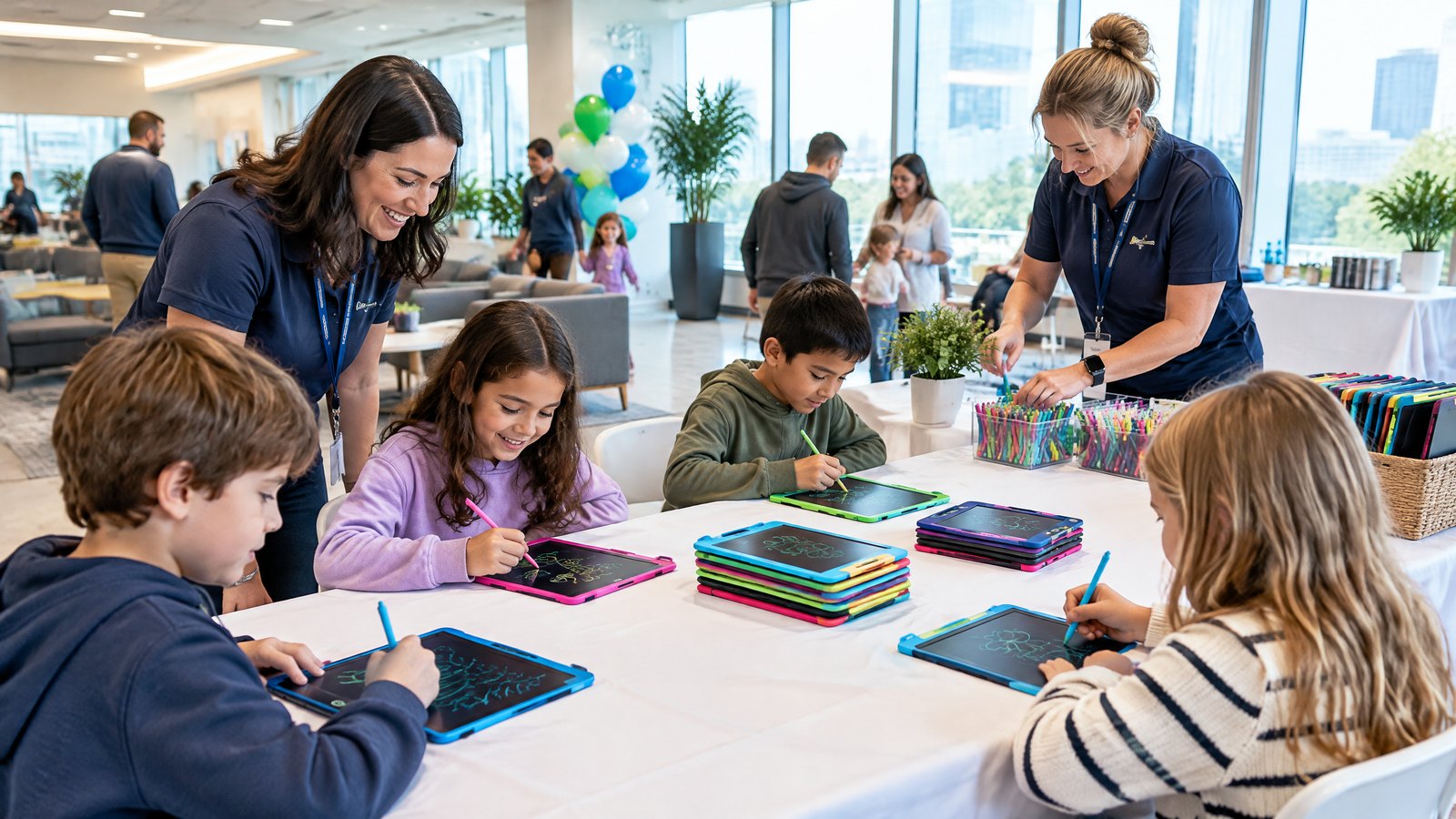
For a family event, list the stations where the item will be used: welcome bags, a quiet zone, a nature-bingo table, a “draw your family” wall, or a journey-home gift. A 10–12 inch display normally gives children enough room to complete a picture without consuming the storage space or budget of a larger board. A tethered stylus reduces loss at activity tables. A lock switch can help staff preserve a finished drawing for a photo, but it should not replace adult supervision.
For a wellness activation, decide whether the workplace wellness activity product is an on-site workshop tool, a desk-drop gift, or an employee-family benefit. Adults often prefer a slim 8.5–10 inch model that fits a tote bag or desk drawer. Program cards can turn a blank tablet into a prompt-led experience: “draw your energy level,” “write one boundary for today,” or “sketch your ideal break.” Keep claims sensible. The device supports an activity; it is not a medical device and should not be presented as diagnosing, treating, or measuring wellbeing.
Set the distribution ratio early. Hold a controlled contingency in master cartons for open attendance or late registrations, and decide whether the product is sold, gifted, or included in admission because that can affect the importer and compliance review.
Module 2: Choose a product specification people will actually use
An LCD writing tablet uses pressure on a liquid-crystal display for notes and sketches; it does not store files, send data, or show video. Its appeal at events is simple use without an app, account, charging queue, or Wi-Fi, but buyers must verify the actual configuration.
Write the RFQ as a controlled specification: screen and overall size, housing and screen colour, stylus and attachment, battery, erase/lock function, logo locations, pack-out, quantity, destination, in-hands date, and markets. Have the factory identify the model code and every change caused by customization; a different battery door, back plate, mould colour, or gift box can make an old report irrelevant.
For child-facing use, assess the whole unit: stylus edges, battery closure, erase effort, housing seams, and parts that could break after a drop. A rounded housing and sturdy stylus slot or cord are usually better event choices than a fragile clip. Check screen readability in the planned light, whether sun, marquee shade, or office lighting.
A passive, non-radio design reduces technical complexity. Do not request a Bluetooth feature merely because it sounds modern if the event does not need it. If a supplied item is an unintentional radiator or digital device, US Part 15 authorization rules may be relevant before marketing; the rule distinguishes authorization pathways such as Supplier’s Declaration of Conformity and certification. 1 The buyer should have the manufacturer or importer confirm the classification for the final configuration instead of treating “no wireless” as a universal compliance exemption.
The following short matrix is useful during selection.
| Event need | Practical specification | Buyer watch-out |
|---|---|---|
| Children’s activity station | 10–12 inch screen, tetherable stylus, easy erase | Verify age grade, battery access, drop performance |
| Wellness desk drop | 8.5–10 inch slim board, simple logo | Avoid clinical or therapeutic claims |
| Outdoor family day | High-contrast display, wipe-clean housing, carton labels by station | Check readability in the actual light condition |
| Premium sponsor gift | Branded sleeve or printed box, refined colour match | Approve brand artwork and packaging dieline separately |
Request a pre-production sample in the chosen colour and actual print method. A digital mock-up proves layout, not ink opacity, texture, engraving depth, or colour shift on plastic. Define whether a Pantone reference applies to ink, housing, or both, then approve a realistic visual standard.
Module 3: Build activities that justify the event spend
The strongest branded drawing tablet event is an activity system. A 30-second instruction card gives people a reason to start and makes the sponsor message useful. Use one task, simple icons, and age-appropriate wording on an insert, station tent card, or sign with an optional QR code.
For family days, use resettable loops: “draw the next stop” in a treasure hunt, “copy this shape” in a quiet zone, or “design the company’s future park” for a photo wall. Give permission to erase, and keep a paper alternative for very young children, accessibility needs, or a shortage.
For employee wellbeing, make prompts voluntary and do not ask people to disclose health conditions or personal problems to managers. A breathing pattern, “three things that went well,” or team doodle break works well. Do not collect tablets holding personal reflections; describe the item as an optional creative tool, not an assessment.
Measure units issued, participation time, repeat use, opted-in photo shares, and post-event retention. A staff tally plus a two-question opt-in survey can show whether corporate event kids supplies improved dwell time or queue management without treating social posts as the sole measure.
Module 4: Plan branding, artwork, and localization without last-minute rework
Branding must stay legible after handling. Common locations are a front-bezel logo, back-panel logo/safety text, sleeve, and instruction insert. Treat each as a separate art file; keep the front logo small and put detailed colour messaging on a sleeve or card.
Provide vector artwork, brand colours, minimum logo size, clear space, and editable copy. Plan localization for US, UK, German, and French audiences before the artwork deadline: safety, recycling, responsible-party, and age text may differ. Reserve adequate space, especially for German and French.
Ask for a print-position drawing showing edge distance, orientation, ink colour, and maximum size. Approve laser contrast, pad-print adhesion/rub resistance, or UV-print curvature limits on the actual sample. Keep large dark graphics off the display window.
Put a factory lot, production-month, or PO-linked code on the unit or pack to isolate a reported issue. CPSC notes tracking-label requirements for children’s products and producer/distributor markings under ASTM F963 provisions. 2 Agree the final responsible party’s name, address, and identifiers; do not copy generic label text.
Module 5: Qualify safety and compliance by market and intended user
Compliance is configuration- and market-specific. The Shenzhen OEM/ODM factory can supply evidence, but the party placing the final product on a market has key responsibilities. Have the importer, brand owner, or qualified adviser validate a written factory matrix against intended use, age grade, sales route, packaging, and destination. Reports are evidence, not transferable certificates for every variant.
In the US, an item designed, manufactured, or marketed as a plaything for children under 14 can be a toy. ASTM F963 is mandatory for children’s toys; CPSC says testing and certification requirements apply to toys primarily intended for children 12 and under. 2 For a children’s product, the responsible party should determine requirements, arrange applicable CPSC-accepted-lab testing, and issue a Children’s Product Certificate. Battery-operated toy requirements address battery access, labels, overheating, and supplied chargers. 2
A casual “14+” sticker does not solve a child-product issue. Age grading must reflect design, marketing, users, and foreseeable play. A product intended for under-threes that presents a small-parts hazard is a banned hazardous substance under 16 CFR Part 1501; certain small-part products need a choking warning. 3 Request product-specific assessment, relevant use-and-abuse testing, and final-language artwork review.
For the EU, including Germany and France, GPSR is part of the framework intended to ensure only safe products reach the market. 4 EEE can also fall under RoHS, which restricts ten substances unless an exclusion applies. 5 The final file may require a safety assessment, technical documentation, conformity route/marking, declaration, economic-operator details, and WEEE/battery handling. Have a qualified EU professional verify the final SKU; never print CE based only on a supplier email.
In Great Britain, the Toys (Safety) Regulations apply to toys designed or intended for children under 14. The guidance requires a safety assessment, relevant conformity assessment, declaration, and visible, legible, indelible marking before placing a toy on the GB market. CE is recognized indefinitely in GB, while CE remains required for the EEA. 6 Check Northern Ireland separately.
Packaging obligations may sit outside product safety but still block a shipment. Germany can require LUCID registration, system participation, reporting, and—where foreign firms sell direct without a German branch—an authorized representative. 7 France’s EPR framework covers products and packaging, including relevant packaging, EEE, battery, and toy streams. 8 Assign legal-producer, registration, eco-fee, and marking roles before goods leave China.
For a compliance matrix, product-specific sample confirmation, and a practical bulk quotation, email info@lcdwritingtablet.com with the destination, age group, quantity, and in-hands date.
Module 6: Evaluate the OEM/ODM factory beyond the quotation
Assess repeatable controls, not only a catalogue. Ask what is made in-house versus purchased—display, housing, battery, stylus, printing, assembly, packing, cartons—and how incoming materials and changes are controlled.
OEM uses a standard platform with buyer-selected logo, colour, packaging, or insert. ODM changes housing, function, or screen configuration and can need tooling, engineering samples, validation, and IP/ownership terms. For a deadline-driven event, use standard tooling unless the shape is campaign-critical and time allows validation.
Ask about approved-sample retention, component holds after artwork approval, defect categories, battery installation and checks, erase tests, unit counting, and carton verification. Require records, photos, and a named quality owner, not broad assurances.
Use independent pre-shipment inspection or equivalent transparent factory data. Agree reinspection costs if the lot fails, confirm test samples are production-representative and name the same model/materials, and require written approval for any substitution.
Module 7: Turn a bulk event order into a realistic schedule
Work backward from the in-hands date. Allow time to receive, count, kit, distribute, and replace supplies, plus contingency for freight, customs, domestic transfer, and venue appointments. Build testing or packaging-proof time in before mass production.
Use this sequence: RFQ; sample; artwork/packaging proof; compliance review; PO; pre-production sample; production; inspection; freight; receiving; kitting. Timing varies by availability, quantity, tooling, test scope, and freight. Request a dated critical path with factory-ready, inspection-ready, departure, and warehouse-arrival milestones—not just “30 days.”
Create a change freeze after pre-production approval. Treat any colour, logo, battery, language, carton, or insert change as a cost and schedule event. Authorize one commercial contact to consolidate directions from event, procurement, and legal teams.
For US, UK, Germany, and France splits, choose direct regional shipping or one hub. Direct shipping can save a handling step but multiplies import and packaging roles; a hub simplifies kitting but can delay local delivery. Choose operationally, not just by freight rate.
Module 8: Understand cost, MOQ, packaging, and landed-price trade-offs
A responsible quotation separates the drivers instead of hiding them in one all-inclusive price. Unit cost is affected by screen size, display colour, housing resin, battery, stylus design, lock function, printing method and colours, custom mould work, testing, individual packing, master-carton strength, and order quantity. Freight and duty depend on the shipping terms, route, dimensions, weight, importer of record, and tariff classification. Ask for Incoterms, quotation currency, validity period, tooling ownership, payment milestones, and what happens if the buyer’s artwork causes a delay.
MOQ is not a single number. The standard black tablet may have one production minimum; a moulded custom housing colour another; a printed sleeve another; and a full gift box another. A smart event buyer can use a standard tablet with a localized paper sleeve to achieve campaign relevance at a lower MOQ and lower risk than a new mould colour. It also makes late copy corrections less disruptive.
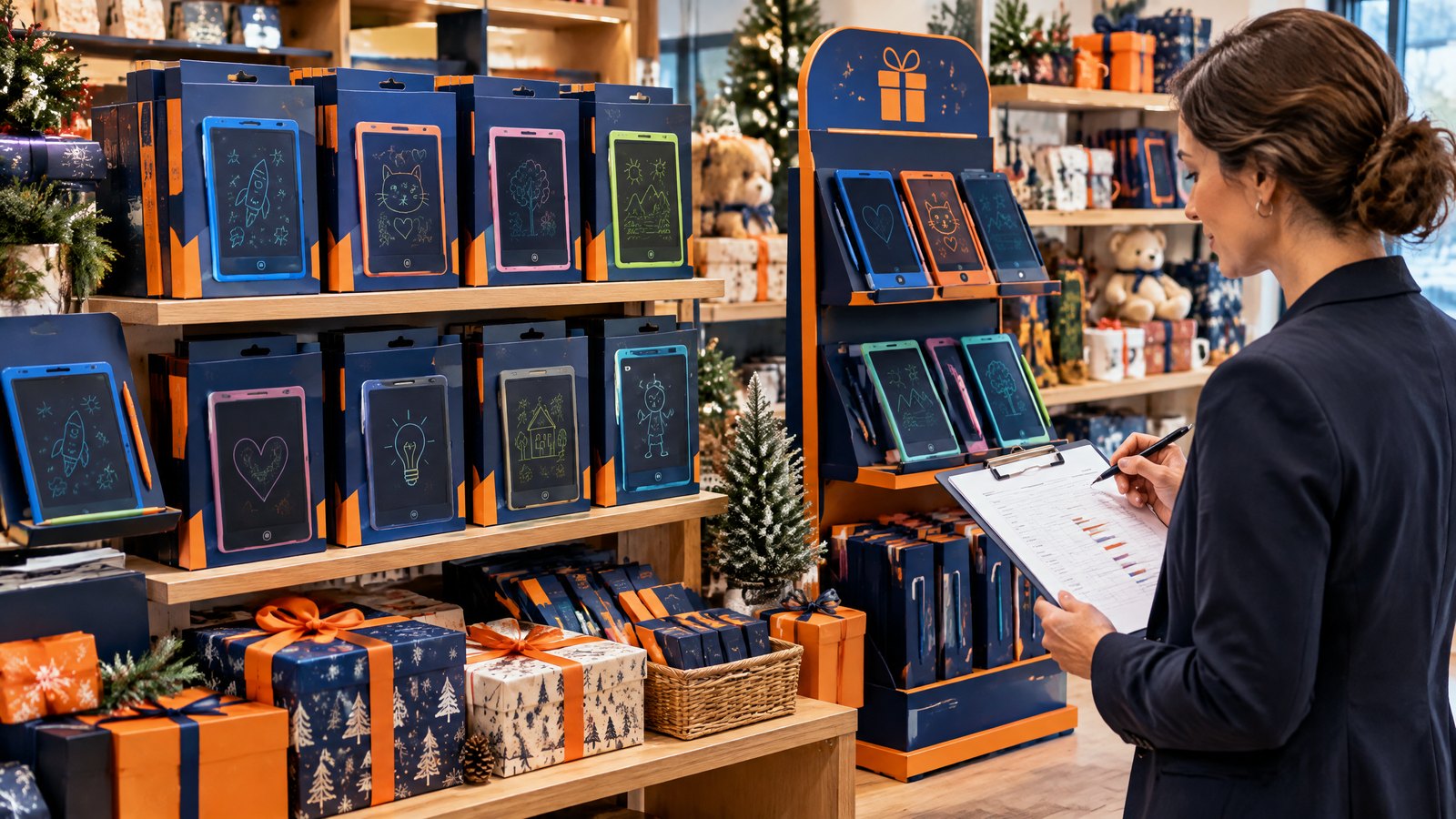
Packaging is a logistics component and a participant experience. Individual polybags can be compact but offer little gift value and can slow table distribution. A paper sleeve or flat envelope can display instructions, logo, and sorting information while protecting the screen. A retail-style colour box looks premium but raises material use, cube, and packing labor. For an event, request cartons clearly marked by SKU, quantity, carton number, gross/net weight, dimensions, destination, purchase order, and activity station if relevant. Avoid mixed-SKU cartons unless the kitting plan explicitly calls for them.
Compare landed cost per usable distributed unit, not only ex-works price. A slightly higher-cost product with an attached stylus and carton labels by station can save staff time and prevent many “missing pen” replacements. Conversely, a premium presentation box may be wasteful if the tablet will be handed to children at a busy outdoor registration table. Ask the supplier to propose two or three packaging levels against the same core product specification so the trade-off is transparent.
Module 9: Set quality controls and receiving criteria before production
The approved sample is the reference standard, but it needs a written inspection checklist. Define critical, major, and minor defects with photographs where possible. Critical defects can include accessible battery hazards, sharp edges, incorrect required markings, or a malfunction that creates a safety issue. Major defects may include non-erasing screens, missing stylus, unreadable logo, cracked housing, wrong colour, or incorrect pack count. Minor defects might be a limited cosmetic mark outside the primary viewing area, only if it does not affect function or brand appearance.
For an LCD writing tablet bulk event order, a practical functional check covers screen writing response, full erase, lock switch operation where fitted, battery operation, stylus fit, front and back print, housing alignment, packaging copy, barcode or lot code, and carton count. Check writing and erasure across the usable screen, not solely at the centre. For tethered designs, test the tether pull and ensure the stylus cannot easily detach under ordinary handling. For printed products, run a controlled rub/adhesion check appropriate to the approved print process.
Use an agreed sampling plan such as ANSI/ASQ Z1.4 or an equivalent agreed approach, selected with the quality team and appropriate acceptance levels. State it in the purchase order and inspection brief, including how rework and reinspection will be handled. The table below is a starting point for the buyer’s internal checklist; it is not a substitute for product-specific test requirements.
| Checkpoint | Acceptance question | Evidence at receiving |
|---|---|---|
| Function | Does each sampled unit write and erase as the approved sample? | Functional tally and photos/video |
| Safety build | Are battery closure, seams, stylus, and edges intact? | Inspection report and sample retention |
| Branding | Is logo location, colour, and legibility within approved tolerance? | Approved sample comparison |
| Pack-out | Are quantity, insert, labels, and carton marks correct? | Carton count and packing list |
| Documentation | Does the file match the final SKU and destination? | Report/declaration cross-check |
At destination, receive before the event kitting deadline. Photograph sealed cartons, capture carton numbers, count a statistically meaningful selection or the full order when practical, and open units from different cartons rather than only the top carton. Quarantine any questionable pallets. Record shortages and defects by purchase order, carton number, SKU, and lot code, then notify the factory within the claim window in the contract. Keeping 2–5% of the shipment unopened until the first event day creates a replacement reserve.
Module 10: Run distribution and end-of-event recovery responsibly
Event operations can make a good product feel disappointing if distribution is improvised. Allocate tablets by station in advance and place a small replacement reserve with the event lead. For a children’s zone, display one sample that has been written on and erased. It demonstrates the function and reduces the number of staff explanations. For office drops, combine the tablet with one short prompt card; loose products without a use case are more likely to remain in a cupboard.
Think about the product after the event. A reusable tablet can replace short-term paper doodling or note-taking in some informal situations, but it is not automatically a sustainability claim. Its benefit depends on actual reuse, durable design, and responsible end-of-life handling. Avoid claiming that every tablet “saves trees” or that it is “zero waste.” Give recipients a simple instruction: remove or manage the battery as applicable and use local electronic-waste/battery collection routes at end of life. For Europe, the WEEE framework promotes collection and recycling of electrical and electronic equipment, while RoHS reduces specified hazardous substances in EEE. 5
For Germany and France, coordinate the marketer’s packaging and EPR process before launch rather than assigning it to venue staff. Germany’s LUCID guidance says that system-participation packaging may require a participation agreement and regular volume reporting in addition to registration. 7 In France, ADEME explains that EPR places lifecycle responsibility on producers and that producer responsibility organizations commonly undertake that role in exchange for a contribution. 8 These are buyer-side market obligations, not a label that an overseas factory can independently complete.
If tablets are not intended to be taken home, create a collection point with a staff-led erase-and-wipe routine and plan a next use. Do not redistribute used units as “new.” Separate damaged electronic items, batteries where safely removable, paper inserts, and outer cartons according to local waste procedures. This small operational plan prevents a wellness activity from generating an avoidable disposal problem.
Module 11: Use this buyer checklist, FAQ, and final decision rule
Before releasing a purchase order, the buyer should be able to answer yes to these questions: Is the intended user and age range documented? Is the final SKU, artwork, and packaging approved? Does the compliance matrix match the final product and markets? Is the legal importer/producer and any packaging or EPR role assigned? Is the factory’s critical path aligned to the in-hands date? Is the inspection plan written? Are carton labels and destination allocation clear? Is there a replacement reserve? If any answer is no, solve that point before mass production.
FAQ: Are LCD writing tablets suitable as corporate event kids supplies?
Yes, when selected and supervised for the intended age group. They provide a reusable drawing surface without crayons, wet paint, or charging stations. Where the item is designed or marketed as a plaything for children, the buyer must use the applicable children’s-product and toy-safety route rather than assume an office-promotional product is exempt. 2 3
FAQ: What should a company family day supplier quote first?
Ask for the standard model, screen size, battery type, stylus design, logo method, individual packing, master-carton data, MOQ by customization level, sample charge, production milestones, Incoterm, and shipping destination. Then request a second option that uses the same tablet with a branded paper sleeve. It often clarifies the cost of premium presentation versus practical distribution.
FAQ: Is a branded drawing tablet event order compliant with CE or UKCA by default?
No. Marking and documentation depend on the final product, intended use, market, and applicable rules. A supplier’s prior report can be useful evidence, but the responsible economic operator should verify that it covers the current configuration and legal route. Great Britain recognizes CE marking indefinitely for relevant goods, but goods placed in the EEA require CE marking; Northern Ireland has separate considerations. 6
FAQ: How many units should we order for a family day?
For pre-registered children, use the registration count plus a replacement and late-registration reserve. For open events, forecast from attendance and allocate by time slot or station capacity. Keep the reserve in a controlled location, not in every welcome-bag pallet. The right buffer depends on whether the item is a limited activity tool, a guaranteed take-home gift, or an employee benefit.
FAQ: Can we put a wellbeing message on the tablet itself?
Yes, but keep the permanent message short: logo, campaign name, or simple prompt. Put detailed challenges, privacy notes, and multi-language text on an insert or sleeve. Do not use product art to make medical, therapeutic, or performance guarantees that the tablet cannot substantiate.
FAQ: What is the most important pre-shipment check?
Compare random production units against the signed approved sample while verifying full erase, writing response, battery function, print legibility, safety build, pack-out, and final-market documentation. A beautiful logo does not compensate for an incomplete erase function or an incorrect carton allocation.
Conclusion
Choose an event tablet that makes participation easy, survives the environment, and reaches each market with product and packaging roles assigned. For a short-turn promotion, a proven standard platform plus a well-designed sleeve is safer than a complex custom build. For a recurring program, use a controlled specification, retained approved sample, lot coding, and a supplier that can reproduce the experience across offices. Email info@lcdwritingtablet.com to plan a branded workplace family-day or wellness-program order with a specification, pack-out, and inspection brief built around your event.
Image plan
| Purpose and placement | Recommended caption | ALT text | English AI image prompt |
|---|---|---|---|
| Hero image beneath the direct answer; show the event use case | “Reusable drawing activity at a company family day” | “Children and parents using branded LCD writing tablets at a company family day activity table” | “Documentary-style corporate family day in a bright park pavilion, diverse parents and children using simple branded LCD writing tablets at organized activity tables, logo area blank, natural daylight, professional B2B event photography, no readable text” |
| Module 3; illustrate a wellness activity | “A one-minute creative reset for workplace wellbeing” | “Employees using LCD writing tablets during a quiet workplace wellness activity” | “Modern office wellness workshop with diverse adult employees seated in small groups using slim LCD writing tablets for doodle and reflection prompts, calm warm light, realistic professional photography, no medical imagery, no readable text” |
| Module 4; explain customization and proofing | “Approve print placement and packaging before mass production” | “Close-up of LCD writing tablet samples with logo placement guides and branded paper sleeves” | “Clean factory sampling table showing LCD writing tablet color samples, vector-style print placement guide sheets, branded paper sleeves with blank logo areas, hands checking quality, crisp industrial product photography, no readable brand names” |
| Module 9; demonstrate quality control | “Pre-shipment function and pack-out inspection” | “Inspector testing erase function and carton labels on LCD writing tablets” | “Chinese electronics-accessory factory quality inspector testing an LCD writing tablet erase button, open labeled master cartons in background, professional audit photography, orderly production environment, no readable text or brand names” |
References
Continue with the next sourcing decision.
Use these internal links to compare products, check common buyer questions, review compliance preparation, or send your requirements to the factory.
Turn this sourcing plan into a product brief.
Share your target market, product requirements, packaging preference and estimated volume for a practical OEM / ODM discussion.