This guide provides a practical B2B decision framework. Final specifications, market obligations, testing scope, labels, packaging and shipment requirements must be confirmed for the exact finished SKU and destination.
2. Direct-answer introduction
Event organizers can use smart electronic badges and LCD pins responsibly by treating them as a short-lived attendee experience with a full product lifecycle—not simply as a giveaway. Start with one clear event job for the device, such as visible staff identification, a sponsor moment, a collectible message, or a managed access cue. Then specify a battery plan, readable artwork, an attendee instruction, a shipping and inspection process, a data boundary, and a retrieval or recycling route before the purchase order is released.
For smart electronic badges events programs, responsible use is practical rather than performative. A badge that needs a confusing app, runs down before the opening session, shows an unreadable logo, or has no end-of-event collection route adds friction to an event that is meant to feel effortless. Conversely, a non-connected LCD pin that displays a preloaded identity or event message may meet the brief with less charging, privacy, and support overhead than a wireless device. The appropriate choice depends on the event objective, venue conditions, audience, and the organizer’s ability to operate the hardware.
This guide concerns event merchandising and deployment rather than a general private-label badge program. It assumes that a buyer is working with a manufacturer such as LcdWritingTablet, a Shenzhen OEM/ODM supplier of LCD writing tablets, talking flashcard machines, and smart electronic badges, and needs a disciplined event brief. It does not assume that every badge variant has wireless connectivity, a rechargeable battery, ingress protection, or a particular runtime. Those are configuration-specific facts to confirm in a written specification and approved sample.
A useful rule is: make the attendee’s visible action simpler than the organizer’s back-office process. The organizer may manage artwork files, staged charging, handout reconciliation, and collection. The attendee should only need to wear the device, understand its purpose, and know where to get help or return it. Where a badge collects, transmits, or links to personal information, disclose that purpose plainly and collect only what the event actually needs. The European Commission describes purpose limitation, data minimisation, storage limitation, security, and accountability as core GDPR principles.1
3. Who this guide is for
Event teams buying more than a logo item
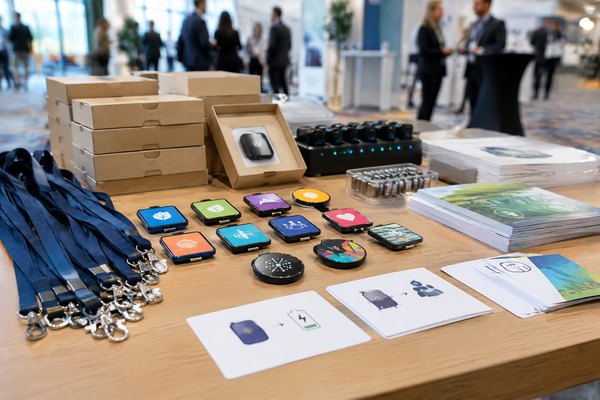
This guide is for conference producers, exhibition organizers, association teams, corporate-event managers, destination-management companies, venue activation teams, sponsorship agencies, and procurement professionals planning a finite deployment. It is particularly relevant when the badge is expected to do more than carry a name: identify crew roles, distinguish ticket tiers, direct visitors to a zone, prompt a sponsor interaction, or serve as a keepsake that makes the event identity visible.
It also applies to brand teams purchasing LCD pins for product launches, roadshows, employee town halls, fan events, and VIP receptions. In these settings, the device can be merchandise, a costume element, a recognition token, or a functional wayfinding cue. The commercial question is not “What is the most advanced device?” It is “What function is valuable enough to justify the operational burden?”
Roles that must align before ordering
The event owner should name one accountable operator for the program and involve four other perspectives early. The creative lead owns readable event art and version control. The registration or operations lead owns allocation, handout, and recovery. The technical lead owns charging, any configuration, and escalation. Procurement or compliance owns the market-specific product and shipping documentation. This is important because a change that looks cosmetic—such as adding Bluetooth, a removable coin cell, an LED effect, or a revised charger—can change the operational and regulatory work.
For a connected badge, add the privacy and information-security owner before selecting features. A device identifier, scan history, location-like proximity data, or a link from a badge ID to a registration record may be personal data in context. The team should document the purpose, access roles, retention period, and deletion path before giving any vendor a data field list. The FTC likewise frames sound data security around collecting only what is needed, keeping it safe, and disposing of it securely; its connected-device materials emphasize authentication, access control, secure data management, and clear user communication.2
Programs that need a more cautious route
Use an elevated review when badges will be worn by children, distributed at a public event without controlled return, shipped internationally by air, used around water or machinery, or provided with separate button or coin batteries. In the United States, consumer products containing replaceable button or coin batteries are subject to specific compartment, warning, and certification requirements; CPSC guidance says accessible compartments must require a tool or two independent simultaneous movements and that product, packaging, and instructions may need warnings.3 This article is operational guidance, not legal advice. The responsible importer, manufacturer, distributor, and event organizer should confirm the rules that apply in each sales or distribution market.
4. Buyer decision framework
Define one job, one audience, and one moment of value
Begin with a one-sentence deployment statement: “This pin identifies on-floor product experts during a two-day launch,” or “This badge is a returnable VIP access indicator at a dinner.” If the statement contains several functions—access, lead capture, gamification, staff identity, sponsor media, and a souvenir—separate them and rank them. The highest-ranked job should still work if network coverage is poor or an attendee never opens an app.
Next, define the audience. A controlled staff group can receive a rechargeable device at a briefing and return it at shift end. A large public audience may be better served by a simple preconfigured display and an optional return incentive. A premium small-group experience can support managed charging and replacement stock; a mass giveaway requires robust handout logistics and a design that remains understandable without staff intervention.
Choose the least complex power and connectivity architecture that serves that job
A preconfigured, non-connected LCD pin is often appropriate when the message does not change during the event. A button-programmed or dock-programmed device may suit several approved display states. A connected badge should be selected only where real-time update, interaction, or event-system integration delivers a defined benefit. “Smart” should describe a useful capability, not a collection of components.
Battery type follows the duty cycle. For a one-off event, a sealed rechargeable battery may reduce loose-cell handling but creates a charging workflow. A replaceable coin cell can simplify storage in some designs but demands secure battery access, correct warnings, spare-cell control, and an end-of-life route. Do not infer runtime from battery capacity alone: display mode, brightness, LED or sound use, radio activity, temperature, firmware, and battery condition all affect use time. Request a configuration-specific operating profile from the supplier, then verify it in the event-like sample test.
Before committing, send LcdWritingTablet a written event brief that states the intended display behavior, distribution markets, audience age, event duration, expected storage interval, available charging area, wireless functions if any, and recovery plan. To turn that brief into a configuration and sample request, contact LcdWritingTablet by email only at info@lcdwritingtablet.com.
Make data optional when it is not needed
If an organizer only needs visible identification, do not use a personal name, registration ID, or trackable device ID unnecessarily. Use role titles, colour groups, or pseudonymous event codes where they achieve the goal. For connected deployments, prepare a concise notice at handout and a longer linked notice stating who controls the data, what fields are processed, why, who receives them, how long they are retained, and how attendees can exercise applicable rights. The European Commission says data subjects should receive this information in concise, transparent, intelligible, and plain language.1
Decide the return outcome before distribution
Every issued unit should have an intended destination: retained by the attendee as merchandise, returned for redeployment, refurbished for a later event, harvested through an authorized recycler, or held as controlled inventory. Do not promote a “sustainable” badge merely because it is electronic or rechargeable. A credible claim requires an actual collection and disposition process. EU WEEE policy prioritizes preventing waste and promotes reuse, recycling, and other recovery routes; it also requires separate collection and proper treatment of WEEE.4
5. Comparison, cost, quality, and specification table
The table below is a planning comparison, not a catalogue specification or price list. “Cost pressure” means the relative factors likely to increase the landed-program budget; obtain a quotation tied to a final bill of materials, artwork, packaging, test scope, and Incoterm.
| Event deployment option | Best-fit event job | Battery and operations | Connectivity/data implication | Cost pressure | Quality points to specify before sampling |
|---|---|---|---|---|---|
| Static or preloaded LCD pin | Brand visibility, staff role, collectible message | Confirm power source, shelf/storage expectation, activation method, and whether attendees can change content | No connectivity required; can avoid personal data entirely | Lower component and support complexity, but artwork and custom tooling may still affect cost | Display contrast in venue lighting, message legibility, pin/clip retention, housing finish, battery access, packaging count |
| Multi-message button-controlled pin | Rotating sponsor or program messages | Confirm button sequence, accidental-press behavior, reset method, and one-event battery profile | Usually no data required unless IDs are linked externally | Added firmware, controls, and validation | Button feel, state sequence, screen refresh behavior, no unintended mode during transport, instructions |
| Rechargeable display badge | Managed staff, VIP, multi-day controlled deployment | Charging bays/cables, charging supervision, shift handover, reserve units, approved charger input | Could remain offline; if connected, specify radio and data flows separately | Charger, cable, battery, labor, spares, and power infrastructure add cost | Charge indicator behavior, connector fit, charge cycle procedure, thermal observations, low-battery behavior, serial tracking |
| NFC/RFID or Bluetooth-enabled badge | Defined access, tap, proximity, or live-update use case | Confirm whether the radio function is always on, and test the actual event duty cycle | Identify data controller, system integration, device ID mapping, privacy notice, deletion path | Module, firmware, integration, validation, support, and compliance work add cost | Exact radio module, firmware version, antenna placement, range/use environment, failure mode, data reset, labels/manuals |
| Returnable pooled badge | Repeat event series or closed attendee group | Check-in/out, cleaning procedure, charging or battery inspection, quarantine for damaged units | Avoid retaining participant associations longer than required | Asset management and reverse logistics become material costs | Durable attachment, unique unit ID, handover record, condition grades, reset verification, protective transport tray |
Build the specification around observable acceptance criteria
A defensible purchase specification says what an inspector can observe. Replace “high quality” with statements such as: “All units must display the approved artwork state after activation”; “the attachment must remain secure during the agreed handling test”; “no sharp edge, cracked housing, loose component, unapproved colour shift, or non-functioning button is acceptable”; and “carton counts must reconcile to the packing list.” State the test method, sample plan, pass/fail rule, and evidence required. Never accept a vague assurance that a variant is “waterproof,” “long-lasting,” “compliant,” or “universal” without the relevant design, test, and market documentation.
For packaging, define the true distribution path: factory to consolidator, air or sea movement, warehouse storage, then venue delivery and internal transport. ASTM D4169 describes a laboratory framework for evaluating shipping units against anticipated distribution hazards, while also noting that it does not replace material specifications or all preshipment procedures.5 A program does not need to claim conformity to that standard to use its basic discipline: test the actual packed unit through a documented sequence, then inspect both carton and device.
6. Product, application, and technical detail
Separate the visible layer from the functional layer
An LCD pin or electronic badge has at least four layers: the visible layer (screen, frame, artwork, name or message); the interaction layer (button, switch, tap point, QR code, or none); the power layer (battery, charging interface, cable, dock, or replaceable cell); and, if included, the communication layer (NFC, RFID, Bluetooth, or another radio). Review each layer independently. A display can be excellent while a clasp is wrong for the garment. A radio can work technically while the data design is unnecessary. A bright animation can be compelling on a desk and inappropriate in a keynote room.
Ask the manufacturer to identify the exact configuration in the quotation: display technology and display area; active versus static content behavior; number and position of controls; housing material and assembly; attachment type; battery chemistry and nominal configuration; charging interface if rechargeable; radio module if present; firmware version; included accessories; and unit, inner-pack, and master-carton dimensions and weights. This is not administrative detail. It is the baseline needed to prevent a sample from being approved on appearance alone.
Custom event artwork must be designed for the physical display
Event artwork should begin with the usable display area, not a social-media canvas. Provide the supplier with the final pixel dimensions or a printable template, colour or monochrome constraints, safe margins, approved fonts converted to outlines when required, and a file naming convention that ties every screen state to an approved proof. Small displays reward short text, high contrast, and an obvious reading order. A full sponsor lockup, a dense agenda, and a small QR code may all become ineffective when reduced to badge scale.
Create a screen-state map before artwork production. For example, State A could show event identity, State B a role, State C a sponsor callout, and State D a handout instruction. Record the trigger for each state, whether attendees may change it, and who approves it. If a QR code is used, test the printed or displayed code with representative phones at the expected scanning distance and lighting. Do not rely on a desktop preview. Include a clear-text destination or short instruction near the code when space permits so the badge is still useful if scanning fails.
Treat colour matching carefully. Screen appearance varies with display technology, backlight or reflective conditions, brightness settings, viewing angle, and venue light. Ask for a physical or filmed proof under conditions relevant to the show floor, but define the approval target as a practical visual match rather than an unsupported claim of universal colour accuracy. Hold final production only after the approved artwork version and physical display version are linked in a signed approval record.
Durability means suitability for a named event environment
“Durable” is not a standalone specification. A two-hour indoor award dinner, a three-day trade show, and an outdoor festival expose a badge to different risks. Define the environment: handling frequency, crowding, garment type, transport in tote bins, temperature, dust, rain exposure, potential drops, and child access. Then choose a proportionate test plan.
For an indoor professional event, focus on finish, attachment retention, display integrity, control operation, and packing protection. For a moving roadshow, add repeated pack/unpack handling and cable or dock wear. For an outdoor environment, do not assume a splash, dust, or temperature tolerance unless the exact variant has an agreed and documented rating or test. The practical control is to choose an appropriate device, carry protective storage, issue replacement units, and explain to attendees when to remove or return a device.
Connected functions require market and product scrutiny
A badge with an RF function is not simply a visual accessory. In the United States, the FCC states that RF devices subject to its rules must be properly authorized before marketing or importation, using the applicable procedure; the process includes determining applicable rules, testing, approval, labeling, user information, and record retention.6 In the EU, the Radio Equipment Directive establishes requirements around safety and health, electromagnetic compatibility, radio-spectrum use, and certain privacy-related aspects for radio equipment.7 The applicable route depends on the actual functions and markets, so obtain professional compliance advice rather than relying on a marketing certificate.
For EEA placement, CE marking is not a generic factory badge. The European Commission says a manufacturer is responsible for conformity assessment, technical documentation, an EU declaration of conformity, and affixing CE marking when the product is within applicable legislation; it also warns that CE marking is compulsory only for covered products and does not mean an authority has approved a product as safe.8 If electronic badges are placed on the EU market, ask the responsible economic operator to identify the applicable laws and provide the appropriate documentation for the exact model—not a document for a superficially similar device. RoHS and WEEE may also matter: RoHS restricts specified hazardous substances in electrical and electronic equipment, while WEEE addresses collection and treatment at end of life.4 9
7. Sample, testing, and quality-control workflow
Stage 1: Make an engineering sample answer the event brief
Order a sample only after issuing a controlled brief. The brief should include the artwork map, event schedule, intended users, markets, target handout date, expected duty cycle, attachment choice, battery/charging plan, packaging concept, and acceptance criteria. Ask for photos or a short demonstration of the exact configuration, but recognize that video is supporting evidence, not a substitute for handling the device.
When the sample arrives, test it in a mini event simulation. Put it on the same kind of lanyard, jacket, shirt, or tote expected at the event. Read it at arm’s length in bright and dim light. Press the controls with staff wearing the gloves or carrying the materials they will actually use. Pack it in the proposed inner box, move it through the planned check-in process, and observe whether an untrained colleague understands it from the handout instruction. Record each finding against the requirement, not as a general impression.
Stage 2: Freeze the approved production configuration
A production approval should identify the artwork version, bill of materials or configuration, firmware version where applicable, battery type, attachment, packaging, accessory list, carton markings, and test plan. If a sample is revised, create a new revision identifier. Do not approve a display layout and later accept a different physical display, battery, charger, or radio module without re-evaluating the affected risks.
For rechargeable designs, confirm the supplied charger and cable arrangement, input requirements, charging indicators, and user instructions against the approved configuration. For coin-cell variants, verify the compartment closure, relevant warnings, and packaging/instruction content for the intended market. CPSC’s published business guidance should be read directly for U.S. products in scope; it describes requirements spanning compartment access, abuse testing, warnings, and certification.3
Stage 3: Use layered production and pre-shipment checks
Request a documented factory check plan that separates incoming materials, in-process assembly, functional checks, cosmetic inspection, packaging verification, and final carton count. The plan need not reveal proprietary processes to be useful; it should state what is checked, when, how defects are classified, and what evidence is retained. At minimum, make the buyer’s release criteria cover correct screen state, button or activation behavior, attachment integrity, housing and display condition, artwork match, accessory presence, label/manual match, and pack count.
Before shipping, inspect a statistically agreed sample from finished goods and a deliberate cross-section of cartons. Compare unit identifiers or lot references with the packing list. Perform basic function checks, inspect the display for damage or unapproved content, verify the attachment, and open selected inner packs. Verify that a charged sample or battery-dependent sample behaves as agreed without claiming a runtime you have not tested. Photograph defects and preserve the chain of evidence so the supplier can identify whether the issue concerns material, assembly, artwork, packing, or transit handling.
Stage 4: Treat failure data as design input
Use a simple disposition log: unit ID or carton, issue, photo, discovered stage, severity, immediate action, root-cause owner, and prevention action. During an event, a lost unit, a bent pin, a drained device, and an unreadable screen are different failure types. Recording them separately helps the next event improve the right part of the system. Do not use a few successful units as proof of broad performance, and do not accept a corrective-action promise without a change that can be verified in the next sample or batch.
8. Ordering and implementation preparation
Build backwards from the attendee handout moment
Work backwards from the moment attendees receive the badge. Allow time for briefing, artwork approval, sampling, production, inspection, payment milestones, international transportation, customs, warehouse receipt, kit assembly, venue delivery, and contingency. Do not treat estimated transit time as the only schedule risk. A late artwork revision, a missing shipping document, an incorrect carton count, or an unplanned radio approval question can consume more time than the freight movement itself.
For air movements, identify the battery configuration early. IATA explains that lithium batteries may travel by air depending on their configuration and watt-hour rating or lithium content, and that spare batteries are not allowed in checked baggage. Its guidance addresses identification, packing, marking, labeling, and documentation.10 Request the relevant UN 38.3 lithium-battery test summary when lithium cells or batteries are involved; U.S. PHMSA notes that lithium batteries must undergo the design tests in UN Manual subsection 38.3 and that the test-summary requirement helps manufacturers and distributors implement the rule.11 Your freight forwarder or carrier should confirm the shipment classification, packing instruction, documentation, and current route-specific restrictions.
Prepare a venue operations pack
The operating pack should contain the final handout script, quick-start card, staff troubleshooting guide, allocation list, replacement process, return instructions, charging plan where relevant, incident escalation contacts, and a reconciliation sheet. Keep it concise enough for temporary staff to use under pressure. If a device is returnable, issue it against a count or identifier and make the return location visible before the event begins.
A responsible attendee instruction is short and specific. It should explain what the badge is for; how to attach or wear it; what a button or indicator means; whether attendees should charge it; what they should not do; where to obtain help; and whether to keep or return it. For connected devices, it should also point to the privacy notice and state whether use is optional. Avoid instructions that imply waterproofing, battery life, device compatibility, or compliance unless the approved product documentation supports that statement.
Plan power, replacements, and accessibility
Charging deserves a physical plan, not an assumption that attendees will find a socket. If recharging is needed, provide a supervised, ventilated, dry charging area consistent with the product instructions, use the specified charging accessories, label batches, avoid overloading power strips, and keep damaged or abnormal units out of service pending the manufacturer’s instructions. Do not distribute loose lithium batteries casually as event spares. For any battery incident or visibly damaged device, stop using it and follow the product, venue, carrier, and local emergency procedures.
Carry a controlled pool of approved replacement units and a process to deactivate or reset a returned connected unit before reuse. Make the experience accessible: use high-contrast critical text, avoid relying on colour alone to convey access status, provide a non-electronic alternative for attendees who cannot or do not wish to wear the device, and ensure a digital-only instruction is not the sole path to essential event information.
9. Practical applications and scenarios
Scenario: The trade-show role identifier
A software company needs visitors to identify product specialists in a busy exhibition hall. A preloaded LCD pin shows “DEMO TEAM,” “SPEAKER,” or “PARTNER” with a high-contrast event mark. There is no attendee data, no radio, and no need for live updates. The organizer assigns each role screen during kit assembly, tests the message under hall lighting, provides a one-line wearing instruction, and holds replacement units at the service desk. At event close, staff can retain pins as controlled merchandise or return them by department for another show. This is responsible because the hardware choice is proportionate to the job.
Scenario: The returnable multi-day VIP badge
A summit uses a rechargeable display badge for a small VIP group. The display provides a visible access tier and a programmed daily message. The event team maps each unit to an inventory number rather than showing personal details on screen. At breakfast, staff inspect and reissue badges; after dinner, staff collect units at a marked return desk. The operations pack specifies charging windows, approved cables, a condition log, and a privacy reset step before the next deployment. A non-electronic credential remains available for any guest who declines or cannot use the device.
Scenario: The sponsor interaction that should remain optional
An exhibition wants a badge to prompt an optional sponsor experience. Rather than automatically recording proximity or building a behavior profile, the event uses a clearly labeled QR display state that attendees may scan voluntarily. The landing page provides its own notice and choices. If a connected feature is proposed, the team defines a specific purpose, access controls, and deletion schedule before integration. This reduces the temptation to collect data simply because the hardware can produce it.
Scenario: The outdoor roadshow
A consumer brand plans an outdoor sequence of pop-up activations. The procurement brief does not call the desired badge “weatherproof” without evidence. Instead, it documents likely exposure, asks the supplier what the exact unit is designed to tolerate, tests protective packing and normal handling, stores reserve units in protected cases, and gives staff a clear rule to remove damaged items from service. The merchandising plan is built around an environment the product can reasonably support, rather than asking a generic pin to solve every field condition.
Scenario: The end-of-event recovery station
An association wants a reuse claim to be credible. The badge handout card says, “Return at the exit for next year’s program,” and the exit station accepts devices in labeled trays. Staff segregate visibly damaged units, reconcile returns, wipe any configuration or personal-data association, and grade units for redeployment, repair evaluation, or recycling. In the United States, lithium-ion devices should not go in household garbage or municipal recycling bins; EPA directs users to separate recycling or household hazardous-waste collection points and recommends terminal protection or separate bagging to help prevent fires.12 The organizer should use an appropriate recycler and follow local rules, especially for commercial volumes.
10. Detailed FAQ
Are smart electronic badges necessary for every event?
No. They are appropriate when a visible or interactive function improves the attendee or staff experience enough to justify the operating effort. A printed credential, lanyard insert, or ordinary pin may be better when the message is static, the event is short, and the hardware adds no clear value. Choose electronic merchandising for a defined job, not for novelty alone.
Should an event badge use a rechargeable battery or a coin cell?
Choose based on duty cycle, distribution control, and market obligations—not on a generic claim that one is better. Rechargeable hardware requires controlled charging, accessories, and reverse logistics. A coin-cell design may avoid charging in some cases, but replaceable cells require secure access, warnings, and safe spare-cell handling. For U.S. consumer products in scope, CPSC requirements for button or coin cells are specific and should be checked against the exact design.3
How should organizers estimate battery runtime?
Ask for the supplier’s configuration-specific operating assumptions, then test sample units in the intended display, brightness, interaction, radio, and temperature conditions. Record a planning margin rather than publishing an unverified promise. Battery capacity alone cannot establish real-event runtime, especially where LEDs, audio, buttons, frequent refreshes, or wireless communications are active.
Can organizers put attendee names or ticket status on the display?
They can if there is a legitimate operational reason and the data design is appropriate, but visible personal data can be read or photographed by others. Consider showing a role, group, or pseudonymous code instead. If personal data is processed, provide a clear notice, define the purpose and retention period, limit access, and remove the association when it is no longer needed. Under GDPR principles, data should be adequate, relevant, and limited to what is necessary.1
Does adding Bluetooth, NFC, or RFID change the compliance work?
It can. The applicable obligations depend on the actual radio function, product configuration, and market. In the United States, FCC authorization requirements may apply to RF devices before marketing or importation.6 In the EU, radio equipment falls within the RED framework.7 Ask the responsible party and a qualified compliance professional to review the exact product; a document for another model or a vague “certificate” is not enough.
What artwork files and checks should be included in the approval process?
Provide the physical display dimensions or template, screen-state map, final text, safe margins, colour/monochrome constraints, required file format, fonts or outlined artwork, and version-controlled filenames. Approve a physical sample or relevant proof in representative lighting, and test any QR code on actual phones. Retain the approved artwork alongside the sample and production configuration record.
How durable are LCD pins and smart electronic badges?
Durability depends on the housing, display, attachment, power design, and event environment. Specify the real handling and exposure conditions, then agree test and acceptance criteria. Do not infer water, drop, dust, or temperature resistance from product category or appearance. A protected indoor deployment and an outdoor festival should not use the same unqualified assumption.
What should be in the attendee instruction card?
Use plain language: the badge purpose; how to wear it; the meaning of controls or indicators; charging instructions if applicable; safety limits; help location; privacy link if relevant; and keep/return directions. Add a non-electronic path for essential event information. The card should mirror the approved configuration and not introduce claims that the sample or documentation has not validated.
How should unused, damaged, or returned badges be handled after the event?
Separate them by condition and battery status. Reusable units should be reconciled, cleaned as appropriate to their materials, reset, and stored under the manufacturer’s instructions. Damaged battery-powered units should not be casually recharged or mixed into general waste. For U.S. lithium-ion devices, EPA advises separate recycling or household hazardous-waste collection rather than trash or municipal recycling and provides business-specific handling considerations.12 For EU deployments, plan separate WEEE collection and the relevant battery obligations; the EU framework emphasizes collection, recycling, and repurposing across the battery life cycle.4 13
11. Conclusion and final email-only CTA
Responsible smart electronic badge programs are designed as event operations with a defined beginning and end. The strongest brief selects the least complex hardware that achieves a clear event job, makes custom artwork legible on the actual display, assigns a battery and charging owner, tests the packed product under representative conditions, tells attendees exactly what to do, and decides what happens to every unit after the closing session.
For LcdWritingTablet buyers, the practical next step is a written event requirement sheet—not an open-ended request for a “smart badge.” State the event use case, markets, audience, display states, attachment, power approach, wireless features, artwork package, packaging path, acceptance criteria, and reuse or return plan. This gives the manufacturer a basis for proposing the right configuration and allows the buyer to test assumptions before production. For a configuration discussion, sample request, or event brief review, email info@lcdwritingtablet.com.
References
Turn this sourcing plan into a product brief.
Share your target market, product requirements, packaging preference and estimated volume for a practical OEM / ODM discussion.