This guide provides a practical B2B decision framework. Final specifications, market obligations, testing scope, labels, packaging and shipment requirements must be confirmed for the exact finished SKU and destination.
Direct answer: Choose 8.5 inch LCD writing tablets for portability, compact giveaways, and price-sensitive volume programs. Choose 10 inch tablets for the most versatile balance of writing room, packability, and everyday family or classroom use. Choose 12 inch tablets when the board is a desk, teaching, meeting, or signage tool and visible space matters more than compact packing. For B2B buying, confirm the active writing area, finished-product and retail-pack dimensions, battery configuration, and target market before choosing a nominal size.
2. Direct-answer introduction
Size changes how the product is held, used, packed, fulfilled, and explained to customers. A compact memo board, a child-directed doodle board, a classroom response board, and a reception sign may use similar LCD writing technology while needing different physical formats.
For a buyer comparing 8.5 vs 10 vs 12 inch LCD writing tablet options, begin with the user task, then test writing area, product envelope, pack design, carton cube, market requirements, and service plan. A nominal diagonal is not a complete specification. The same named size can have different bezel widths, aspect ratios, stylus storage, lock arrangements, housings, weights, and accessories.
This guide does not assume every LCD writing tablet is a children’s toy, uses the same battery, erase mechanism, or belongs in the same market. In the United States, a product designed, manufactured, or marketed as a plaything for children under 14 may fall within the CPSC toy framework, with particular battery, small-parts, labeling, and testing considerations.1 In the European Union, safety obligations and the responsible economic operator depend on the final product and supply arrangement.3
3. Who this B2B LCD writing tablet size guide is for
This guide is for professionals building a private-label range, promotional program, school or office supply offer, retail assortment, or OEM/ODM request—not an individual choosing one board.
Private-label and e-commerce teams need a clear product page, defensible dimensions, retail-ready pack, barcode placement, inbound discipline, and a returns process that distinguishes expected use from a defect. Choose the size that makes the clearest promise.
Promotional-product distributors and corporate buyers should consider the hand-off: 8.5 inches may fit a welcome kit or event bag; 10 inches may provide a balanced writing and branding format; 12 inches may suit a desk or training room. Select by recipient use, decoration, artwork, and distribution method.
Education, stationery, and office suppliers should define the activity before sourcing. A personal scratchpad, spelling slate, response board, meeting note board, and counter message board demand different writing space. Larger surfaces show more content but can be less convenient for smaller users, bags, storage, or parcel packing.
Importers and distributors need a complete SKU specification: identity, accessories, battery information, labels, instructions, responsible party, pack, inspection rules, and shipment documents. Where an item is placed on the EU market as electrical and electronic equipment, end-of-life responsibilities can include country-specific registration and reporting.4
4. Buyer decision framework: select the job before the diagonal
A strong B2B selection uses five questions so unit price does not mask poor channel fit.
4.1 Define the primary writing job
Write a one-sentence use statement, such as “A child uses it for short drawing and letter practice while travelling” or “A retail associate uses it for daily counter messages.” It determines mark size, content amount, viewing distance, and handling. 8.5 inches typically supports mobile personal use; 10 inches broader everyday use; 12 inches a visible page-like surface.
Have representative users perform the real task during sampling. Ask them to write a complete list, solve arithmetic, copy an address, draw a simple diagram, or draft a relevant sign. Photograph the screen at normal viewing distance. This is more informative than comparing diagonals.
4.2 Separate display diagonal from active writing area
The advertised number usually identifies a nominal display class, not necessarily usable surface or outer body. A 10-inch board with a wide protective frame can have a different usable area from another 10-inch board; aspect ratio can also change how a 12-inch board feels.
Request a dimensioned sheet for every candidate: diagonal, active writing area in millimetres, product length × width × thickness, net weight, stylus length and retention. Also obtain individual-pack, master-carton, and pallet measurements. Put approved values in the purchase specification, not only the marketing artwork.
4.3 Decide how the product travels
A larger board may change freight economics because the pack and carton occupy more volume. Carriers may charge actual or dimensional weight, whichever is greater, and calculations vary by mode and trade lane.7 Evaluate carton cube and chargeable weight from confirmed packed dimensions, not the tablet diagonal.
For parcel retail, compare fully packed units and identify thickness added by the stylus, leaflet, battery, sleeve, hanging tab, seal, or labels. For institutions, compare carton handling, shelf storage, and corner protection. A compact body does not guarantee an efficient carton.
4.4 Map size to the sales claim and audience
Claims influence validation. A general note board may need a different review from a children’s plaything, learning product, or sound-enabled device. CPSC notes requirements for battery-operated toys can address battery access, labeling, overheating, and chargers; small parts and age grading can also matter.1 For child-directed products, give the reviewer complete pack, instructions, marks, accessories, and age claim—not only the tablet.
An erase lock, stylus tether, battery door, sound module, magnet, removable accessory, or battery change can alter the risk profile. Size alone does not determine burden. Freeze claims and target age before testing or production approval.
4.5 Score total program fit, not only ex-works price
Use a weighted scorecard. A travel retailer may weight portability and retail cube; a school supplier, writing room and durability; a corporate-gifting buyer, brand presentation and delivery format. Document the choice for purchasing, quality, sales, and logistics.
| Decision criterion | Questions to answer | Typical priority by size |
|---|---|---|
| Writing task | How many words, symbols, or drawings must be visible at once? | 8.5: short notes; 10: varied everyday work; 12: larger notes, diagrams, signs |
| User mobility | Will it be carried in a small bag, issued at an event, or kept on a desk? | 8.5 strongest; 10 balanced; 12 desk-oriented |
| Retail presentation | Does the pack need a strong shelf presence or a compact display footprint? | 8.5 compact; 10 adaptable; 12 high-visibility but larger |
| Branding surface | Is a printed logo, instruction card, or private-label story central to the offer? | Assess actual bezel and pack layout for every SKU |
| Fulfilment economics | What are the confirmed individual-pack and master-carton dimensions and weights? | Compare actual cube; do not infer from diagonal |
| User age and claim | Is it a general-use note board, a child-directed play product, or a learning item? | Determine from final claim and configuration, not size |
| Service risk | Are lock, erase, battery door, stylus, screen contrast, and pack damage easy to explain or inspect? | Test the exact model in the intended pack |
5. 8.5 vs 10 vs 12 inch LCD writing tablet comparison and specification table
The table below is a selection framework, not a catalogue specification. “Best fit” means a common commercial role to validate with samples. Confirm every measurement and feature on the quotation and golden sample. Variants can differ in battery, screen color, pressure response, casing material, lock function, stylus design, and retail packaging.
| Factor | 8.5 inch LCD writing tablet | 10 inch LCD writing tablet | 12 inch LCD writing tablet |
|---|---|---|---|
| Core buying rationale | Compact, approachable, easy to bundle or distribute | Broadest all-rounder for one-SKU programs | Greater visual workspace and desk presence |
| Typical task fit | Quick notes, simple drawings, travel activity, event giveaway | Home notes, learning practice, retail generalist, portable desk use | Lists, diagrams, teaching prompts, counter messages, meeting or desk use |
| Writing-area perception | Deliberately limited; encourages short-form content | Enough room for many routine tasks without feeling oversized | More page-like or sign-like; better where content must remain visible |
| Portability | Usually the easiest class to carry and merchandize in compact spaces | Usually manageable for bags and desks | Better suited to a desk, tote, classroom bin, or fixed location |
| Retail-pack consequence | Usually supports a smaller shelf footprint | Requires moderate space while retaining versatility | Needs more shelf, parcel, and storage space; verify thickness and corner protection |
| Brand-story opportunity | Good for a simple branded giveaway or impulse item | Supports a balanced value story and standard accessory set | Supports a premium, productivity, education, or display-oriented story |
| Common buyer error | Selecting it for a task that needs multi-line writing or large drawings | Assuming it is automatically a standard across factories | Choosing it for visual impact without measuring packed cube or use ergonomics |
| Sample decision test | Can the user complete the real short task comfortably? | Does it work for both seated use and light carrying? | Can users hold, write on, store, and ship it as planned? |
| Recommended commercialization path | Entry tier or compact program | Mainline / balanced SKU | Specialist, premium, or desk-use SKU |
Mid-article CTA: turn the size choice into a sample brief
Do not request “an 8.5, 10, and 12-inch tablet” as a bare inquiry. Send LcdWritingTablet a short decision brief covering your intended use, sales country, target age or audience, desired nominal size, active-area preference, lock and stylus requirements, retail-pack concept, logo artwork status, and estimated order timing. Ask for a model-specific specification sheet and sample options. For OEM/ODM discussion, email info@lcdwritingtablet.com.
6. Buyer checklist before approving the size
Use this checklist to convert a visual choice into a purchase-ready decision. A “no” identifies work to resolve before deposit, artwork release, or production booking.
| Approval item | Evidence to request or create | Why it matters |
|---|---|---|
| Use case is written in one sentence | Internal brief with target user, setting, and task | Prevents choosing on appearance alone |
| Nominal size is unambiguous | Supplier drawing states diagonal and active writing area | Avoids confusing visible screen, active area, and outside dimensions |
| Finished-product dimensions are confirmed | L × W × T, net weight, photos with scale | Supports retail copy, storage planning, and ergonomic review |
| Retail-pack and master-carton data are confirmed | Pack dimensions, gross/net weights, units/carton, carton markings | Supports landed-cost and fulfilment estimates |
| User task succeeds in sample use | Written sample-review notes and photos | Tests real writing room, contrast, erase, lock, stylus, and handling |
| Battery configuration is identified | Battery type, quantity, installed/separate status, replacement method | Directs safety review and shipping documentation |
| Claims, age grade, and market are frozen | Artwork brief and legal/compliance review record | Aligns the sale proposition with verification scope |
| Label and language plan is approved | Packaging and instruction artwork proof | Avoids a mismatch between physical product and market-facing information |
| Acceptance criteria are measurable | AQL/inspection checklist or agreed quality standard | Creates a common basis for factory and third-party inspection |
| A golden sample is retained | Signed, dated reference sample and photo record | Controls consistency after initial approval |
Use the same product name on the invoice, box, listing, and test request. Reconcile terms such as “writing board,” “toy,” “learning tablet,” “electronic slate,” or “gift”; the name and claims should match intended use and the compliance assessment.
7. Sample, testing, factory, and shipment inspection workflow
Control the size decision through sampling and production; treat the sample as the start of the specification, not a decorative preview.
Step 1: build a sample matrix. Order representative candidates, not one “best-looking” board. For every candidate, document model code, colors, active area, lock behavior, stylus, battery, included items, packaging, and observed flaws. Use the same test script across sizes.
Step 2: run task-based review. Ask representative users to complete the intended task uncoached. Check legibility, hand coverage, stylus comfort, and erase/lock clarity. Test write, lock if fitted, transport, unlock, erase, and repeat. Record a decision log.
Step 3: verify construction and function. Inspect cosmetic condition, edges or burrs, housing fit, screen, stylus retention, lock/erase, battery door where applicable, contents, printed information, and barcode readability. Do not claim “child-safe,” “durable,” or “safe for travel” without product- and market-specific substantiation.
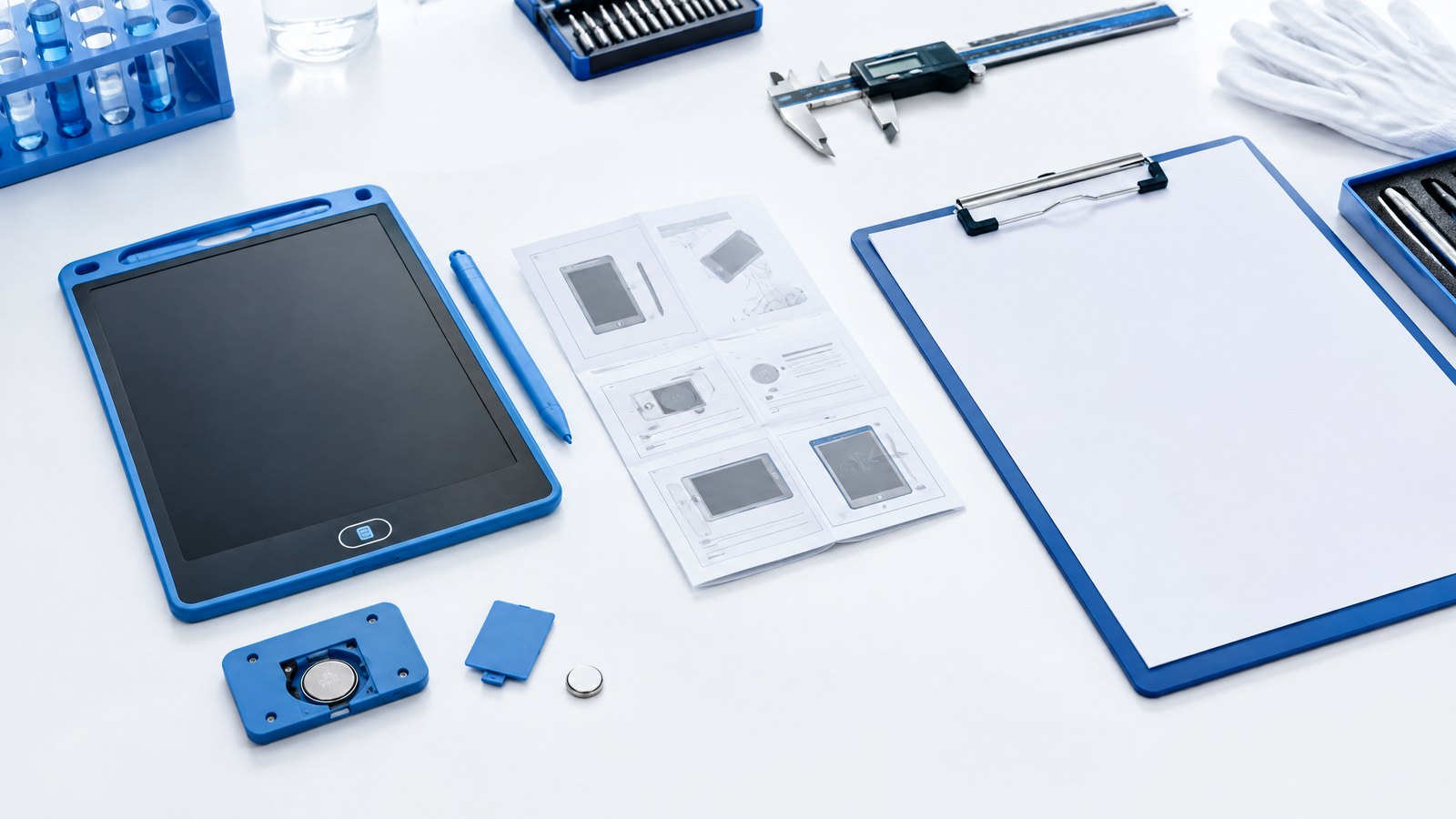
Step 4: align testing with the final SKU and claim. The responsible importer, brand owner, or economic operator should decide applicable requirements. A U.S. product marketed as a toy may follow a different route from a general-use writing board. CPSC states ASTM F963 is mandatory for children’s toys in its framework and describes additional battery-operated toy requirements.1 For replaceable button or coin cells, CPSC describes secure access, use-and-abuse, and warning considerations; application depends on product type and rule scope.2 Obtain advice for the actual model; do not substitute a report for a similar-looking SKU.
For EU consumer products, plan a product-specific safety assessment and economic-operator arrangement. GPSR has applied since 13 December 2024, includes online sales, and requires an EU responsible economic operator for covered products.3 Electrical, battery, radio, toy, chemical, environmental, language, and national obligations can vary with configuration and market. Confirm final obligations before sale.
Step 5: conduct production and pre-shipment checks. Compare production units to the golden sample and artwork. Inspect model identity, quantity, appearance, functions, pack contents, carton count, marks, and carton condition. Reconfirm packed dimensions and weights. For formal transport validation, consider a laboratory distribution test. ASTM D4169 describes laboratory evaluation against sequential distribution hazards and notes that a performance-test unit remains unopened through the sequence.6 Choose methods and pass criteria for the actual route.
Step 6: clear shipment configuration. Before booking, confirm battery type, rating, installed/packed-with status, packaging, and route with the forwarder. IATA classifies lithium-ion batteries contained in equipment under UN 3481 and says that, except for button cells installed in equipment, relevant battery-powered equipment requires an available UN 38.3 test summary.5 Carrier acceptance, markings, and documents differ by configuration and mode; review the final shipment with the carrier or a qualified dangerous-goods provider.
8. Ordering and implementation preparation
Once the size is chosen, create a purchase specification for the factory, inspector, forwarder, warehouse, and marketplace team. Include model code, revision date, nominal size, active area, dimensions, weight, colors, logo, stylus, lock/erase behavior, battery, instructions, pack, barcode, labels, carton pack-out, and shipping marks.
Separate must-have requirements from preferences. A must-have may be active-area range, stylus arrangement, retail pack, or language. This lets the supplier identify tooling, lead-time, cost, testing, carton, or MOQ effects before a late artwork request changes the approved SKU.
Plan project gates: brief/quote, sample review, artwork/pack approval, final market review, pre-production confirmation, inspection, and shipment/warehouse reconciliation. Assign an owner and date at each gate; use version control to avoid producing against an old size or carton drawing.
Match implementation to the size story. For 8.5 inches, show compact everyday use and active area. For 10 inches, show credible varied tasks. For 12 inches, show desk, teaching, signage, or planning context and exterior/pack dimensions. Describe only functions present; an LCD writing tablet is not necessarily a connected or data-storage device.
Before release, calculate landed cost at the packed-SKU level, then check the master carton. Include product, pack components, labels, inspection, test work if required, transport, duty/tax assumptions, fulfillment preparation, storage, and anticipated damage/returns allowance. Because dimensional weight may determine chargeable freight when it exceeds actual weight, rerun costs if any pack dimension changes.7 Compare costs and margin by size using the supplier’s confirmed measurements, not a generic ratio.
9. Practical applications by size
8.5 inch: compact distribution and personal use. Use when portability is the promise: travel activity packs, reception giveaways, to-do or message boards, short-form practice where claim and market review support it, and value bundles. Its limitation is room for longer lists, worksheets, or detailed drawings. Show it in hand or bag and disclose outer and active-area dimensions.
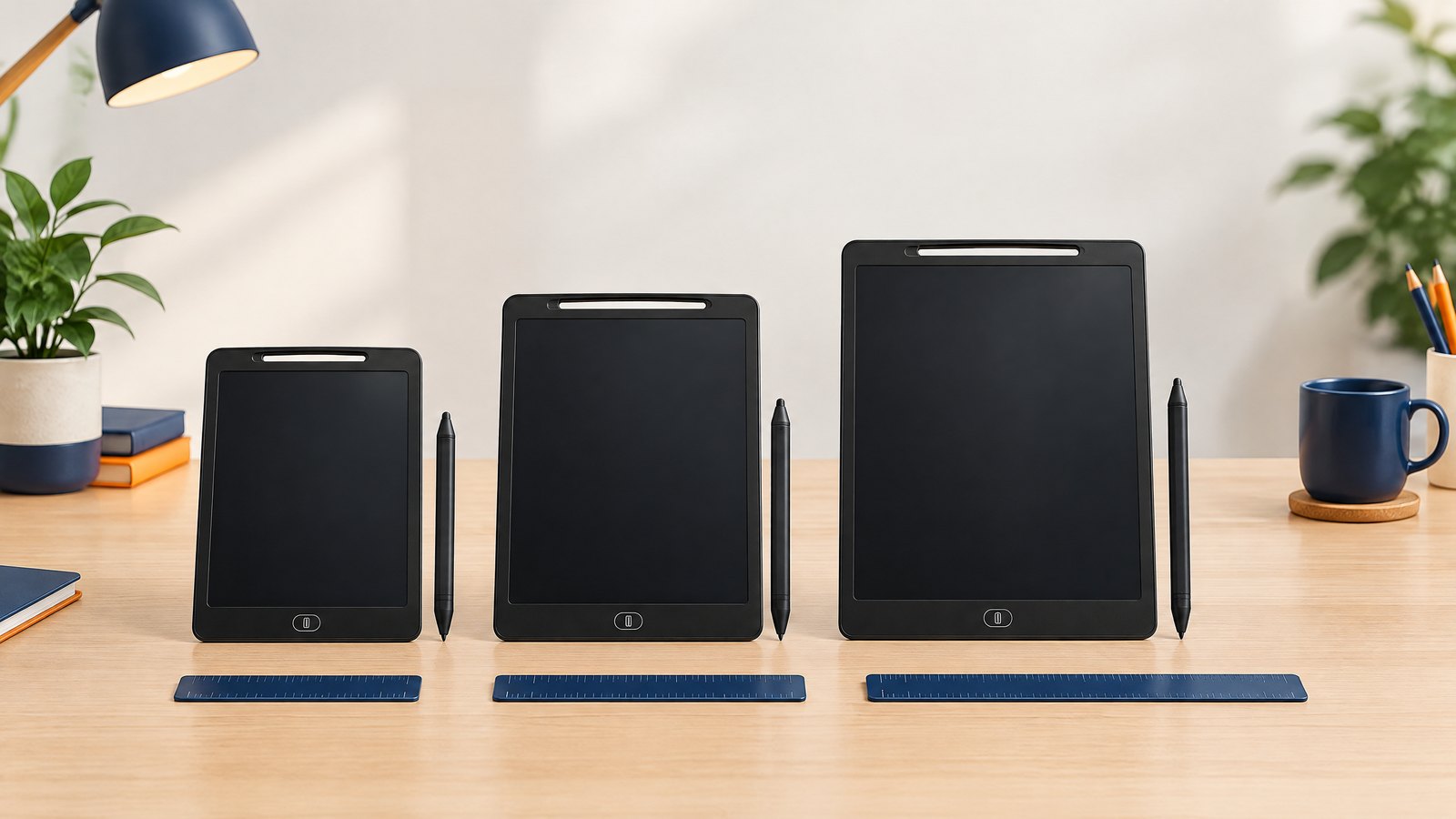
10 inch: one-SKU versatility. This format can serve family notes, spelling and arithmetic practice, short meeting notes, task boards, waiting-room activity, and stationery retail. The benefit is range, not a guarantee for every task. Confirm comfort for the smallest intended user and convenience for the largest. Side-by-side testing may show that it eliminates the need for a three-size assortment.
12 inch: visibility and stationary use. Choose it when the promise requires more content at once: classroom prompts, desk planning, staff messages, counter signage, meeting diagrams, or larger handwriting practice. Sample it on the counter, desk, classroom table, or storage bin where it will live. It must earn extra pack space through utility, readability, or premium presentation—not a more impressive catalogue diagonal.
Mixed-size assortments: segmentation without confusion. A three-size range can make sense when each size has a distinct job and price architecture: compact, everyday, and desk/display. Use a shared design language but make the use cases obvious. Avoid giving all three indistinguishable names and descriptions. If retail space is constrained, a two-size architecture—8.5 plus 12, or 10 plus 12—may create clearer separation. Test the assortment’s carton complexity, replenishment demand, and web-listing clarity before committing.
10. Detailed FAQ
Is a 10-inch LCD writing tablet always the safest B2B choice?
No. It is often a balanced starting point, but it is not automatically the best commercial decision. Choose 10 inches when user testing confirms enough writing room and the packed SKU meets your retail, fulfillment, and price requirements. An 8.5-inch model can be more appropriate for compact distribution, while a 12-inch model can be more appropriate for visible desk or teaching tasks.
Do 8.5, 10, and 12 inches describe the active writing area?
Not necessarily. Treat them as nominal display classes until the supplier confirms the diagonal reference and active writing area. Request a dimensioned drawing and measure the physical sample. In your listing, distinguish the screen or active area from product outer dimensions and package dimensions so buyers can understand the usable workspace.
Which size is best for children?
There is no size-only answer. Match the tablet to the child’s intended activity, grip, carrying situation, and age-appropriate market positioning. More importantly, decide whether the product will be designed or marketed as a children’s toy or learning product, then review the exact configuration, accessories, battery, packaging, claims, and destination-market requirements. CPSC’s toy guidance specifically addresses battery-operated toys and other hazards in the applicable framework.1
Does a larger LCD writing tablet need a different compliance route?
Not solely because it is larger. Requirements can change when the configuration, electrical/battery design, wireless function, included charger, intended user, claims, accessory set, or market changes. Ask the responsible economic operator or qualified adviser to assess the final SKU. Do not rely on a document for another size unless its scope clearly covers the same construction and market conditions.
What should we ask a factory to quote for each size?
Ask for model code, nominal diagonal, active area, full product dimensions, thickness, net weight, battery type and installation status, erase and lock features, stylus and accessories, material description, logo options, retail-pack dimensions, master-carton dimensions, units per carton, gross/net carton weight, sample lead time, production lead time, proposed quality checks, and market-relevant documents available for that exact model. Ask which values are estimates and which are measured.
How do we compare shipping costs fairly across sizes?
Use the same incoterm, destination, transport mode, pack style, and order quantity. Compare individual-pack dimensions and master-carton cube, then ask your forwarder to calculate chargeable weight using the actual shipment assumptions. UPS notes that carriers may use actual or dimensional weight, whichever is greater, and that the approach varies by mode or lane.7 Do not compare one size in a basic sample pack with another in a final retail pack.
What battery questions should a buyer ask?
Identify the battery chemistry, quantity, location, rating where relevant, whether it is installed or supplied separately, how the compartment opens, whether the battery is replaceable, and which documents are required for the route. For products using replaceable button or coin cells in the U.S. consumer market, CPSC guidance describes secure-compartment, warning, and certification considerations that may apply.2 For lithium-powered equipment, obtain the relevant UN 38.3 test summary and validate transport treatment with your forwarder.5
Is a sample enough before we place a production order?
A sample is necessary but not sufficient. Approve a written specification, packaging artwork, critical dimensions, function criteria, market/claim review, and inspection checklist. Retain a golden sample. During production, verify that the final unit, pack, and carton remain consistent with what was approved. The buyer should also make a plan for receiving inspection and customer-service troubleshooting.
Can the manufacturer handle all compliance obligations?
An OEM/ODM manufacturer can provide product information and may support testing or documentation discussions, but responsibility depends on the legal market role and supply arrangement. In the EU, GPSR contemplates a responsible economic operator in the Union for covered products.3 For WEEE-related obligations, the business that manufactures, distributes, or sells EEE can have country-specific responsibilities such as registration and reporting.4 Confirm allocation of duties in writing with qualified local advice.
11. Conclusion: choose the size that strengthens the complete program
The decision between 8.5, 10, and 12 inches should be made at the intersection of user task, verified writing area, pack economics, market claims, and inspection control. Select 8.5 inches when a compact, personal format is the product’s advantage. Select 10 inches when a versatile mainline tablet serves the widest practical range of everyday tasks. Select 12 inches when additional visible workspace supports a desk, classroom, planning, or signage application strongly enough to justify the larger physical footprint.
A disciplined buyer does not purchase a diagonal number. They approve an exact SKU, pack, claim set, and shipping configuration. Start with comparative samples, write measurable acceptance criteria, retain the approved reference, and verify the final production and transport documents against the chosen model. This approach makes a size decision easier to explain internally and more reliable in the market.
Ready to compare an 8.5, 10, or 12-inch program? Send your target market, use case, preferred format, branding needs, packaging concept, and expected order timing to info@lcdwritingtablet.com. Ask LcdWritingTablet for model-specific samples and specifications so your final selection is based on the actual product, not a nominal size alone.
References
Turn this sourcing plan into a product brief.
Share your target market, product requirements, packaging preference and estimated volume for a practical OEM / ODM discussion.