This guide provides a practical B2B decision framework. Final specifications, market obligations, testing scope, labels, packaging and shipment requirements must be confirmed for the exact finished SKU and destination.
LCD Writing Tablets for Toy Fairs and Trade Shows: Sample Kit and Lead Follow-Up Guide
Direct answer: The most effective LCD writing tablet trade show program begins before the fair. Take a controlled sample kit that demonstrates the proposed product, documents its compliance route, and makes a buyer demo repeatable. At the booth, capture the prospect’s market, intended use, price tier, customization requirement, and decision date—not simply a business card. Follow up within one business day with the exact configuration discussed, then convert interest into a written sample specification, pre-production approval, and receiving plan. For US, UK, German, and French buyers, a capable Shenzhen OEM/ODM partner connects a clear brief to traceable quality, market-specific labeling, and reliable freight execution.
This procurement guide is for toy brands, retailers, importers, promotional-product distributors, and event teams meeting a Shenzhen manufacturer. “LCD writing tablet” here means a pressure-sensitive LCD doodle board or writing tablet, not a powered display tablet. Requirements depend on age grade, intended use, claims, battery configuration, and destination market; confirm the final product path before commercial placement.
Module 1: Set the trade-show procurement brief before the meeting
A fair meeting is too short for a vague request such as “show your best seller.” That request often produces a generic quotation, an attractive but unrepeatable sample, and a slow clarification cycle. Send shortlisted suppliers a one-page brief before the meeting. It gives each writing tablet exhibition supplier the same basis for preparation and lets your team compare responses fairly.
Start with the product role: children’s toy, travel activity, party favor, classroom item, restaurant giveaway, or branded gift. The target age, packaging copy, retail channel, and planned claims affect safety assessment and labeling. CPSC defines a toy as an object designed, manufactured, or marketed as a plaything for children under 14; its children’s-product testing and certification requirements are especially relevant to products primarily intended for age 12 or younger.1
Set boundaries rather than expecting a factory to infer them. State target markets, target retail price or landed-cost range, forecast, initial order quantity, desired arrival date, screen size, color mode, body material, stylus retention, erase-button feel, lock function, hanging loop, battery option, and packaging requirement. Identify which items are fixed and which are exploratory. A logo, age grade, language set, and screen size may be fixed, while a molded character shape or magnetic stylus dock may be open for factory proposals.
Name the technical evaluator, commercial owner, and final approver. End the brief with the next decision gate: for example, “two models will advance after a demo and document review.” This makes the discussion accountable procurement rather than a catalog tour.
Module 2: Build an LCD tablet sample kit that earns a second meeting
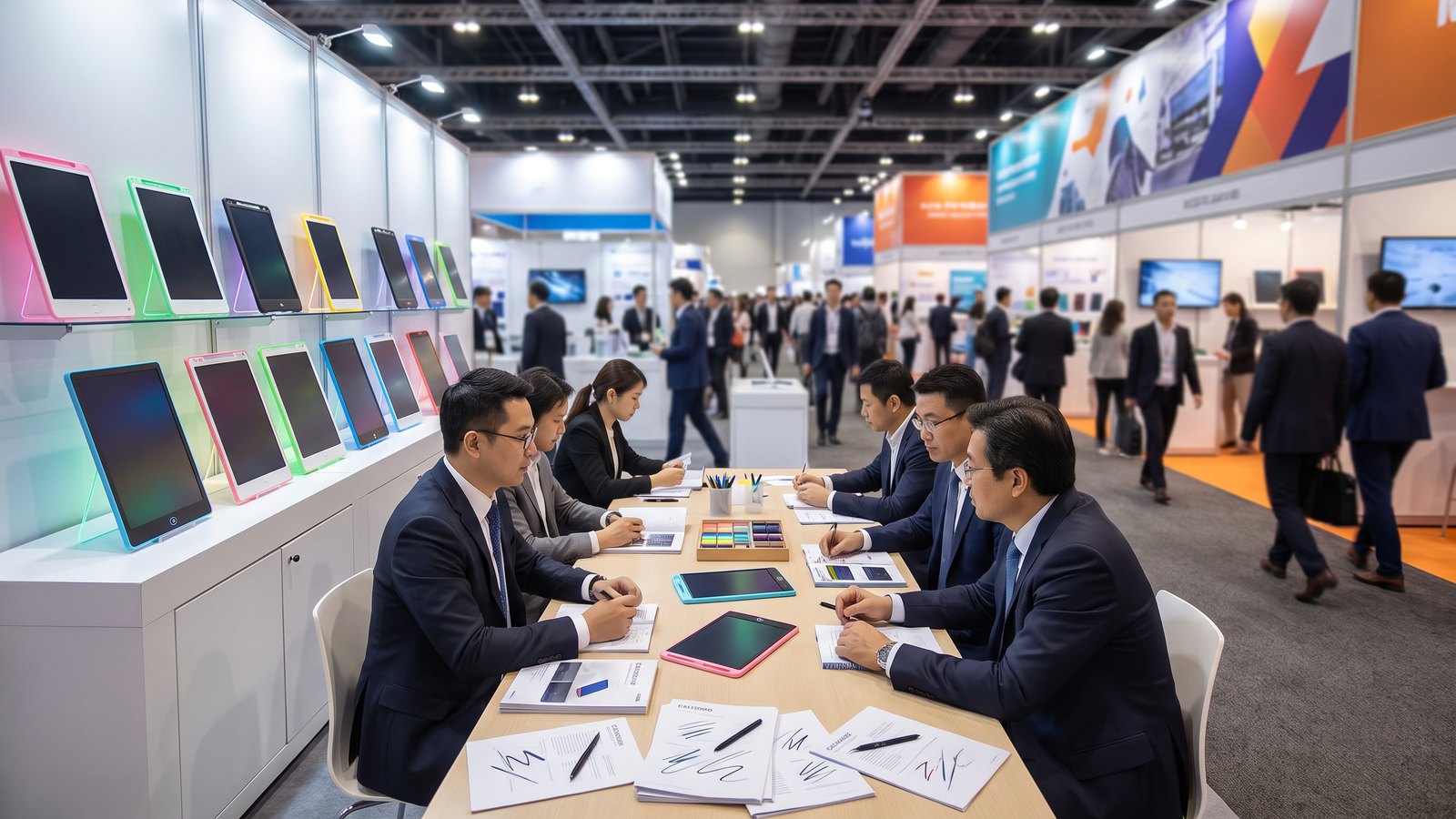
A useful LCD tablet sample kit is a comparison tool, not a carton of random colors. Ask for every sample to carry an identifier linked to a specification card. In a busy hall, this protects the buyer from confusing similar 8.5-inch and 10-inch boards.
For a focused appointment, request three archetypes: an entry model for promotional or value retail, a core retail unit likely to become the first order, and one customized direction that proves OEM/ODM capability. Include one tablet in final-style packaging, even with provisional artwork. A bare device proves function; packaged toy fair product samples reveal shelf footprint, opening experience, instruction capacity, warning space, and whether the stylus, battery tab, or hanging feature survives transit.
Each card should identify model code, dimensions, net weight, LCD type and active screen size, shell and stylus materials, battery type/access method, functions, individual-box dimensions, master-carton pack count, and carton gross weight. Add a clear status: concept, engineering sample, approved reference, or mass-production sample. This stops a buyer from approving a hand-modified mock-up as if it were production-ready.
Test with hands, not only eyes. Write across the panel; check line continuity, pressure response, contrast, lock function, and repeated erase operation. Inspect stylus fit, mold flash, screen gaps, battery-door security, rattles, logo alignment, and small printed warnings. Place shaped units on a flat table to check stability. Score each product immediately against writing performance, visual appeal, customization fit, packaging practicality, compliance-document readiness, commercial range, and supplier responsiveness.
Module 3: Design a buyer demo writing tablet experience around real use
A tablet is remembered when its use is clear in seconds. Build one controlled demo per buyer type. For a toy retailer, write a name, draw, use the lock, and erase. For a promotional distributor, show branded front print and a simple event-message use case. For an education buyer, demonstrate a prompt-and-response activity and portability.
Place a small card beside the unit: “Write → Lock → Show → Erase.” Keep battery-checked demonstration units separate from sealed samples. This avoids a common booth failure: an active shipping tab or engaged lock makes a good product look defective.
Be candid about limits. Most LCD writing tablets are trace displays with one-touch erase; they are not image scanners, storage devices, or backlit screens unless the documented specification says otherwise. Accurate claims protect the buyer’s packaging, returns rate, and reputation.
End the demo by recording the next sample decision: stock model, logo-print sample, packaging proof, color chip, new-mold proposal, or full prototype. The buyer demo writing tablet then becomes an orderable product configuration.
Module 4: Qualify the trade show OEM writing tablet supplier beyond the booth
A polished booth demonstrates presentation, not necessarily production control. Verify the legal entity, facility location, core manufacturing scope, export history for the requested markets, and whether final assembly, printing, packaging, and quality checks are managed in-house or through partners. Request the factory address, available audit or quality-system evidence, and named engineering, quality, and export-document contacts.
Define OEM and ODM deliverables in writing. OEM commonly means production under the buyer’s brand and specification; ODM may begin from the manufacturer’s platform. The labels alone are insufficient. Put artwork approval, logo-print method, color standard, tooling ownership, mold-release terms, approved sample reference, packaging dieline, language versions, inspection level, and intellectual-property treatment into the quotation. If a proprietary shape is proposed, clarify exclusivity by territory, channel, or term.
A qualified factory asks about age grade, destination, battery, package language, sales channel, compliance target, forecast, and timeline. Treat a universal “certificate” offered before the product configuration is known with caution. A report has a specific model and scope; a change to accessible parts, plastic, screen, battery, print, or age claim can change what must be assessed.
Ask how the supplier controls sample requests, specifications, artwork proofs, revisions, final inspection, and material substitutions. Require disclosure and written approval before an alternate resin, battery source, screen supplier, print, or carton is used. The fair relationship has value only if the approved product can be reproduced.
Need a sample-kit checklist, product-brief template, or documented OEM/ODM discussion for an upcoming fair? Email info@lcdwritingtablet.com.
Module 5: Build a cost model linked to the show objective
The lowest ex-works price is not automatically the lowest business risk. Have suppliers quote the same configuration and Incoterm, then separate recurring unit cost from development and logistics charges. A usable quote identifies currency, validity, MOQ by SKU and color, sample and freight cost, payment milestones, production lead time after approval, carton configuration, port or delivery basis, and exclusions.
| Cost area | What to lock down before comparing suppliers |
|---|---|
| Product | Screen size/type, shell resin, stylus, battery configuration, functions, logo-print colors |
| Customization | Artwork setup, print plate or mold charge, color matching, packaging dieline, tooling ownership |
| Compliance | Product-specific test scope, documentation, labeling review, re-test triggers |
| Packaging | Individual box, inserts, protective bag, master-carton count, display carton, palletization |
| Delivery | Incoterm, origin, freight mode, insurance, destination charges, duty/tax responsibility |
Budget in three layers. First comes discovery: evaluation samples, shipping, and a possible paid prototype. Then comes launch readiness: artwork, custom print, packaging proof, testing, and tooling. Finally comes scalable landed cost: production, cartons, transport, insurance, import clearance, and destination handling. Comparing only unit cost hides the work that turns an exhibition sample into sellable inventory.
Request a quantity ladder at the first qualified MOQ, a mid-volume run, and forecast volume. Ask whether MOQ is per color, artwork, language, or mixed assortment, and whether it uses production materials rather than leftover stock. For Germany and France, include the applicable importer and producer responsibilities in landed-cost planning. For the UK, separate Great Britain from Northern Ireland. For the US, budget testing and labeling before approving claims.
Module 6: Map compliance and claims before samples become sellable stock
Compliance is configuration- and country-specific. A show sample may be displayed under event rules, but sale or placing a product on a market has separate obligations. Request evidence tied to the actual model, materials, battery, age grade, labels, and destination, then have the responsible importer, brand owner, qualified laboratory, or adviser confirm the final route. This is procurement guidance, not legal advice.
United States. When the LCD board is a children’s toy, assess applicable US requirements before sale. CPSC says ASTM F963 is a mandatory consumer-product safety standard for children’s toys and that manufacturers and importers of covered children’s products issue a Children’s Product Certificate (CPC).1 Its guidance also notes product and packaging tracking-label expectations and requirements relevant to battery-operated toys.1 Build age grade, warnings, producer/importer details, tracking information, relevant test coverage, and the CPC into the production pack. A report for another model or brand is not a substitute.
European Union, including Germany and France. Toys sold in the EU require CE marking as the manufacturer’s declaration that the toy meets essential safety requirements, with suitable conformity assessment and technical documentation.2 Those requirements address general safety and physical, mechanical, flammability, chemical, electrical, hygiene, and radioactivity risks.2 An electrical writing tablet can also bring RoHS questions; the European Commission says EEE with an electrical/electronic component, unless excluded, must meet RoHS substance restrictions.4 Plan German and French instructions, warnings, and economic-operator details early. Verify applicable product category, producer-responsibility arrangements, and packaging duties before launch; WEEE rules cover separate collection and proper treatment of EEE.5
Great Britain. The Toys (Safety) Regulations 2011 apply to toys intended for play by children under 14 and require safety information and warnings in English.3 GB recognizes CE marking indefinitely for relevant product regulations, while UKCA remains available; CE remains mandatory for EEA placement and Northern Ireland has separate considerations.3 The same UK guidance requires safety assessment, appropriate conformity route, declaration, technical documentation, and marking before a toy is placed on the GB market.3
Ask for a compliance-document index instead of disconnected files. It should link model/SKU, age grade, report number/date, tested materials, applicable requirements, declaration, battery information, artwork/label version, and revision status to the golden sample. If the product changes after testing, pause and establish whether reassessment is needed.
Module 7: Turn the fair sample into a controlled quality and receiving standard
A fair sample becomes useful only when backed by a dated written specification. Create photographs of all sides, acceptable color reference, logo dimensions, screen appearance, stylus fit, battery-door details, packaging layout, carton marks, and pass/fail criteria. Mark the document and physical item as the approved golden sample, retain a controlled copy, and record written buyer/factory approval.
For LCD boards, pre-shipment inspection should cover appearance, assembly, and function. Agree the sampling plan and defect definitions before production. Critical defects may include unsafe battery access or sharp accessible edges. Major defects may include a non-functioning erase or lock function, screen damage preventing normal use, missing required information, or wrong artwork. Minor defects can cover defined cosmetic tolerances. Your quality team should set classifications for the market and product risk.
Practical checks include agreed function testing, repeated write/erase sampling, lock verification, stylus retention, button actuation, surface condition, seams, print, battery polarity and isolation tab, package completeness, barcode scan, and carton count/marks. Record results by SKU, lot, carton, inspector, date, and photo.
At receiving, match cartons and pallet labels to the packing list before opening representative units. Check crush or water damage, wrong-language packs, mixed colors, short counts, missing accessories, and functional failure. Photograph discrepancies immediately, retain units and labels, and notify the supplier within the agreed claim period.
Module 8: Plan packaging, batteries, and logistics for the fair and first order
Show goods and commercial stock need different shipment plans. Send a small, traceable exhibition kit early enough for customs, venue receiving, and delay. Carry digital and printed commercial/pro forma invoice, packing list, description, country of origin, values, model list, event-consignee details, and carrier-requested battery paperwork. Confirm venue receiving windows, label format, storage, and release process.
If goods will be temporarily imported and re-exported rather than sold or given away, investigate ATA Carnet eligibility with a customs professional. The US International Trade Administration says an ATA Carnet can cover temporary, duty- and tax-free entry of commercial samples and trade-show goods, but is not recommended for consumable goods or merchandise expected to be sold abroad.6 Confirm destination eligibility and reconcile every serialized or kit-numbered sample on return.
Battery-equipped models require carrier-specific review. IATA says lithium cells and batteries must pass applicable UN 38.3 tests. A test summary is generally required for equipment containing lithium cells/batteries except equipment with only lithium button cells.7 Ask the freight provider to confirm classification, marks, documents, quantity limits, and whether spare cells alter the route. Do not replace a battery source after transport documentation is prepared.
For the first order, agree individual protection, inner-box orientation, master-carton strength where relevant, carton gross-weight limit, pallet pattern, moisture protection, shipping marks, and claims responsibility. Define who books freight, receives cargo, and manages damage claims under the agreed Incoterm.
Module 9: Make LCD tablet lead generation qualified, not a card collection
The aim of LCD tablet lead generation is a relevant next action. Use a two-minute lead form with name, company, role, business email, country, sales channel, product tested, expected quantity, price/budget band, customization request, compliance destination, launch date, and follow-up permission. Add two high-value fields: the buyer’s current alternative and the specific decision blocker.
Train booth staff to ask concise questions: Which market will receive the first shipment? Will it sell as a toy, gift, or promotion? Which sample fits the range? Is stock artwork, private label, or an original shape needed? What must be approved before a purchase order? These questions show competence and create a useful post-show brief.
Code leads while the conversation is fresh. An A lead has a defined program, decision maker, approximate volume, and timing. A B lead has product fit but an open commercial or technical condition. A C lead is exploratory with a scheduled future contact. A D lead lacks a current match. Record the reason: “A—needs French packaging proof by 15 May” is useful; “hot lead” is not.
Give active prospects the relevant sample identifier and a date for quotation or revision. Do not promise exclusivity, test completion, delivery dates, or final price from the booth without approval. At day end, reconcile notes, scans, and sample sign-outs, then assign an owner and next action before the next morning.
Module 10: Run a lead-follow-up sequence that advances decisions
Send the first email within one business day. Reference the exact sample handled, market, use case, agreed next step, and attachment that moves the decision forward. A generic catalog blast signals that the exhibitor did not listen.
For an A lead, include a meeting recap, preliminary configuration, quotation basis, sample status, required buyer inputs, document-index availability, and dated approval gate. For a B lead, answer the blocker: OEM print illustration, MOQ ladder, packaging concept, documentation gap, or sample plan. For C leads, send a concise recap and honor the agreed follow-up date.
Use a five-touch sequence built around decisions, not calendar spam: recap the meeting; answer the blocker; provide an artwork/prototype/test/production route; offer a review at the decision date; then ask whether the project is active, deferred, or not suitable. Log outcomes to distinguish product objection from price, timing, channel, or compliance constraints.
The follow-up pack should contain a labeled product sheet, quotation assumptions, relevant packaging or branding visuals, sample status, estimated lead time after approval, and decisions required from the buyer. Do not send reports that do not match the offered configuration. Track lead-to-meeting, meeting-to-sample, sample-to-quotation, quotation-to-order, and time-to-first-response rates. These measures reveal whether the issue is traffic, product fit, sample readiness, price clarity, or response discipline.
Module 11: FAQ, launch checklist, and conclusion
Frequently asked questions
How many units should an LCD tablet sample kit contain?
Bring enough for planned demonstrations, internal scoring, and a few high-value follow-ups without carrying an untracked surplus. A practical kit has two working demo units per key model, one clean approval-reference unit, one packaged unit, and controlled spare accessories or batteries when permitted. Venue and carrier rules determine the final count.
Can an existing report support a private-label LCD writing tablet?
It may be relevant only where the report, model, materials, components, age grade, destination, and offered configuration align. A private-label project may still need updated labels, declarations, packaging checks, or reassessment. Confirm the final scope with a qualified laboratory or adviser.
What must be approved before mass production?
Approve the commercial specification, golden sample, artwork/languages, packaging proof, compliance route, price and Incoterm, payment terms, lead time, inspection plan, carton configuration, and change-control rule. For tooling, also approve ownership, maintenance, storage, and release terms. Date and version every approval.
How should samples be handled after an international fair?
Reconcile sample identifiers, condition, and destination promptly. Return eligible temporary-import goods correctly, send approved samples by traceable method, and keep one controlled golden sample. If goods will be sold or given away, confirm customs and compliance treatment in advance; temporary-import tools may not fit that plan.6
What is the fastest way to improve trade-show conversion?
Use a buyer-specific demo, labeled sample, two-minute qualification record, owned next action with date, tailored follow-up within one business day, and a written sample-to-production approval route. Speed helps, but relevance and accuracy secure the order.
Final launch checklist
Before the first production order, confirm the selected tablet matches the show version; commercial terms and customization are written; golden sample and artwork are approved; destination-specific compliance and labels are reviewed; battery/transport documents are correct; carton and receiving standards are agreed; and every active lead has a recorded next decision.
Conclusion: Treat a fair as procurement, not promotion alone. A deliberate kit lets buyers test function, packaging, and brand fit. A transparent OEM/ODM brief helps the Shenzhen factory quote the right build. Destination-led compliance, traceable approval samples, battery-aware logistics, and disciplined inspection reduce surprise. Timely follow-up that reflects the buyer’s actual discussion converts a live demo into a qualified commercial opportunity.
For a trade-show-ready LCD writing tablet sample kit, OEM/ODM evaluation, or post-show quotation aligned to US, UK, German, or French requirements, email info@lcdwritingtablet.com.
Image plan
-
Purpose: Show how a curated sample kit enables efficient buyer comparison. Placement: After Module 2’s opening paragraph. Caption: “A labeled LCD writing tablet sample kit turns a fair meeting into a documented product comparison.” ALT: “LCD writing tablet sample kit with three labeled tablet models, packaging, and specification cards.” English AI prompt: “Photorealistic B2B trade show tabletop scene, three premium LCD writing tablets in different sizes and colors, one retail box, clean specification cards with fictional non-legible markings, stylus accessories, professional toy buyer, bright convention hall background, no visible logos, landscape.”
-
Purpose: Make the buyer demonstration sequence clear. Placement: In Module 3 after the demo workflow. Caption: “Write, lock, show, and erase: a repeatable demonstration for buyers.” ALT: “Four-step LCD writing tablet demonstration showing writing, locking, displaying, and erasing.” English AI prompt: “Clean editorial product infographic with four sequential panels: hand writes on LCD writing tablet, presses lock, holds display upright, presses erase; minimalist blue and charcoal palette, clear hands, no text, no logos, horizontal.”
-
Purpose: Reinforce quality and receiving control. Placement: In Module 7 before the receiving paragraph. Caption: “An approved reference sample and inspection record connect booth approval to production quality.” ALT: “Quality inspector compares LCD writing tablet with approved golden sample and inspection checklist.” English AI prompt: “Realistic Shenzhen electronics quality-control workstation, professional inspector comparing LCD writing tablet with approved reference sample and clipboard, organized cartons behind, neutral lighting, no logos, documentary commercial photography.”
-
Purpose: Visualize the lead-to-order process. Placement: At the end of Module 10. Caption: “Capture decision data at the booth, then follow up with the exact product configuration discussed.” ALT: “Trade show lead form connected to sample, quotation, approval, and shipment stages.” English AI prompt: “Modern B2B process illustration showing trade show badge scan leading to labeled LCD writing tablet sample, tailored quotation, artwork approval, factory carton, delivery icon; clean professional vector style, navy and teal, no logos, visual flow with minimal text.”
References
Continue with the next sourcing decision.
Use these internal links to compare products, check common buyer questions, review compliance preparation, or send your requirements to the factory.
Turn this sourcing plan into a product brief.
Share your target market, product requirements, packaging preference and estimated volume for a practical OEM / ODM discussion.