
This guide provides a practical B2B decision framework. Final specifications, market obligations, testing scope, labels, packaging and shipment requirements must be confirmed for the exact finished SKU and destination.
Introduction
Direct answer: LCD writing tablets can work as reusable desk and counter message boards when the message is short, the viewing distance is realistic, lighting is suitable, and staff can write, lock, and erase the screen consistently. Buyers should select the format by message size and workflow—not by the assumption that every LCD writing tablet behaves like a backlit digital sign.
Reception teams, café counters, retail associates, event desks, hotel lobbies, and office teams often need to change a short message without printing a new sheet. A reusable writing tablet can be useful for “Reserved,” “Today’s special,” “Please wait here,” “Meeting room in use,” simple directions, or a staff note. The product is most effective when it is framed as an on-site, hand-written message surface rather than a networked display.
This application also needs honest expectations. Standard LCD writing surfaces are reflective rather than self-illuminated. A message can be clear for someone standing near a desk but unsuitable for a distant menu, outdoor sign, or low-light location. The right sample test should match the intended installation preparation and message type.
1. Match the board to the message and distance
Direct answer: Write the actual message on a sample, place it at the intended location, and view it from the normal customer distance. Choose the tablet only if the message remains useful under normal operating light and staff can update it reliably.
Start with a one-sentence product application. For example: “A portable reception-desk sign for short appointment messages viewed from one to two metres,” or “A restaurant table-reservation board held by staff and viewed at close range.” The message length, letter height, viewing angle, and available desk space determine whether a compact, standard, or large model is practical.
| Application | Sample message to test | Key decision questions |
|---|---|---|
| Reception desk | “Please check in here” | Is the message readable at visitor approach distance? |
| Restaurant host stand | “Reserved 7:30” | Can staff update and protect the message between seatings? |
| Retail counter | “Ask us about today’s offer” | Does normal lighting create reflections? |
| Hotel or event desk | “Registration opens at 9:00” | Is the board portable, stable, and easy to store? |
| Office meeting point | “Room in use until 14:00” | Is the message clear without implying a live booking system? |
Do not market a standard board as a digital menu, electronic notice system, or outdoor display unless the selected model and operating environment support those claims. The product may be a simple, useful short-message surface without replacing a powered sign.
2. Evaluate screen visibility and stand stability
Screen appearance depends on panel type, background tint, writing trace, lighting, and viewing angle. Test the board under the counter light, lobby lighting, or indoor daylight relevant to the actual location. Make sure the message remains usable in the normal operating position, not only when the board is held at an ideal angle.
Choose a format by usable writing area
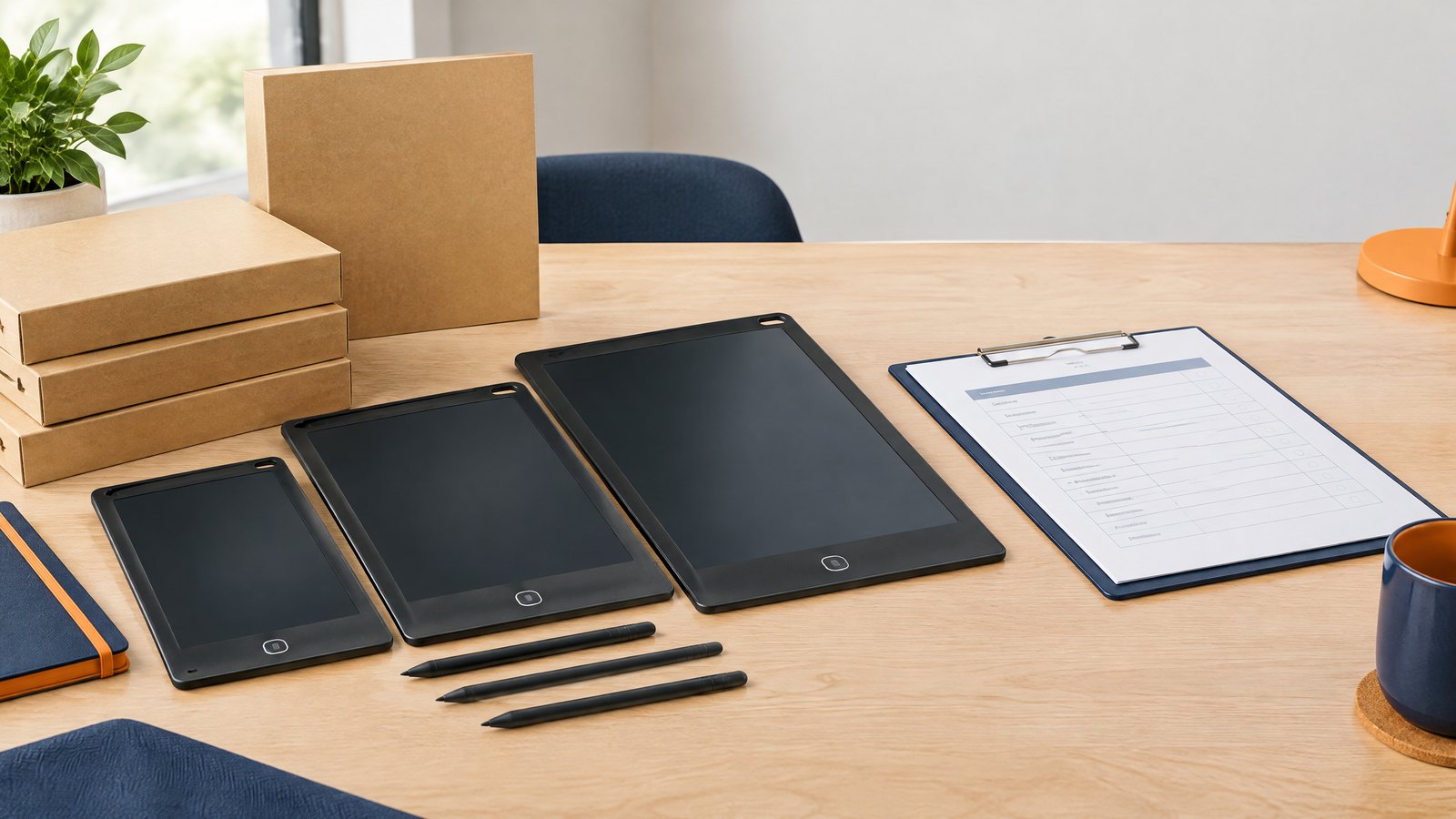
Ask for the active writing area as well as nominal diagonal and finished footprint. A larger format may allow clearer lettering, but it also needs more counter space, more protective packaging, and a stable stand or holder. A small board may suit reservation notes, but long messages can look crowded.
Our 8.5 vs 10 vs 12 inch size guide helps buyers compare task fit, portability, and carton consequences. Use it as a starting framework, then test the exact model and message.
Define the holder or placement method
Some projects need only a portable tablet; others need a tabletop stand, wall-adjacent holder, clip, or counter display. A stand is a separate component to sample and inspect. Confirm:
- angle and stability on the intended surface;
- whether the stylus has a storage location;
- whether the tablet can be removed for writing;
- whether a lock switch can be reached without disturbing the message;
- whether the holder can scratch or mark a counter;
- whether the complete unit fits the retail or distribution pack.
Do not claim a board is wall-mountable, waterproof, anti-theft, or drop-proof without an approved design and supporting validation.
3. Build a staff workflow before bulk purchase
Direct answer: A counter-sign program works when staff know who writes the message, who checks it, when the lock is used, where the stylus is stored, and how the board is cleared and stored at the end of a shift.
Installation preparation can be simple but should be explicit. Before a rollout, define the message template, preferred handwriting size, placement position, normal operating light, cleaning method, storage point, and spare-stylus process. For a larger site, assign a person or shift role to check that outdated messages are erased.
Use a short training card with the product:
- Place the tablet in the agreed holder or desk position.
- Write the current message with the supplied stylus.
- Check visibility from the visitor side of the counter.
- Engage the erase lock if the selected model and workflow require it.
- Store the stylus with the board when not in use.
- Clear the message at the agreed shift or event endpoint.
This modest preparation prevents common support issues, such as an accidental erase, a missing stylus, or a message being left on a board after it is no longer valid.
Mid-article CTA
Planning a reception, hospitality, retail, or event program? Send your requirements with the intended message, viewing distance, counter size, target quantity, market, and preferred pack format. We can help structure a sample test for the real application.
4. Customize without losing operational clarity
Private-label customization may include a frame logo, corporate color, screen border, reusable message template card, stand, instruction insert, and packaging. Keep the operational elements clear. A large printed border can reduce the apparent writing space; a logo near a control can make instructions hard to see; a stylus tether can improve retention but change how the board sits in a stand.
For event or corporate programs, ask whether the artwork should identify the owner, the venue, the campaign, or simply the operating function. Minimal branding can be more useful on a message board that staff must update quickly.
Use sample approval to review the full system: board, holder, stylus, logo, instruction, pack, and real example message. Do not approve a board in isolation if the application depends on a stand or other accessory.
5. Factory testing and shipment inspection for counter-sign programs
Factory testing should check writing response, erase response, lock operation where included, frame and control fit, stylus retention, and the specified stand or holder. If a branded template or insert is supplied, verify its placement and revision.
During shipment inspection, compare finished units to the golden sample and packing list. Check screen appearance, stylus and holder count, printed logo, package condition, and carton configuration. If a destination-specific label or instruction is included, inspect the current revision rather than relying on artwork from an earlier order.
Product application testing is especially helpful here: place an approved sample in its holder, write the sample message, and view it from the specified distance under a representative light. This does not create a universal visibility guarantee; it verifies the customer requirements that were defined for the program.
6. Plan service and replenishment
Counter-sign programs are operational tools, so a missing stylus or broken holder can interrupt use even when the writing surface is fine. Decide whether spare styluses, holders, instruction cards, or boards are required at the site. The after-sales and spare-parts guide explains how to identify model-specific service parts and build a simple support path.
Keep spare parts identified by the approved model and revision. A stylus, holder, or printed template from a different model may not fit or may create confusion.
FAQ
Can an LCD writing tablet be used as a restaurant sign?
It can be useful for short, close-range messages such as reservations, daily notes, or host-stand instructions. Test the real message at the intended distance and lighting before purchasing in volume.
Is an LCD writing tablet visible in low light?
Standard LCD writing surfaces are generally reflective rather than self-illuminated. Visibility should be tested in the actual environment; do not assume it will replace a backlit sign.
What size is suitable for a reception desk?
The suitable size depends on message length, viewing distance, counter space, and holder design. Test a complete written message on representative samples rather than selecting by nominal size alone.
Can a lock prevent a message from being erased?
An erase lock can prevent the clear function from operating while engaged, according to the selected model. It does not store the message digitally or prevent physical loss of the product.
What should be checked before shipping a counter-sign program?
Check the board, stylus, holder, logo, message template, instruction, pack contents, functional controls, labels, carton data, and the sample application test against the approved reference.
Conclusion
LCD writing tablets can be practical reusable counter-sign tools when buyers match them to a short-message, close-range application. Select using real message tests, prepare staff workflow, sample the complete system, carry the requirements into factory testing and shipment inspection, and hold small, compatible spare stock where operations require it.
Final CTA
Contact us about LCD writing tablets for counter-sign applications. Include your use case, message size, viewing distance, needed holder, target quantity, branding scope, and destination market.
Turn this sourcing plan into a product brief.
Share your target market, product requirements, packaging preference and estimated volume for a practical OEM / ODM discussion.